

By Ben Emos & Don Terry | Thursday, January 15, 2026 | 5 min read
There is a particular kind of alarm that sets in when diplomacy stops being about disagreement and starts being about disbelief. That was the feeling left in the wake of the recent meeting involving Vice President J.D. Vance, Secretary of State Marco Rubio, and representatives of Denmark and Greenland—a meeting that ended not with resolution, but with an uncomfortable clarity: nothing was solved, nothing shifted, and no one genuinely believed progress was possible.
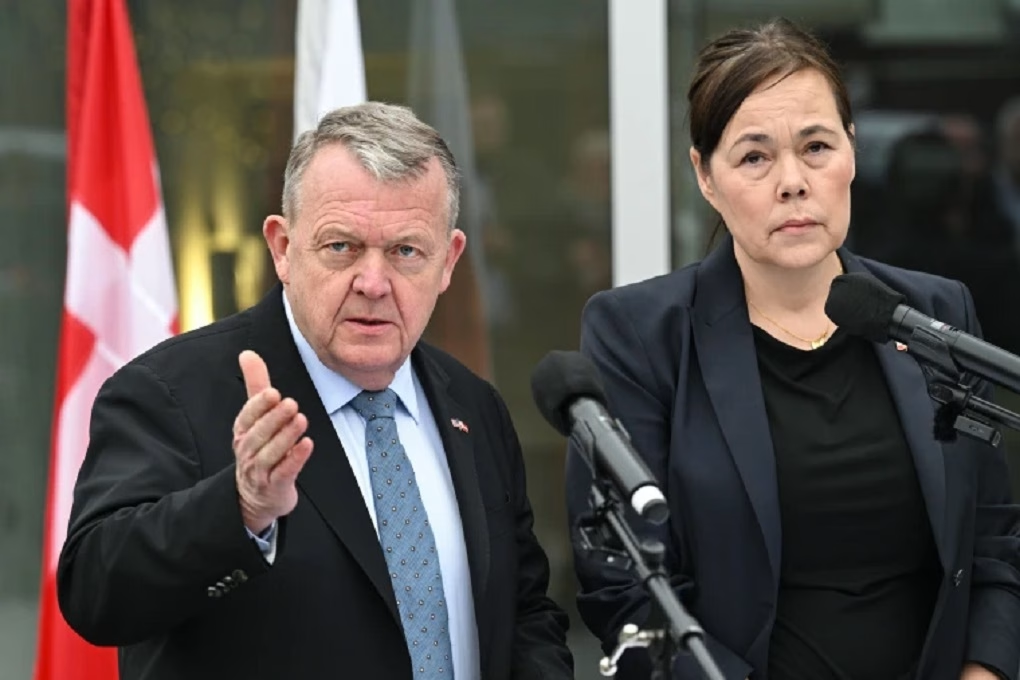
Those words alone should trouble anyone who cares about alliances or truth in governance. “We didn’t manage to change the American position,” the Danish Foreign Minister Lars Lokke Rasmussen admitted. “Honestly speaking, I didn’t believe that was doable.” That is not the language of hard negotiation. It is the language of resignation—of partners realizing they are no longer dealing with a good-faith actor.
At the heart of this breakdown is a claim so extreme it almost sounds absurd: the recurring suggestion that the United States could somehow “conquer” Greenland. Not negotiate expanded cooperation. Not deepen security arrangements. Not revisit basing agreements. Conquer.
This is not a case of mixed signals or diplomatic ambiguity. Danish officials were clear. Greenland’s premier was clear. Greenland has its own elected government, supported by roughly three-quarters of its population, and it has repeatedly stated that it will remain within the Kingdom of Denmark for the foreseeable future. There is no confusion here. And yet, the American position appears unmoved.
That raises a more troubling question than any single policy dispute: when figures tied to the Trump administration speak, can allies trust that they are hearing a serious statement of intent—or are they watching a performance designed for domestic consumption?
Diplomacy depends on shared facts. Nations can argue fiercely over interests and priorities, but once fantasy is treated as leverage, the entire process breaks down. When American officials indulge rhetoric about territorial conquest of an allied region, it signals something more dangerous than bluster. It suggests a willingness to detach words from law, truth, and consequence.
What makes this moment especially unsettling is that U.S. interests in the Arctic are real and legitimate. Climate change is reshaping shipping routes. Security dynamics are shifting. Resource access matters. Denmark and Greenland have worked with the United States on these issues for decades. What has changed is not the strategic landscape—it’s the credibility of the messenger.
The Danish side spoke plainly about the need for “respectful cooperation” and respect for red lines. That should be the baseline of any alliance. Yet under Trump’s leadership, red lines—legal, ethical, diplomatic—have too often been treated as suggestions rather than boundaries. Allies hear one message in public and another behind closed doors. Statements are floated, denied, softened, or reframed depending on the reaction. Truth becomes flexible.
J.D. Vance and Marco Rubio are not inexperienced actors. They understand how diplomacy is supposed to function. That makes their role here more troubling, not less. Either they are lending credibility to claims they know are unrealistic, or they are signaling that facts are secondary to projecting dominance. Neither interpretation inspires trust.
The damage from this approach isn’t theoretical. When allies walk into meetings assuming nothing will change, cooperation erodes. Intelligence sharing becomes cautious. Negotiations harden. Mutual defense starts to feel conditional. And adversaries notice. They see a United States willing to blur the line between intimidation and policy—even with friends.
It becomes even more disturbing when the conversation veers into treating people as bargaining chips. At first glance, the idea of paying citizens to change national allegiance sounds like satire. But these discussions are real, and they raise serious questions about respect for sovereignty and human dignity.

Mein Kampf & Trump Now On AMAZON
Greenland is not an empty expanse of ice waiting to be claimed. It is home to roughly 57,000 people with deep roots, distinct cultural traditions, and a long, complicated relationship with Denmark. Its economy is not desperate or marginal. Greenland’s GDP per capita is about $58,000—on par with many European countries—and its Nordic welfare system guarantees healthcare, education, and social supports that millions of Americans still struggle to access. In practical terms, many Greenlanders already live with a level of economic stability comparable to middle-income Americans in states like Mississippi, Arkansas, or West Virginia. This is not a society waiting to be “bought.”
And this is how credibility erodes—not through a single falsehood, but through repeated indifference to reality. When officials refuse to challenge or rein in presidential fantasies, those fantasies start to feel acceptable. Over time, they stop sounding like outliers and begin to shape expectations. Once that happens, they stop being rhetoric and start becoming risk.
The real question isn’t whether Greenland will remain Danish. It will. The question is whether America’s partners can still rely on the United States to speak honestly about its intentions at all. Diplomacy doesn’t require agreement. It requires trust that words still mean something. Right now, too many allies are leaving the table unsure that they do.