
By Don Terry | Friday July 17 2026 | 5 min read
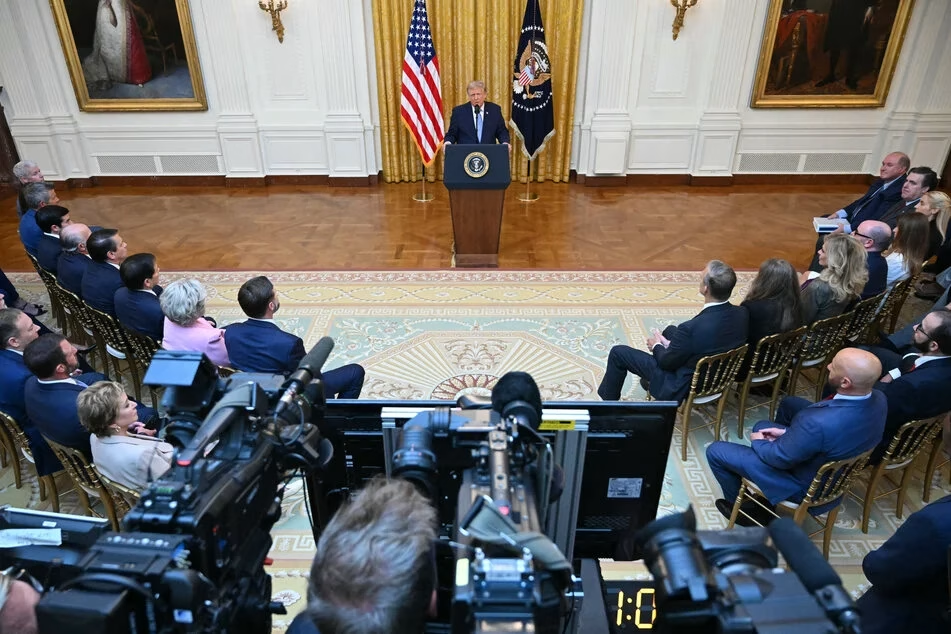
Donald Trump’s primetime address from Washington on Thursday night was supposed to be about the ongoing conflict in Iran — a war he continues to prosecute with escalating rhetoric and shifting justifications. Instead, the speech veered sharply back into familiar territory: the 2020 election, voting machines, foreign interference, and a parade of claims that have been investigated, litigated, and rejected for years.
It was a jarring moment. A sitting president addressing a nation at war, yet choosing to relitigate an election he lost six years ago. The stakes were bigger than the speech itself. Trump wasn’t just revisiting old grievances; he was trying to fold them into the present crisis, using the gravity of wartime leadership to give new life to narratives long dismissed by courts, audits, and his own officials.
He alleged that China had obtained data on 220 million American voters, warned of compromised voting machines, and claimed non‑citizens were appearing on state voter rolls. But according to NPR, several of the heavily redacted documents released by the White House did not support the sweeping conclusions Trump presented. They offered no evidence that fraudulent votes altered any election result, nor did they substantiate the idea that foreign powers manipulated ballots or vote counts.
Trump insisted his goal was “not to weaken confidence in elections.” Yet his words did exactly that. For years, he has repeated the assertion that the 2020 election was stolen — an assertion rejected by investigations, recounts, audits, and judges across the country, including officials from his own administration.
The Long Trail of Debunked Claims
After the 2020 election, Trump and his allies launched a sprawling effort to explain his loss through conspiracy. China hacked voting machines through thermostats. Italian satellites switched votes. Election workers smuggled ballots in suitcases. The New York Times documented these claims as they spread across right‑wing media ecosystems, only to be dismantled one by one.
Dozens of investigations at every level of government found no evidence of widespread fraud. Trump’s own attorney general, William Barr, told the Associated Press that federal investigators had found nothing capable of changing the outcome. Federal cybersecurity agencies described the election as the most secure in American history.
The primetime speech ignored all of that.
A federal intelligence assessment released in 2021 found no indication that any foreign government altered voter registration, ballots, vote counting, or election results. China, like other nations, gathers information about American voters — but there is no evidence it used that information to change votes.

Mein Kampf & Trump — Available on Amazon
One of the documents Trump cited mentions China obtaining voter data, but NPR noted that the document provides no evidence of interference. Much of that data is publicly available in many states.
Trump again claimed voting machines were “extremely exposed to attack.” Election security experts agree vulnerabilities exist — but that’s true of any complex system. Vulnerability is not exploitation.
Christopher Krebs, who led the Cybersecurity and Infrastructure Security Agency under Trump, testified in 2020 that no adversary had developed the ability to manipulate even a single vote in a U.S. election. Doing so at scale, he said, would be “incredibly difficult.”
Post‑election reviews in Arizona and Georgia confirmed the original results. Arizona’s review found Biden had slightly more votes than initially recorded. Georgia conducted a hand recount, a machine recount, signature audits, and investigations — none supported Trump’s claims.
In a now‑infamous phone call, Trump pressured Georgia Secretary of State Brad Raffensperger to “find” 11,780 votes. When Trump claimed 5,000 dead people voted, Raffensperger corrected him: the real number was two.
Non‑Citizen Voting: Rare, Not Rampant
Trump claimed more than 250,000 non‑citizens were illegally registered in four states. But NPR reported that the SAVE database he cited has a history of incorrectly flagging U.S. citizens. Research consistently shows non‑citizen voting is exceedingly rare.
Senator Mark Warner warned that false narratives — not foreign hackers — pose the greatest threat to American elections. Trump, indicted for pressuring Georgia officials to overturn results, remains a central figure in that danger.
His primetime address showed why. Even as a war drags on abroad, he continues waging a political war at home — one built on claims that investigations have already dismantled, and one that risks eroding trust in the very system he seeks to lead.
Justice Jackson Obliterates Clarence Thomas Over His Stunning Dissent
When Satire Becomes Reality: Justice Thomas and the Clayton Bigsby Paradox
R.A.G.E. in 2028: Why Democrats May Turn to Jack Smith or Jon Ossoff to Reset American Politics
Jon Ossoff Declares ‘Day of R.A.G.E.,’ Warns Corruption Is Becoming America’s Defining Crisis