

By Jane Lewis | Sunday February 01, 2026 | 4 min read
For nearly a decade, Donald Trump has built political capital by painting immigrants—particularly Mexicans—as criminals, rapists, and threats to American safety. Those words, spoken at the launch of his 2015 campaign, were not a slip. They were a foundation. Trump returned to that framing again and again, using fear and moral outrage as blunt instruments in pursuit of power.
Now, newly released documents connected to Jeffrey Epstein have reopened an uncomfortable and deeply ironic chapter—one Trump has long tried to keep closed.
The latest batch of Epstein-related files includes references to a rape allegation involving Trump and a minor, an accusation Trump has repeatedly and forcefully denied. The documents do not constitute a legal finding, nor do they prove guilt. But their release has reignited scrutiny of Trump’s past associations with Epstein and resurfaced claims that many Americans never fully grappled with amid the political chaos of Trump’s presidency.
To be clear: an allegation is not a conviction. Trump, like anyone else, is entitled to the presumption of innocence. He has denied the accusation, and no court has ruled against him in this matter. That distinction matters.
But context matters too.
The allegation itself is not new. It circulated years ago, then faded from public attention, drowned out by the daily noise of Trump-era politics. What is new is its reappearance in official records tied to Epstein—a man now universally recognized as a serial sexual predator who trafficked and abused underage girls, often with the protection or indifference of powerful people.
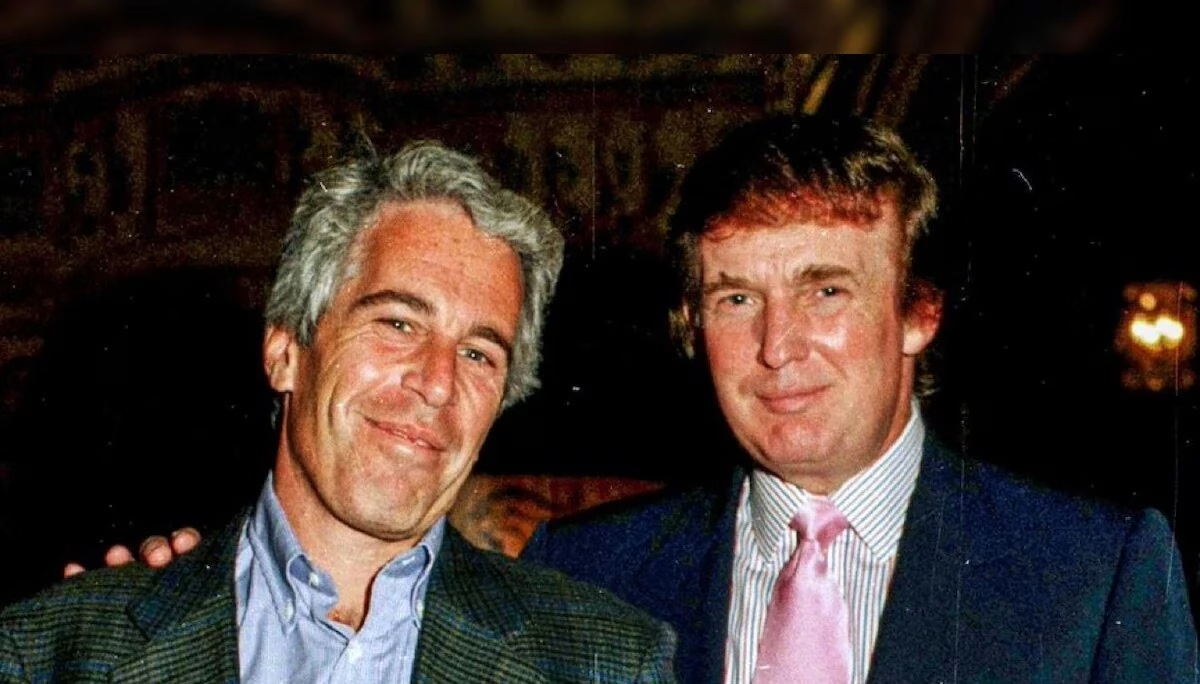
Trump’s past relationship with Epstein has been documented in photos, social events, and Trump’s own words. He once described Epstein as a “terrific guy” who liked women “on the younger side.” Trump has since claimed he distanced himself from Epstein well before Epstein’s crimes became widely known. That claim, like so many others, is difficult to independently verify.
What makes this moment resonant is not just the allegation itself, but the glaring contradiction it exposes.
Trump built a political brand around outrage over sexual violence—when it could be weaponized against outsiders. Immigrants were framed not as human beings, but as predators. The language was sweeping, dehumanizing, and absolute. Mexicans were called “rapists.” Immigrants were portrayed as the “worst of the worst.” There was no nuance then. No caution about allegations versus proof. No concern for due process.
Yet when Trump himself is named in documents referencing sexual assault—particularly one involving a minor—the standard abruptly changes. Suddenly, restraint is demanded. Skepticism is encouraged. The same voices that once insisted we should “believe” accusations when they served a political purpose now urge silence, dismissal, or outrage at the media for even reporting the claim.
This isn’t about guilt or innocence alone. It’s about moral consistency.
If accusations of sexual violence are serious—and they are—then they must be treated seriously regardless of who is accused. If we believe that calling entire groups of people rapists is reckless and harmful, then we should be especially careful when allegations touch someone who built a career doing exactly that.

Mein Kampf & Trump — Available on Amazon
The resurfacing of these Epstein files doesn’t answer every question. It raises them. Why were these allegations so easy to ignore for so long? Why did Trump’s rhetoric about sexual violence never include reflection on his own past associations? And why is accountability so often conditional on power?
For the Justice Department, the question is hard to ignore: why would anyone choose to look past documented rape allegations to protect a president whose record shows so little moral restraint? Is silence about accountability a strategic decision—or something deferred for a future tell-all, when the damage is safely behind us?
For voters, this moment isn’t primarily about legal technicalities. It’s about ethics and standards. Trump has spent years urging Americans to judge others quickly and harshly, while insisting he deserves endless benefit of the doubt. The Epstein documents turn that logic on its head. They ask the public to aim the same scrutiny upward that Trump has long aimed downward—and to decide whether double standards are acceptable when power is involved.
In the end, the files don’t deliver a verdict. But they do expose a truth many have sensed for years: outrage, when selectively applied, isn’t justice. It’s politics. And the contradictions are becoming harder to ignore.
Ya