

By Mary Jones | Thursday January 29, 2026 | 6 min read
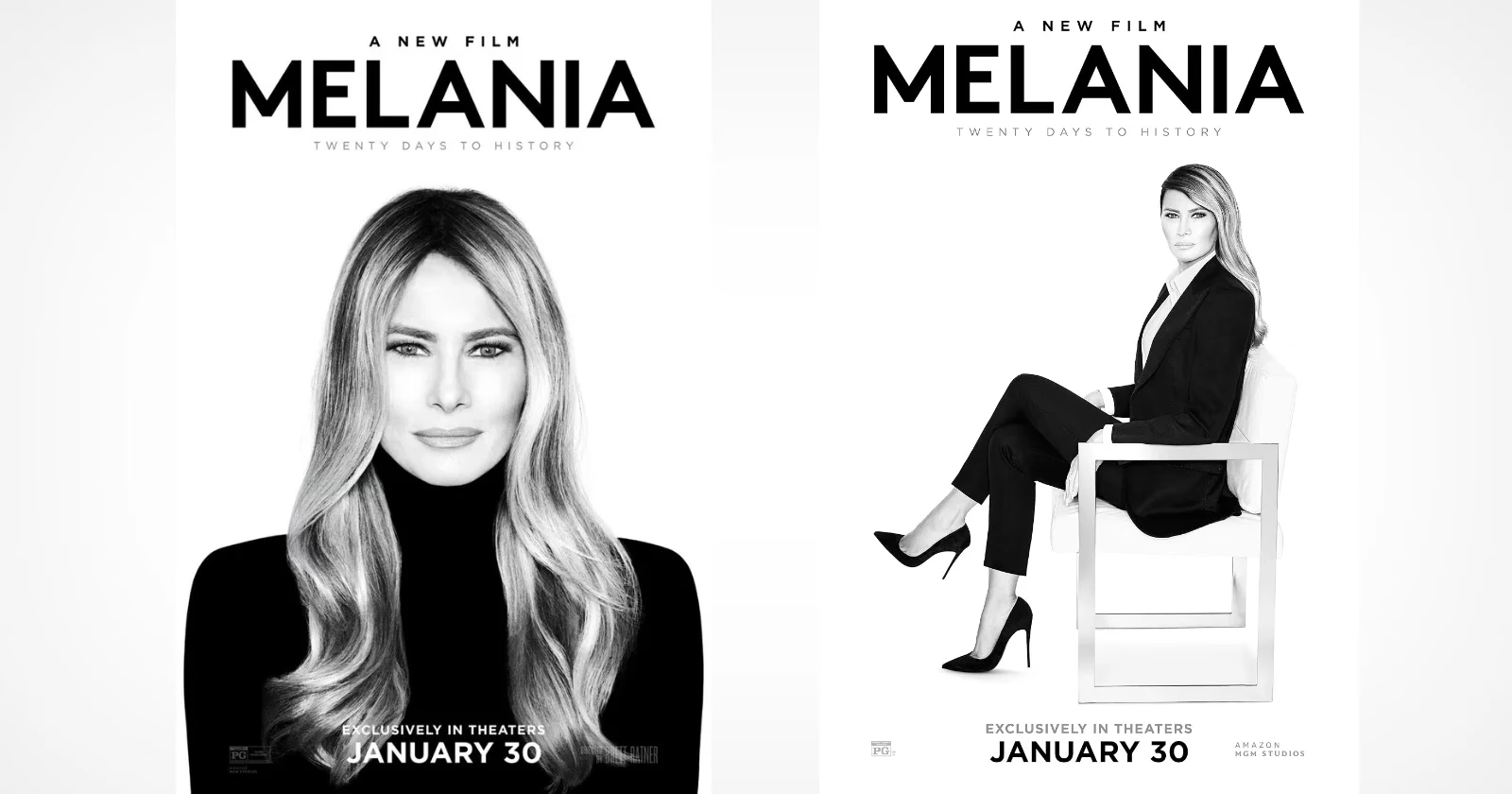
Some movies come because audiences are eager for them. Others surprise viewers who never asked for them, yet somehow capture attention anyway. Then there’s the announced “Melania” movie—a project that feels oddly untethered from demand, as if irony alone is doing the heavy lifting. The film focuses on the 20 days leading up to the 2025 presidential inauguration, following Melania as she organizes the event, navigates the challenges of a White House transition, and moves her family back to the nation’s capital. If the movie has accomplished anything so far, it’s this: generating a steady stream of jokes and outright dismissals—not cruel jokes, but ones born almost instinctively from disbelief rather than malice.
That disbelief stems from a simple question: what story is this movie actually trying to tell?
Melania Trump has long cultivated distance as part of her public image. Silence is presented as grace, detachment as intrigue. That approach continues to define her role as First Lady, where she largely stays out of the spotlight. But a movie demands the opposite: story, context, and credibility. That’s why the jokes hit so easily—the gaps in her public narrative are louder than any script could cover.
Big budgets only raise the pressure. A $75 million documentary comes with enormous expectations, and when the finished product feels cautious or surface-level, disappointment is almost inevitable. What was likely intended to refine Melania Trump’s image or offer clarity has instead reopened familiar questions about authenticity and control. For Amazon MGM, it’s a blunt reminder that visibility doesn’t automatically translate into approval.
The production itself hasn’t helped. The film was directed by Brett Ratner, marking his first major project since multiple sexual misconduct allegations surfaced in 2017. Reports from the set paint a troubling picture: crew members described the production as chaotic and poorly managed, with as many as two-thirds of staff allegedly requesting their names be removed from the final credits.
The reception abroad has been just as rocky. In South Africa, the film was pulled from theaters only days before its scheduled release, with distributors citing “recent developments” and concerns about how it would be received in a politically sensitive climate. In the UK, early reports pointed to weak interest, including London screenings where only a single ticket was sold for the premiere. Similar patterns have emerged in the United States, where social media tracking shows many theaters sitting largely empty.
Taken together, the message has been hard to miss: attention can be bought, but interest—and credibility—cannot.
If the film were meant to be taken seriously, it would have confronted the long-standing questions Melania has avoided for years, particularly about her entry into elite social circles. Those questions, including ones involving Jeffrey Epstein, endure not because they are settled facts, but because the movie leaves them untouched.
The same silence surrounds her own immigration story: her visa status, the path that brought her parents to the U.S., and her refusal to publicly challenge her husband’s attacks on “chain migration,” even though it benefited her family directly. Silence has a way of inviting speculation. A glossy biopic that pretends these issues don’t exist won’t make them disappear; it will only make the omissions more obvious.
This isn’t a call for sensationalism or scandal-mongering. It’s a recognition of how public trust works. You cannot ask audiences to take a personal story seriously while selectively airbrushing the parts that make people uncomfortable. A film that insists on telling only the polished version of events will be read as propaganda—or parody—no matter how earnest its intentions.
Then there’s the most glaring absence of all: immigration—and the timing that makes that absence impossible to ignore. Melania Trump is one of the most visible immigrants ever to occupy the White House, yet during an administration defined by family separation, deportations, and deliberate cruelty toward migrants, her outrage was nowhere to be found. That silence feels even louder now. No one wanted a “Melania” movie while the killing continues—while images of displaced families, dead civilians, and broken asylum systems dominate the global conscience.
In moments like this, audiences aren’t seeking curated personal nostalgia; they’re asking where the empathy went. A film celebrating an immigrant success story, released amid ongoing violence and humanitarian collapse, cannot sidestep the fact that its subject benefited from power while others like her were vilified, detained, or erased. Ignoring that contradiction doesn’t preserve dignity—it exposes it.
Where was Melania’s voice when immigrant children were placed in cages? When asylum seekers were demonized? When policies explicitly targeted people whose stories mirrored her own, minus wealth and proximity to power?
If the movie wants emotional resonance, this is where it should look. Not in marble staircases or couture gowns, but in the moral tension of benefiting from a system that brutalized others like you—and choosing not to challenge it. That silence is not a footnote. It is central to her public legacy.
Audiences are sophisticated. They know when they’re being sold a myth. They also know when someone is ducking accountability. The jokes surrounding this movie aren’t cruel because Melania is private; they’re sharp because the project feels unearned. It asks for attention without offering honesty.

Mein Kampf & Trump — Available on Amazon
Ironically, that honesty is the one thing that could disarm the mockery. A film that acknowledged controversy, grappled with complicity, and addressed uncomfortable truths might actually surprise people. It might even matter.
In the end, the problem with a “Melania” movie isn’t just that no one asked for it. It’s that it arrives while the killing continues, while displacement and cruelty toward immigrants remain unresolved realities rather than distant memories.
In that context, a film built on omission feels less like storytelling and more like evasion. Audiences aren’t turning away from the “Melania” movie out of spite—they’re responding to the gap between its carefully crafted image and a world still looking for honesty and accountability. If silence was once mistaken for elegance, it no longer passes. When suffering is ongoing, detachment reads as complicity—and no amount of careful editing can cut around that truth.
Ya