

By Don Terry | Saturday January 31, 2026 | 4 min read
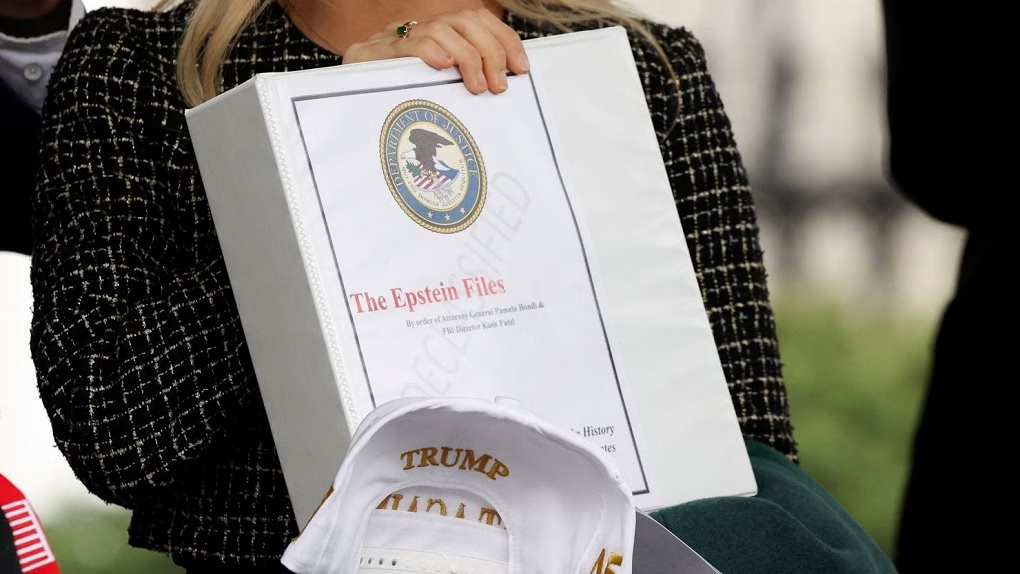
The Department of Justice has released a massive new tranche of documents related to Jeffrey Epstein, shedding fresh light on his relationships with powerful figures while raising renewed questions about accountability and long-delayed transparency.
The release, which comes more than 40 days after a deadline set by federal law signed by former President Donald Trump, includes roughly three million pages of records and more than 100,000 images. According to the DOJ, the disclosure marks the completion of an extensive document identification and review process, capped by the submission of a final report to Congress as required under the statute.
For observers who have followed the Epstein case for years, the moment is both significant and unsatisfying. The delay itself drew criticism and accusations that the Justice Department failed to meet the plain requirements of the law. At the same time, skeptics who feared the government would simply stall indefinitely were proven wrong. Despite long-standing norms protecting grand jury secrecy and the DOJ’s institutional preference for confidentiality—across both Republican and Democratic administrations—a vast volume of material has now been made public.
Addressing concerns that the review process may have shielded President Trump, the Deputy Attorney General said the department complied fully with the statute and did not protect the president. He acknowledged that DOJ staff had certain communications with the White House but stressed that those contacts had no role in the document review or oversight process.
The newly released files include a wide range of tips, accusations, emails, and internal materials referencing Epstein’s interactions with prominent individuals. Officials caution that these tips do not constitute proof of criminal conduct, and in many cases it remains unclear whether specific leads were fully investigated. Some documents include forwarded news articles or routine correspondence in which Epstein mentioned public figures, including Trump—material that had surfaced in earlier reporting.
One of the more notable disclosures involves previously unseen emails between Epstein and Elon Musk. In those messages, Musk discussed a possible visit to Epstein’s private island, using language that referenced what he described as a “wild” gathering. In follow-up correspondence, Epstein suggested arranging helicopter transportation. The documents do not indicate whether the visit ever took place, nor do they establish that any criminal activity occurred.
Additional emails reference contacts involving Howard Lutnick, a Trump Cabinet official who has publicly said he distanced himself from Epstein and was disturbed by visiting his home. The newly released materials suggest planning around a potential island visit, reportedly during a trip Lutnick was taking with his wife. The emails appear to complicate some public accounts of the extent and timing of those associations.
The files also include a partially redacted chart produced within the federal government that categorizes individuals connected to Epstein as agents, accountants, authorized individuals, associates, or employees. Many names remain redacted, and only Ghislaine Maxwell—Epstein’s longtime associate—has been criminally charged in connection with his crimes.
While the DOJ has characterized this disclosure as the final release of Epstein-related materials, questions linger. Prosecutors previously suggested that as many as six million pages existed, leaving uncertainty about whether the public has now seen the full record.

Mein Kampf & Trump — Available on Amazon
Legal analysts and journalists reviewing the documents say they underscore how deeply Epstein was embedded in elite political, financial, and social circles spanning multiple administrations. Critics argue the files raise uncomfortable questions about whether law enforcement agencies aggressively pursued leads involving influential figures. The DOJ has long maintained that Epstein acted alone with Maxwell, a position that survivors and plaintiffs have repeatedly challenged.
Many of Epstein’s victims—now adults—have turned to civil lawsuits after statutes of limitations barred criminal charges. Maxwell herself has reportedly said that dozens of men entered settlements with at least one plaintiff, further fueling skepticism about the scope of past investigations.
As reporters continue to sift through the newly released records, survivors and advocates say transparency, while necessary, is not enough. They argue that the public still lacks clear answers about why so many tips and allegations failed to result in prosecutions—and whether justice was compromised by power, proximity, or fear of consequences. For them, the documents are not an ending, but another reminder of how much remains unresolved.
Ya