

By Jane Lewis | Tuesday March 24 2026 | 4 min read
The days following the death of Jeffrey Epstein were already steeped in confusion, suspicion, and a deep sense that the public was not getting the full story. Found dead in a Manhattan jail cell in August 2019, Epstein left behind not only a trail of unanswered questions about his own case, but also a cloud of uncertainty around the powerful networks he was believed to be connected to. What happened next inside the federal system has only added to that unease.
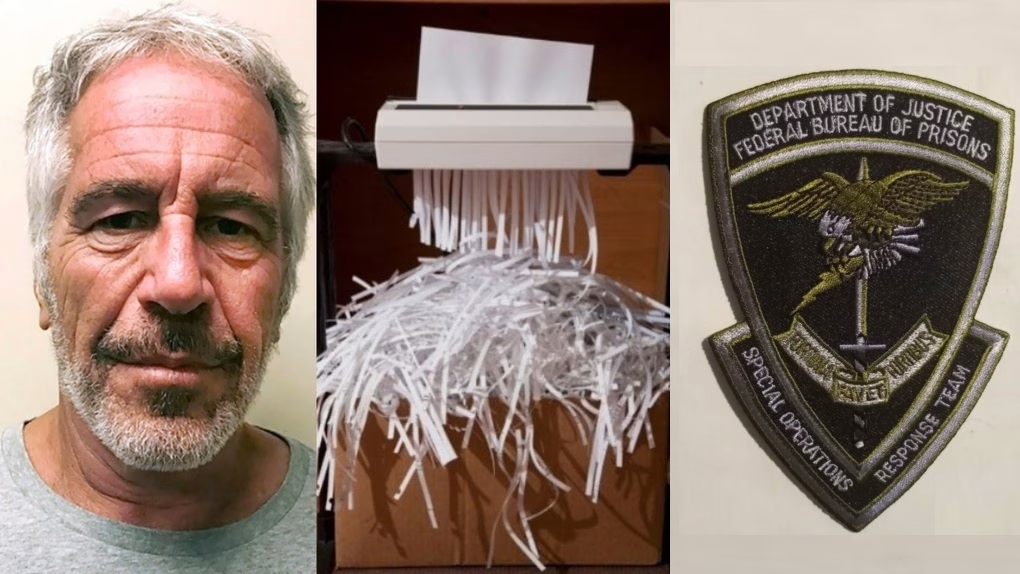
According to documents later released by the Department of Justice, a significant amount of material was destroyed in the immediate aftermath of Epstein’s death. An FBI official, whose name remains redacted, described a scene that stood out even to seasoned observers: bags upon bags of shredded paperwork being removed from the Metropolitan Correctional Center. The volume alone was enough to raise eyebrows. As the report put it, the official had “never seen this amount” of shredded material being hauled out and discarded.
The destruction reportedly took place as part of an “after-actions” review conducted by the Bureau of Prisons, which falls under the Department of Justice. At the time, the department was led by officials appointed during the administration of Donald Trump. While document disposal can be a routine part of internal reviews, the scale and timing in this case have fueled lingering doubts. Why so much, and why then?
For many, the episode fits into a broader pattern that has defined Trump’s public life—one marked by controversy, confrontation, and a willingness to push or blur institutional norms. Over the years, there have been moments that seemed to underscore a disregard for conventional boundaries: reports that associates were sent to retrieve personal medical records, or the well-documented case involving classified materials stored at his Mar-a-Lago property. Each incident, on its own, sparked debate. Together, they have shaped a perception—fair or not—of a leader comfortable operating in gray areas.
That context matters when examining what happened after Epstein’s death. The financier’s case was not just another criminal proceeding. It touched on allegations involving influential figures, wealth, and power at the highest levels. Any action taken in the wake of his death was bound to be scrutinized, especially actions that could affect the preservation—or destruction—of records.
Officials have not publicly provided a detailed accounting of what exactly was shredded. That absence of clarity has left room for speculation. Were these routine administrative documents? Sensitive internal notes? Or something more significant? Without transparency, even ordinary procedures can take on a more troubling appearance.
It’s also worth noting that the Epstein case has long been plagued by institutional failures. From earlier plea deals to lapses in supervision at the jail where he died, the system repeatedly fell short. The document destruction, whether justified or not, has become another piece of that larger puzzle—one that many people still feel has not been fully assembled.

Mein Kampf & Trump — Available on Amazon
To be clear, Governments dispose of documents regularly, often for bureaucratic or legal reasons. But trust in institutions depends not just on what is done, but on how it is explained. In this case, the explanations have been limited, and the optics are difficult to ignore.
What remains is a lingering question that refuses to go away: what might have been lost in those bags of shredded paper? In a case already defined by secrecy and suspicion, even the possibility that important information disappeared is enough to keep doubts alive.
Years later, the Epstein saga continues to echo through public discourse, not just because of the crimes themselves, but because of the unanswered questions that followed. Among them, the fate of those documents stands as a quiet but persistent reminder that, in some cases, the full story may never be known.
#Epstein #Trump JeffreyEpstein, #EpsteinFiles, #TrumpDOJ, #BreakingNews, #USPolitics, #GovernmentAccountability, #FBI, #JusticeDepartment, #PoliticalNews, #Transparency