
By Ben Emos | Monday, March 30, 2026 | 5 min read
Hungary rarely commands the world’s attention—but it arguably deserves more of it. With over a thousand years of history and a strong cultural identity, it has influenced the world in ways both striking and unexpected, from Béla Lugosi to the ever-iconic Rubik’s Cube.
And yet, that sense of pride and legacy sits alongside something more complicated. There’s a noticeable gap between the image Hungary projects and the tensions simmering beneath it—a contrast that feels increasingly hard to ignore today.
The country is once again heading into a pivotal election. Voters will choose a new parliament, which will determine whether Prime Minister Viktor Orbán remains in power or finally faces a serious shift in leadership. Orbán has led Hungary since 2010 with a dominant parliamentary majority, making him the longest-serving current leader in the European Union. Over that time, he has transformed not just his party, but the structure of Hungarian politics itself.
Early in his career, Orbán was part of a liberal, youth-driven movement that championed democratic reforms after the fall of communism. But over the decades, his politics shifted significantly. Today, he presents himself as a defender of national sovereignty, traditional values, and what he describes as a broader cultural struggle shaping the West.
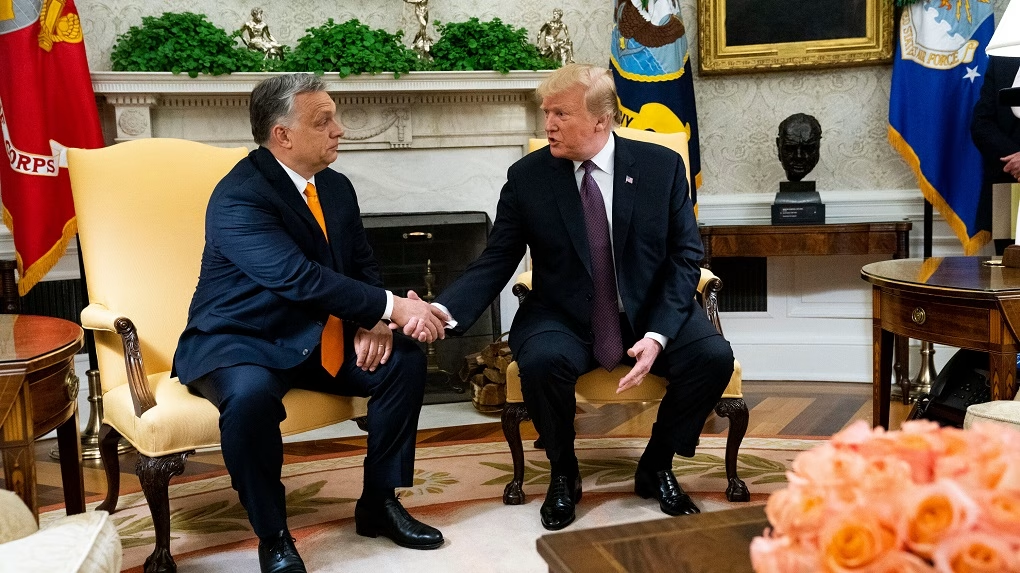
That positioning has earned him admiration from conservative figures abroad, particularly in the United States. Orbán has spoken at major gatherings like CPAC, and American political voices have praised Hungary as a model—especially on issues like immigration and national identity. In return, Orbán has embraced this alignment, framing Hungary as a kind of ideological outpost within a larger global movement.
But inside Hungary, the picture is more complicated.
Critics argue that Orbán has systematically reshaped the country’s institutions to secure long-term power. Election rules have been rewritten, judicial independence weakened, and large portions of the media landscape consolidated under allies of the government. Observers often describe Hungary’s elections as “free but not fair”—a phrase that captures the tension between democratic form and political reality.
Media control has been central to how power is maintained. State-run outlets operate under strict oversight, and many once-independent media companies have gradually fallen into the hands of allies close to the government. The end result is a landscape where dissenting voices struggle to break through and political messaging stays carefully aligned.
Seen in that light, certain international relationships start to look less like casual alliances and more like strategic alignment. The connection with Trump, for instance, can be read not just as personal rapport, but as a reflection of shared tactics—and perhaps a willingness to learn from a playbook that has proven effective elsewhere.
Internationally, Hungary has also become a difficult partner within the European Union. Orbán’s government has repeatedly clashed with EU institutions, especially over relations with Russia and decisions requiring collective agreement. His willingness to block or delay major initiatives has added to concerns about Hungary’s role within the bloc.
Domestically, Orbán’s policies have focused heavily on cultural and demographic issues. His government has taken a hard line on immigration, introduced controversial measures affecting LGBTQ+ communities, and invested heavily in programs designed to boost birth rates. These include financial incentives for families, such as tax breaks and subsidized loans tied to having children.
Yet despite these efforts, Hungary continues to face economic challenges and a declining population. Public dissatisfaction has grown in recent years, with protests highlighting concerns over governance, public services, and the direction of the country as a whole.
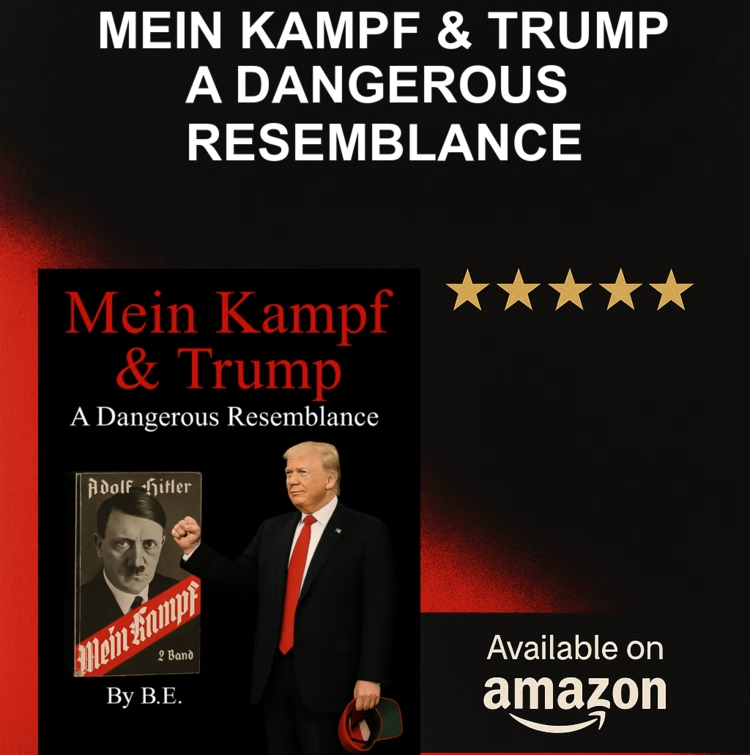
Mein Kampf & Trump — Available on Amazon
There is also a growing sense that some of Orbán’s more aggressive policies may be backfiring. Attempts to restrict certain rights and public expressions have, in some cases, led to larger and more visible opposition movements. What was meant to suppress dissent has occasionally energized it instead.
Even so, Orbán remains a formidable political force. His influence extends beyond Hungary’s borders, shaping debates about democracy, governance, and the future of Western politics. For supporters, he represents strength and clarity. For critics, he is a warning sign of how democratic systems can be gradually reshaped from within.
As Hungary approaches its next election, the stakes go beyond a single leader or party. The outcome will signal not just the country’s direction, but also how resilient its institutions truly are. And for observers around the world, Hungary offers a case study in how power evolves—not always through dramatic upheaval, but often through slow, deliberate change.
Did Trump Just Hand Iran the Power to Move Wall Street With a Single Denial?
How Did Bill Maher Become a Defender of Israel’s Gaza War and Netanyahu’s Iran Threats?
$39 Trillion and Counting: Is Trump Driving America Toward Economic Disaster?
Trump and the Supreme Court Could Hand Democrats Control of Congress
After Epstein’s Death, Trump’s DOJ Allegedly Shredded Key Documents—What Was Lost?
Copyright 2024 FN, NewsRoom.