

By Ben Emos & Don Terry | Monday February 09, 2026 | 4 min read
When Donald Trump unveiled his “Board of Peace” at Davos in January, the announcement landed with the kind of spectacle he favors: a grand new international body, billions of dollars in promised funding, and a founding charter signed by nearly twenty countries. The initiative was pitched as a vehicle for rebuilding Gaza, but the fine print suggested something far more sweeping—an organization with ambitions that could rival the United Nations itself.
What has followed is a rush of mostly autocratic governments eager to align themselves with the project. The appeal is obvious. A body led by a single powerful figure, unencumbered by the slow consensus‑building of multilateral institutions, offers a shortcut to influence. But Italy’s response has shown that not every democracy is willing to bend its constitutional guardrails to accommodate Trump’s vision.
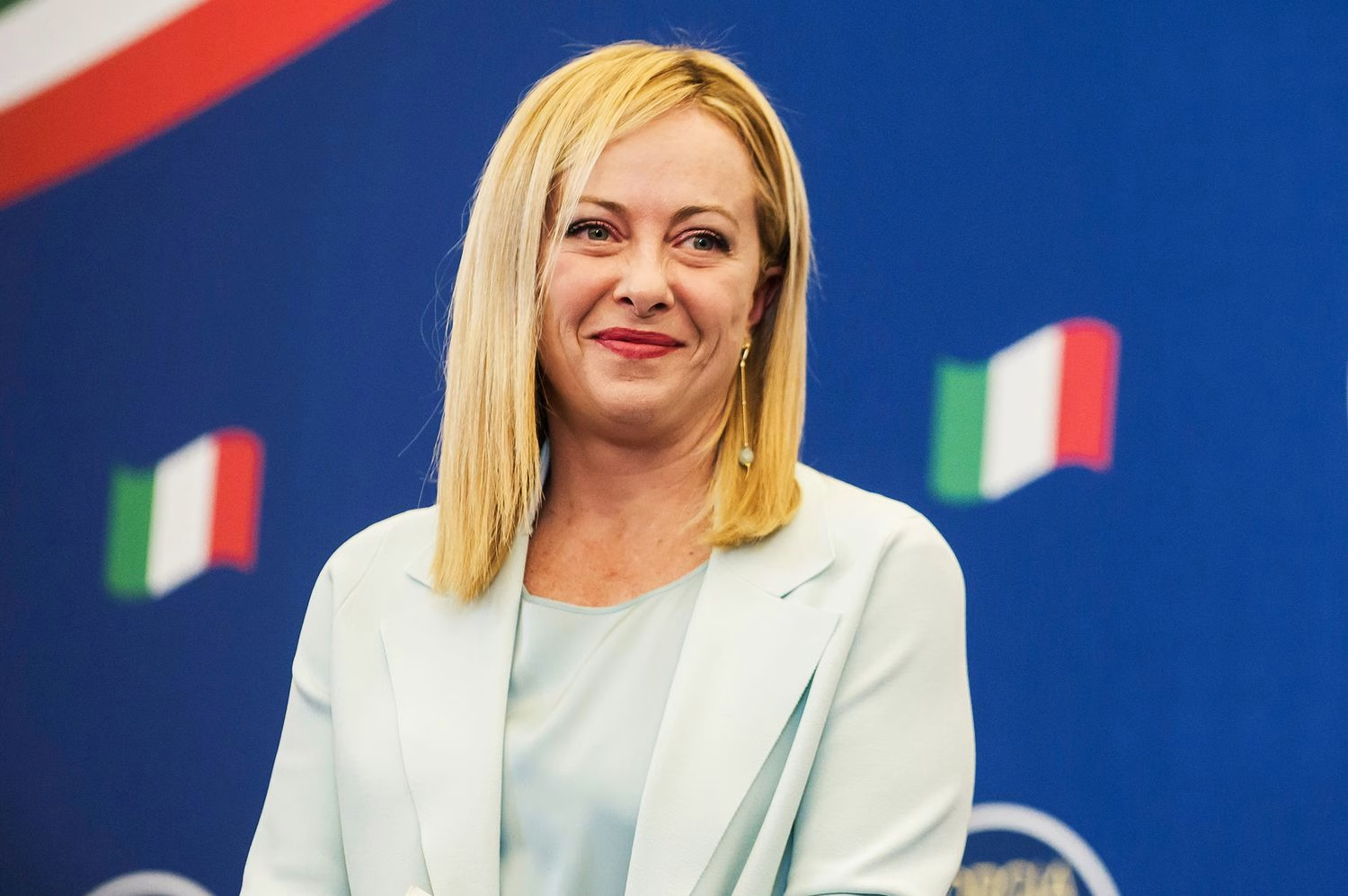
Prime Minister Giorgia Meloni, often described as one of Trump’s closest ideological allies in Europe, initially tried to strike a diplomatic balance. She acknowledged “constitutional problems” with joining the Board, hinting that perhaps the framework could be revised “to meet the needs not only of Italy, but also of other European countries.” It was a careful way of saying no without embarrassing a political partner.
But Foreign Minister Antonio Tajani dispensed with the euphemisms. Speaking to Italy’s ANSA news agency after meeting U.S. Secretary of State Marco Rubio and Vice President JD Vance at the Olympics in Milan, he was blunt: “We cannot participate in the Board of Peace because there is a constitutional limit. This is insurmountable from a legal standpoint.” No hedging, no diplomatic cushioning—just a reminder that in a functioning democracy, constitutional law outranks political convenience.
Italy’s constitution prohibits the country from joining an organization led by a single foreign leader. That provision, written with the memory of 20th‑century authoritarianism still fresh, was designed to prevent exactly the kind of personalist international structure the Board appears to be. The fact that this barrier is being tested today is a sign of how dramatically global politics has shifted.
The deeper question is why so many governments are willing to sign on to a project whose durability is far from guaranteed. Trump’s political future remains clouded by ongoing investigations into actions taken while in office. Even if the Board were to gain traction now, its fate under a future U.S. administration is uncertain. A body built around one leader’s authority is, by definition, vulnerable to that leader’s political fortunes.
For countries that have rushed to join, this should give pause. Hitching national policy to a single figure—particularly one who remains a lightning rod in global politics—carries risks. If the next U.S. president chooses not to continue the Board, or if Trump’s legal troubles escalate, the entire structure could collapse overnight. That is not a foundation on which stable international cooperation is built.

Mein Kampf & Trump — Available on Amazon
Italy’s stance offers a reminder that democratic institutions still matter. Constitutional limits are not inconveniences to be negotiated away; they are safeguards designed to prevent the concentration of power, whether at home or abroad. By standing firm, Italy has shown that even close allies can draw a line when fundamental principles are at stake.
The Board of Peace may continue with its current roster of supporters, but Italy’s refusal underscores a broader truth: international legitimacy cannot be manufactured through spectacle or personality. It must be earned through transparency, accountability, and structures that outlast any one leader. Democracies that value those principles will need to decide whether Trump’s Board can meet that standard—or whether Italy has already shown the wiser path.