
By Andrew James | Thursday February 05, 2026 | 5 min read
Every once in a while, a moment arrives that strips away the last illusions about the state of American democracy. This week delivered one of those moments. When President Trump was asked whether he would accept the results of the next election — and whether he still supports a federal takeover of state‑run voting systems — his answer was as revealing as it was alarming. He spoke again about “cheating,” hinted that states might need to be overruled, and said he would trust the results only “if the elections are honest.” We’ve heard this before. In Trump’s vocabulary, “honest” simply means “if my side wins.”This isn’t improvisation. It’s preparation.
He used the same language in 2020, the same insinuations, the same groundwork for rejecting any outcome that doesn’t favor him. And the timing is no mystery. His approval rating has slipped again — down to 37% in the latest Quinnipiac poll — and his numbers are falling across every major issue. When a politician senses the public drifting away, they can either adjust or attack the system that measures their standing. Trump has chosen the latter.
But the threat goes deeper than rhetoric. It extends into the information ecosystem itself — and into the hands of the billionaires who increasingly control it.
From the moment he took office, Trump has worked to narrow the flow of independent reporting. He pushed the Associated Press out of the White House press pool. He eliminated federal funding for public broadcasting. He shut down Voice of America’s overseas bureaus. He tightened control over Stars and Stripes. His allies at the FCC have issued threats against networks that criticize him. He has used lawsuits to pressure news organizations, extracting settlements that drained resources from real journalism. He restricted Pentagon reporters and replaced them with loyalists. And in one of the most chilling episodes, the FBI raided the home of a Washington Post reporter who had been well sourced inside his administration.
This is not the behavior of a leader who welcomes scrutiny. It is the behavior of someone who fears it — and wants to silence it.
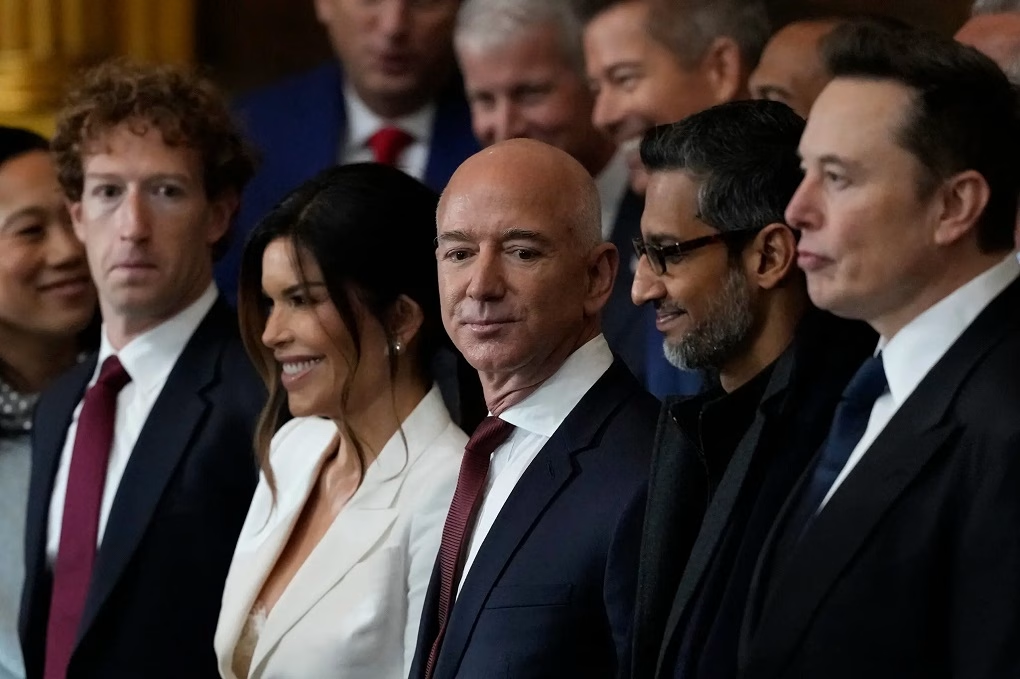
And he has found willing partners among the ultra‑wealthy. Elon Musk and Mark Zuckerberg have allowed disinformation to spread freely on their platforms. Executives at ABC/Disney paid Trump millions to settle a lawsuit and even pulled Jimmy Kimmel off the air before public outrage forced them to reverse course. Larry and David Ellison took over CBS News, paid Trump millions to settle another lawsuit, and handed editorial control to a partisan loyalist with no experience running a major newsroom. They even canceled a popular late‑night show to silence Stephen Colbert, one of Trump’s most persistent critics.
Then there is Jeff Bezos.
In the span of a week, Bezos spent $75 million on a Melania Trump documentary, posed for a photo‑op with Trump’s Secretary of Defense at his space company, and then gutted the Washington Post — one of the most important news institutions in the country. More than 300 journalists lost their jobs. Entire desks were wiped out: sports, international, metro. The Cairo bureau chief was laid off. The entire Middle East team was laid off. The Ukraine correspondent was laid off while reporting from a war zone. Even the reporter covering Amazon was shown the door.
To call this a “business decision” is to ignore reality. Bezos could fund the Post for years with what he earns in a single week. Instead, he chose to shrink it.
And many of the wounds were self‑inflicted. When he canceled the Post’s tradition of endorsing presidential candidates, 250,000 subscribers canceled their subscriptions. When he narrowed the editorial board’s focus to “free markets” and “personal liberties,” many saw it as an attempt to appease Trump. And when the FBI raided a Post reporter’s home, Bezos said nothing.
Yet through all of this, the journalists kept doing their jobs. They were tough, relentless, and often inconvenient. But their job was never to make presidents comfortable or billionaires richer. Their job was to inform the public and hold power to account.
Bezos once liked to say that real leaders should welcome scrutiny. It was a neat line — confident, principled, almost civic‑minded. But the gap between what he once preached and what he’s doing now has become impossible to ignore. His recent decisions paint a very different picture, one where criticism is treated as a nuisance rather than a democratic necessity, and where the public ends up paying the price.

TREATMENT GEL FOR ERECTILE DYSFUNCTION
The latest example is almost surreal: Amazon pulled the film Melania from a movie theater simply because the marquee displayed jokes about it. A multibillion‑dollar corporation leaning on a small theater over a few words on a sign isn’t just thin‑skinned — it’s a reminder of how easily powerful people can smother expression when it suits them. It’s the kind of move that reveals more about insecurity than strength, and it lands hardest on the people who rely on open debate and independent voices to understand what’s happening in their own country.
Bezos once talked about the value of scrutiny. Today, he’s showing us what happens when those with the most power decide they’d rather not face any at all. And if we don’t pay attention, we may wake up to find that the space for honest criticism has quietly disappeared — not with a bang, but with a corporate memo and a darkened marquee.
Absolutely No One Wanted a “Melania” Movie, While the Chaos and Killing Continues
Europe Rejects Musk’s FSD Timeline, Creating New Headaches for Tesla Shareholders
Not Every Republican Is Racist. Every Racist Knows Which Party Welcomes Them
Inside Elon Musk’s Neuralink and the Difficult Road to Human Brain Implants
Copyright 2024 FN, NewsRoom.