

By Don Terry | Sunday April 05 2026 | 5 min read
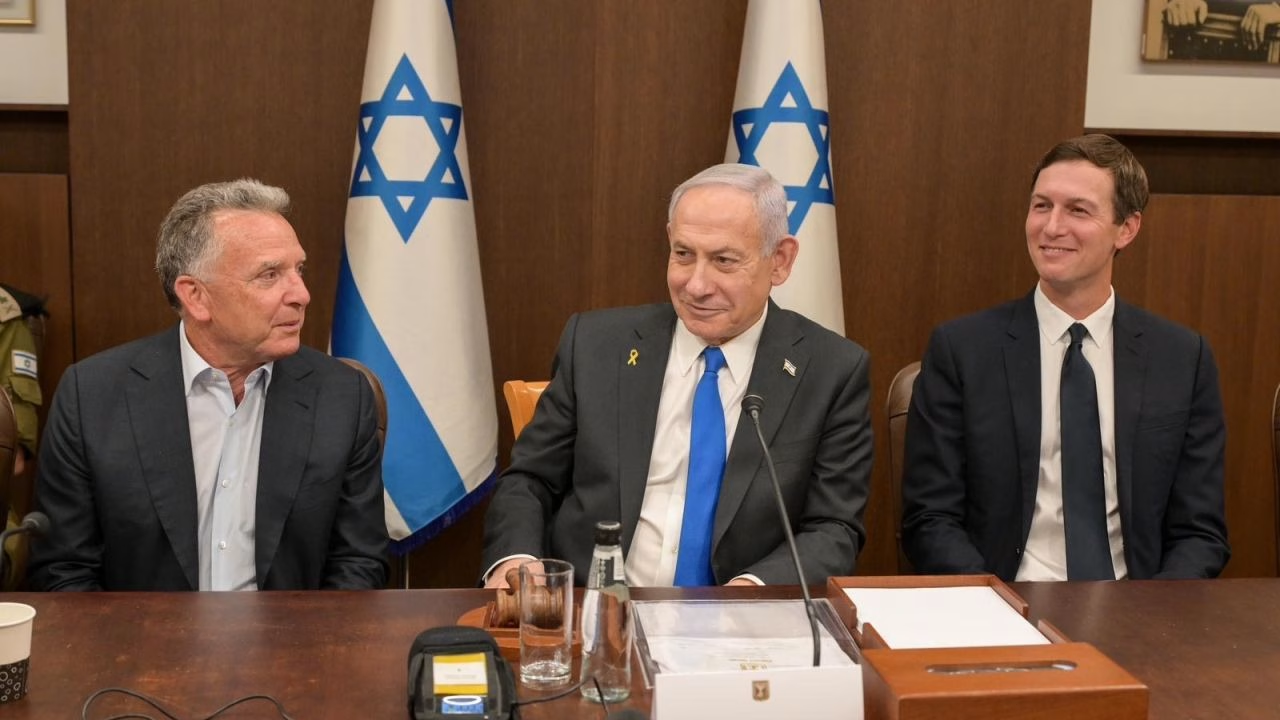
Wars don’t start with a single moment—they creep in through bad advice, flawed assumptions, and urgent convictions dressed up as certainty. The U.S. conflict with Iran didn’t happen by accident. At its center sits a strikingly influential trio: Steve Witkoff, Jared Kushner, and Benjamin Netanyahu. In the Trump era, a single suggestion can become policy overnight—just ask anyone who remembers how Ronald Lauder planted the idea of annexing Greenland in the president’s head. When influence travels unchecked to the top, mistakes aren’t just possible—they become inevitable.
On paper, Witkoff was cast as a negotiator—a dealmaker tasked by Donald Trump to explore a diplomatic path with Tehran. But his public remarks told a different story. On the very day the war began, he sounded less like a diplomat and more like a man who had already concluded that diplomacy was futile. Iran, he suggested, could not be stopped; talks were going nowhere; confrontation was inevitable.
That tone matters. Diplomacy depends not only on facts but on posture—the willingness to leave space for ambiguity, for compromise, for the possibility that the other side might bend. When a chief negotiator signals, publicly, that the process is doomed, it raises a deeper question: was the process ever given a real chance?
Reports suggest that Witkoff and Kushner delivered a stark assessment to the White House in the final hours before the campaign: Iran, they argued, was stalling, using negotiations as cover to advance its nuclear ambitions. It’s a familiar claim in Washington, one that has surfaced in nearly every round of talks with Tehran. But in this case, it appears to have carried decisive weight. Their assessment didn’t emerge in a vacuum. It reflected a worldview shaped by close political ties, long-standing relationships, and a shared alignment with Netanyahu’s hardline approach to Iran.
Donald Trump has openly acknowledged that Steve Witkoff and Jared Kushner played a meaningful role in shaping his call. But that choice didn’t come out of nowhere. For weeks leading up to it, Benjamin Netanyahu had been making the same argument in increasingly urgent terms: the window to act was closing, and Iran was getting too close for comfort. That sense of urgency didn’t stay confined to private conversations—it echoed across Washington, picked up by allies on Capitol Hill and reinforced by conservative media figures, all driving home a simple message: move now, or pay for it later.
Amid this high-stakes pressure, some observers have raised a more fundamental question: did those leading the discussions truly grasp the technical realities at play? Critics suggest that Witkoff and Kushner were out of their depth when it came to the complex nuclear details at the heart of the negotiations, leaving their interpretation of Iran’s intentions open to doubt.
Meanwhile, Netanyahu leaned on a familiar playbook, warning—much like he had in the lead-up to the Iraq War—that Iran was dangerously close to developing nuclear weapons. Compounding the problem, the administration chose not to include experienced nuclear experts in the negotiating team, a move that reportedly left Iranian officials confused and, according to some analysts, narrowed the space for a more measured, informed diplomatic outcome.
The result was a convergence of pressure, persuasion, and perception. And at the heart of it was a critical judgment call: were the talks a genuine opportunity, or a delaying tactic?
Not everyone agreed with the answer that prevailed.
In an unusual move, Badr bin Hamad Al Busaidi, who had been mediating the negotiations, traveled to Washington to push back. His message was blunt: Iran had, in fact, made meaningful concessions—arguably going further than it had under the 2015 agreement brokered during the Barack Obama administration.
Arms control experts echoed that concern. Daryl Kimball and others pointed to what they saw as a fundamental misunderstanding of technical details. One sticking point—the use of 20% enriched uranium at a research reactor—was treated by Witkoff and Kushner as a major red flag. Yet specialists noted that such material, in that context, was not well-suited for weapons use.
This is where the story becomes less about ideology and more about competence. Nuclear negotiations are dense, technical, and often counterintuitive. Small details—enrichment levels, reactor types, inspection regimes—carry enormous weight. Misreading them can tilt the entire strategic picture.
Mein Kampf & Trump — Available on Amazon
None of this is to suggest that Iran was negotiating in perfect faith, or that the risks were imaginary. Tehran’s nuclear program has long been a source of legitimate concern. But the difference between a dangerous program and an imminent threat is precisely the kind of distinction that diplomacy is meant to test.
Instead, the United States appears to have acted on a worst-case interpretation—one shaped, in part, by advisers who may have lacked either the technical grounding or the diplomatic patience the moment required.
In the end, the path to war was not forged by one man alone. It was built through a chain of influence: a president inclined toward decisive action, a foreign ally pressing urgency, and advisers whose counsel reinforced the sense that time had run out.
History will judge whether that sense was accurate. But one thing is already clear: when the stakes are this high, the cost of getting the details wrong is measured not in headlines, but in lives.