

By Ben Emos | Monday March 02 2026 | 8 min read
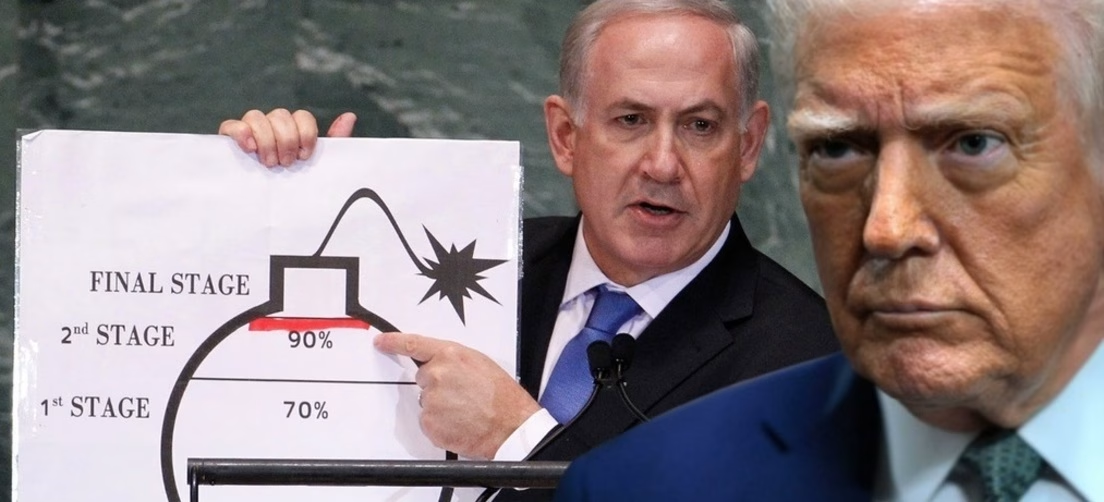
When President Trump stood before the world this past weekend and said Iran was only weeks away from possessing a nuclear weapon, it wasn’t the first time such dire language had been used to justify military action in the Middle East. That sense of existential threat — that an adversary was on the verge of unleashing a catastrophic weapon — has become almost a familiar drumbeat in U.S. foreign policy. And history suggests we should listen for the echoes of the past.
Twenty-four years ago, Benjamin Netanyahu, then Israel’s emerging leader, stepped before the U.S. Congress to warn that Saddam Hussein’s Iraq was on the brink of developing nuclear weapons. His testimony was urgent, confident, and unambiguous: Iraq’s supposed arsenal wasn’t some distant possibility but an imminent danger. That message helped build the emotional and political case for the Iraq War. But as we all now know, the weapons of mass destruction never materialized, and the invasion unleashed consequences no one foresaw, from prolonged sectarian violence to the destabilization of an entire region.
Critics argue that this moment is worth remembering when looking at Netanyahu’s relationship with the Trump administration. When Donald Trump entered the White House, analysts noted that Netanyahu saw an American president whose foreign‑policy instincts and personal dynamics created an opening for Israel to push long‑standing strategic priorities—especially regarding Iran. After the devastation and political fallout in Gaza and other areas, commentators say Netanyahu viewed the moment as an opportunity to press for a more aggressive posture toward Tehran.
Public remarks attributed to Secretary of State Marco Rubio, added fuel to that perception. Rubio described what he called unusually forceful diplomacy from Israel, with Netanyahu reportedly prepared to confront Iran even without broad international backing. According to these accounts, the Trump administration found itself pulled deeper into a confrontation shaped as much by Israeli urgency as by American strategy.
At the same time, Pentagon briefers told congressional staff that Iran was not preparing any preemptive strike on U.S. forces or bases in the region. That assessment introduced another layer of tension, sharpening the debate over how far the United States should allow itself to be pulled into the unfolding standoff.
The pattern, critics contend, is familiar: a leader making dire warnings, urging decisive action, and shaping U.S. policy debates in ways that reverberate far beyond the moment. History has a way of circling back, and you can feel it here. Whether this moment becomes its own chapter or ends up shelved beside the Iraq era is anyone’s guess, but the resemblance is unsettlingly hard to dismiss.
That action has now swept the region into a dramatic new chapter. Iran’s Supreme Leader, Ayatollah Ali Khamenei, who ruled since 1989, has been confirmed killed in the combined strikes on Tehran, according to Iranian state media and international reporting. The death of an 86-year-old head of state — a figure who defined Iranian politics for decades — is the most momentous event in the country since its 1979 revolution, triggering uncertainty about the regime’s future and adding a new layer of unpredictability to an already volatile conflict.
In Washington, supporters of the strikes are celebrating what they see as a decisive blow against a longtime enemy. President Trump called the killing “justice for the people of Iran and for all Americans,” presenting the operation as proof that the United States is done projecting hesitation and ready to act with force. To his backers, it was strength made visible.
But beyond the triumphant language, the images tell a heavier story. Apartment buildings reduced to concrete shells. Parents clutching children in hospital corridors. Families grieving not just a political leader but neighbors, relatives, friends. The region is once again bracing for what comes next — retaliation, escalation, a widening circle of instability that rarely stays contained.
The diplomatic fallout has been just as immediate. Trump said he was “quite very disappointed” in British Prime Minister Keir Starmer for declining to support the proposed military action. The president had reportedly sought access to the joint U.S.–U.K. base on Diego Garcia, the strategically vital British-controlled island in the Indian Ocean. London said no.
Speaking before Parliament, Starmer made clear that Britain did not participate in the initial U.S. and Israeli strikes — and that the decision was intentional. He argued that the most constructive path forward is still diplomacy: a negotiated agreement in which Iran permanently abandons any pursuit of nuclear weapons and halts destabilizing activities across the region. The United Kingdom, he stressed, does not support Trump’s regime change imposed through military force. Decisions of this magnitude, he said, require a clear legal foundation and broad international backing.
That position carries its own historical weight. Britain was a signatory to the 2015 Iran nuclear agreement — the deal painstakingly negotiated by American officials alongside European allies, China, and Russia. The accord imposed strict inspections and limits on Iran’s nuclear program in exchange for sanctions relief. It was imperfect, critics said, but it put guardrails in place.
In 2018, early in his first term, Trump pulled the United States out of the nuclear agreement, dismissing it as weak and fundamentally flawed — an argument that closely mirrored the long-standing criticism voiced by Israel’s prime minister, Benjamin Netanyahu. The decision didn’t just scrap a deal; it signaled a dramatic shift in American strategy. What followed was the so-called “maximum pressure” campaign — tightening sanctions, diplomatic isolation, and increasingly heated rhetoric between Washington and Tehran. Years later, the language of negotiation has been replaced by the sound of airstrikes, and whatever comes next is no longer theoretical. It’s happening in real time.
History offers sobering reminders about what happens after the removal of powerful leaders. The toppling of Saddam Hussein did not usher in the stable, democratic Iraq many envisioned. Instead, it opened a vacuum that insurgents, militias, and extremist groups rushed to fill. Libya followed a similar trajectory after Muammar Gaddafi’s fall — the dictator gone, but the country splintered into rival factions and armed groups battling for control.
These examples matter because regimes are not single pillars that collapse neatly when struck. They are webs of institutions, security forces, patronage networks, and deeply embedded loyalties. Remove the figure at the top, and the structure often bends rather than breaks. Sometimes it hardens.
Iran is no exception. Its political and security architecture has been built over decades. The Revolutionary Guard is not a symbolic force; it is woven into the country’s economy and governance. Clerical institutions, military commanders, and political elites all hold stakes in the system’s survival. The death of a supreme leader, dramatic as it is, does not automatically dismantle that machinery.
There is also the human dimension, which rarely fits into strategic briefings. Ordinary people — shopkeepers, teachers, students — are the ones who absorb the shock of geopolitical gambits. They endure sanctions that squeeze livelihoods, air defenses that turn their skies into battlegrounds, and uncertainty that stretches for years. They are rarely consulted in the calculations that reshape their futures.
Supporters of the strikes argue that decisive action was necessary, that deterrence requires boldness. Critics warn that history is littered with examples of interventions launched with confidence and ending in prolonged turmoil.
What is undeniable is this: removing a leader is the beginning of a new chapter, not the end of a story. The question now is whether this chapter leads toward stability or deeper fracture — and whether the lessons of recent history will guide what happens next, or once again be overshadowed by the urgency of the moment.
For Iran, the challenge now is exactly that: the Revolutionary Guard Corps, clerical institutions, and entrenched political factions remain. Even with Khamenei gone, the mechanisms that have sustained the Islamic Republic do not vanish overnight. Analysts caution that the regime may not simply collapse, but instead fracture, leading to internal struggle, renewed hardline leadership, or greater militarization.

Mein Kampf & Trump — Available on Amazon
This matters not just for Iran’s citizens but for people around the globe. We have seen how the language of imminent nuclear threat can rally support for military action — and we have seen the toll that follows. The story from Baghdad should have been a lesson, not a template. Yet here we are, watching repeated rhetoric offer justification for force, even as the evidence on the ground remains complex and contested.
In times of war, leaders will always seek certainty before action. But when the cost is measured in lives and the future of nations, certainty becomes a luxury we can ill-afford to manufacture. Warnings about weapons and threats must be rooted in verifiable assessments, and they must be weighed against the human consequences of military intervention. Otherwise, history doesn’t guide us forward — it simply echoes louder, repeating the same missteps under new headlines.