

By Ben Emos | Monday March 09 2026 | 4 min read
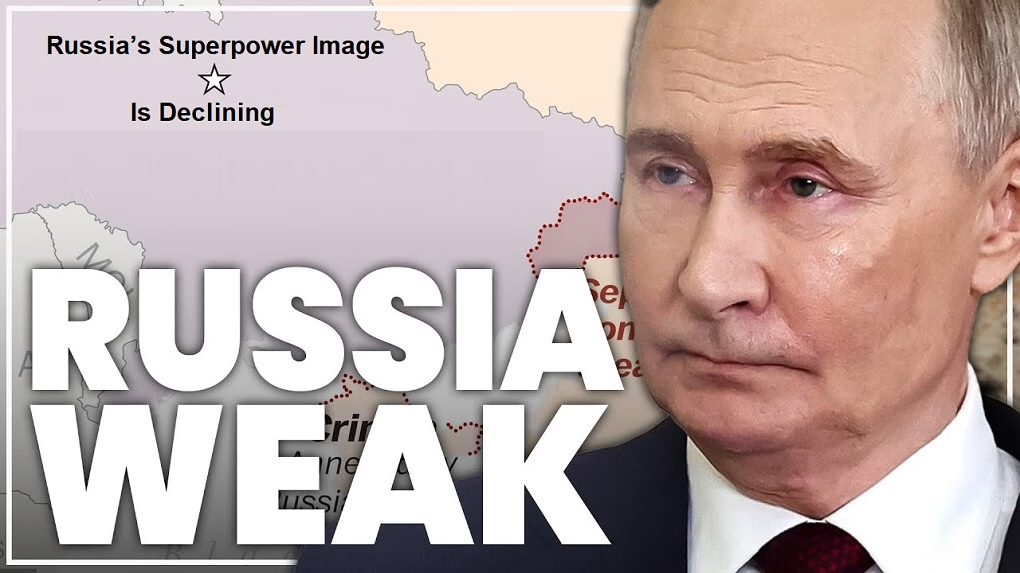
For decades, Russia has projected the image of a formidable superpower — a country capable of intimidating its neighbors and forcing the world to take it seriously. That image, carefully cultivated since the collapse of the Soviet Union, relied as much on perception as on reality. Today, however, the façade appears to be cracking, and Washington is clearly paying attention.
Long before the war in Ukraine, Russia demonstrated a willingness to use overwhelming force in its neighborhood. The wars in Chechnya during the 1990s and early 2000s were brutal campaigns that crushed separatist resistance at enormous human cost. Later came the brief but decisive war with Georgia in 2008. To many outside observers, these conflicts reinforced the idea that Russia remained a military giant — unpredictable, perhaps reckless, but undeniably powerful. Few countries seemed willing to challenge it directly.
That perception lingered for years. When Russia launched its full-scale invasion of Ukraine in February 2022, many analysts expected a rapid collapse of Ukrainian resistance. Moscow’s military had been modernizing for more than a decade, and the Kremlin itself projected confidence that the operation would be swift. The expectation in many capitals was that Kyiv would fall within days or weeks.
Instead, the war dragged on — and with each passing month, the image of Russian military dominance began to fade. Logistics failures, poor coordination, and repeated battlefield setbacks raised uncomfortable questions about the true strength of the Russian armed forces. What was supposed to be a demonstration of power instead exposed significant weaknesses.
The human cost of the war underscores the scale of the problem. Independent researchers using open-source evidence — obituaries, court records, and local news reports — have verified more than 152,000 Russian military deaths since the invasion began. This tally, compiled by BBC Russian and the independent outlet Mediazona, includes only confirmed Russian citizens and excludes fighters from the self-proclaimed separatist regions in eastern Ukraine. Even so, the numbers are staggering. They also reveal a pattern: many of the dead come from small towns and rural regions far from Moscow and St. Petersburg.
Other estimates suggest the toll is even higher. Analysts at the Center for Strategic and International Studies estimate that Russia may have suffered roughly 1.2 million total casualties, including around 325,000 killed, with the rest wounded or missing. Figures cited by Western officials and publications such as The Economist place Russian deaths somewhere between 190,000 and 350,000, depending on how irreversible losses are calculated.
Whatever the exact number, the broader picture is clear. A military sustaining losses on this scale inevitably loses some of the aura of invincibility that once surrounded it.
In Washington, policymakers appear to be drawing their own conclusions. With Russia heavily committed in Ukraine, the United States has shown increasing confidence in confronting Moscow’s partners and proxies. American forces have carried out strikes against Iranian-linked groups in Syria, while diplomatic and economic pressure has intensified against states seen as aligning with the Kremlin.
The message reaching many capitals is simple: Russia’s ability to project power beyond its immediate battlefield may be more limited than previously assumed.
This marks a striking contrast with the Cold War era. During the Cuban Missile Crisis in 1962, the United States and the Soviet Union negotiated carefully because both sides recognized the devastating consequences of direct confrontation. The balance of power demanded caution. Each superpower knew the other had the capability to respond in kind.

Mein Kampf & Trump — Available on Amazon
Today, that sense of balance looks less certain. Russia still possesses a vast nuclear arsenal and remains a significant military force. Yet the war in Ukraine has revealed vulnerabilities that few anticipated just a few years ago.
In international politics, perception often matters as much as reality. A state’s influence depends not only on the strength of its weapons but also on the belief that it can use them effectively. Once that belief begins to erode, the strategic landscape shifts.
Whether Russia’s power is truly declining or merely overstretched by one brutal war remains open to debate. But one thing is increasingly clear: the image of an unstoppable Russian superpower no longer commands the same unquestioned respect it once did. And in Washington, that change in perception is already shaping the way the United States approaches the world.
#Russia, #UkraineWar, #RussiaUkraineWar, #Geopolitics, #GlobalPolitics, #MilitaryAnalysis, #RussiaMilitary, #WorldAffairs, #ForeignPolicy, #SecurityStudies, #InternationalRelations, #WarInUkraine