

By Jane Lewis | Wednesday February 18, 2026 | 5 min read
There was a time when a presidential pardon felt like an act of grace — a solemn gesture meant to correct injustice, not reward loyalty — which is why a Republican now backs Democrats on a constitutional amendment to limit Trump’s pardon power, as bipartisan lawmakers push to give Congress the authority to review and potentially override controversial presidential pardons.
The framers of the Constitution gave the president the authority to pardon for a reason. They understood that justice, though structured, is still human. Courts make mistakes. Sentences can be excessive. Political prosecutions can occur. A pardon was meant to be a safety valve — an act of grace used sparingly, soberly, and in the national interest.
What it was never meant to be was a political shield.
In a recent opinion piece, we compared the modern abuse of pardons to the medieval sale of indulgences — when forgiveness was effectively handed out not on the basis of repentance, but on proximity and power. The analogy was uncomfortable, but history often is. And it seems that discomfort is spreading beyond editorial pages.
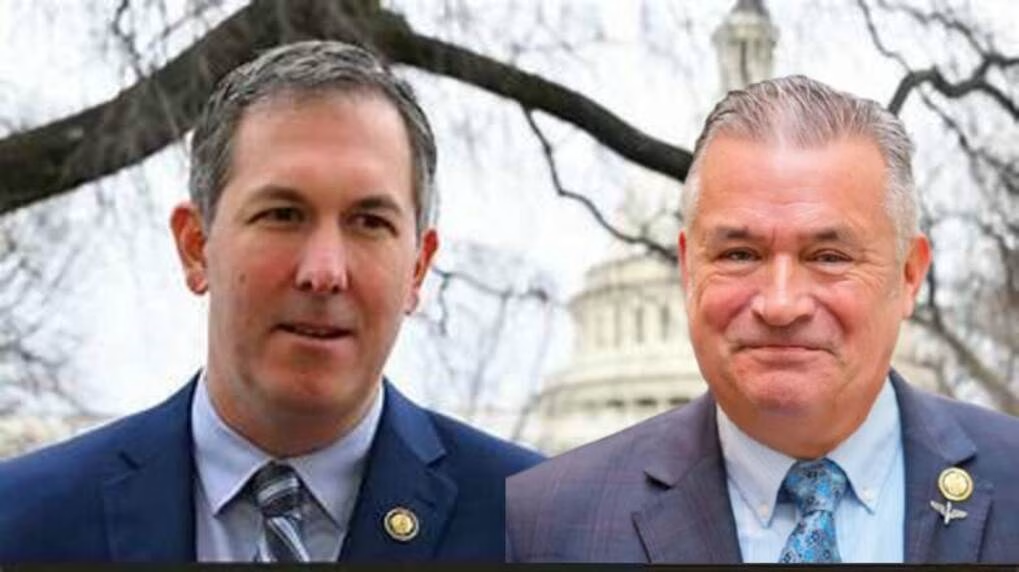
Representative Johnny Olszewski (D-MD) has introduced what he calls the Pardon Integrity Act — a proposed constitutional amendment that would allow Congress, under narrow conditions, to review and potentially nullify a presidential pardon. Under the proposal, a minimum of 20 House members and five senators could trigger a review. Congress would then have 60 days to override the pardon with a two-thirds vote, similar to how it overrides a presidential veto.
It is not a repeal of the pardon power. It is not an effort to weaken the presidency. It is, in essence, an attempt to restore balance.
“None of us should accept it as normal practice that a president, any president, used their executive pardon power to absolve convicted drug kingpins, those found guilty of violently attacking law enforcement officers, and even a money laundering crypto magnate with ties to the president’s family business,” Olszewski said.
Yet that is precisely the landscape we now find ourselves navigating.
On his first day back in office, President Trump pardoned roughly 1,500 individuals connected to the January 6 attack on the U.S. Capitol. Since then, he has pardoned or commuted the sentences of nearly 90 others. Among the most controversial was former Honduran president Juan Orlando Hernández, who had been serving a 45-year sentence after being convicted of conspiring to smuggle massive quantities of cocaine into the United States and accepting bribes from violent cartels.
Supporters of these pardons argue that the Constitution grants the president broad authority, and they are correct. Article II is clear. But constitutional authority and constitutional wisdom are not always the same thing.
The surprise — and perhaps the significance — in this moment is that the push for reform is not purely partisan.
Representative Don Bacon, a Republican and former Air Force general, has joined Olszewski’s effort. Bacon is not seeking reelection in his competitive district, which may give him unusual freedom to speak plainly. He did just that.
“Presidential pardons are an important constitutional authority,” Bacon said, “but like all powers held by the executive branch, these authorities benefit from the appropriate checks and balances the Constitution envisioned.”
He went further: “Frankly, it is clear to me the pardon authority has been abused.”
That word — abused — is not chosen lightly. Across multiple administrations, both parties have faced criticism over controversial pardons. But the volume and scope of recent actions have intensified concerns that the pardon power is drifting from its original purpose and becoming a tool of political loyalty.
Bacon has also backed bipartisan legislation to return the authority to levy tariffs solely to Congress, aligning with the Constitution’s original text. In both cases — tariffs and pardons — the underlying principle is the same: powers concentrated too heavily in one branch invite imbalance.
This is not about one president alone. It is about precedent.
If one president can pardon political allies, benefactors, or figures whose cases intersect with his personal orbit without meaningful oversight, then future presidents — of either party — can do the same. And once the public comes to see pardons not as acts of justice but as rewards of proximity, faith in the rule of law erodes quietly but steadily.

Mein Kampf & Trump — Available on Amazon
The founders built friction into the system on purpose. They expected ambition to counter ambition. They did not design a monarchy softened by elections; they designed a republic sustained by accountability.
A constitutional amendment is not a small undertaking. It requires broad consensus, ratification by states, and serious debate. But the mere fact that a Republican and a Democrat are willing to begin that conversation suggests something deeper: an acknowledgment that norms alone may no longer be enough.
The pardon power should remain. Mercy matters. But mercy without guardrails risks becoming something else entirely.
And when the public begins to wonder whether justice depends less on the law and more on loyalty, that is not a partisan concern. It is a constitutional one.