

By Jane Lewis | Tuesday March 03 2026 | 4 min read
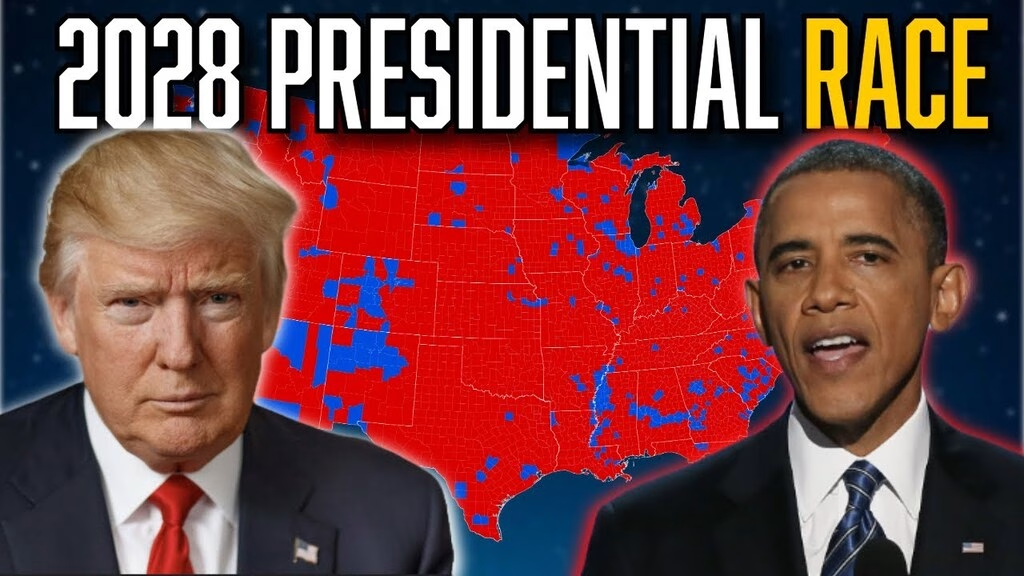
American politics has always had a flair for the dramatic. But the possibility now floating through Washington feels less like ordinary speculation and more like the opening scene of a constitutional thriller: Donald Trump, newly returned to the White House after his 2024 victory, potentially seeking a third term — and Barack Obama, the only Democrat with the stature to match him, being pulled back into the arena.
Trump’s comeback already rewrote political history. Now, whispers are growing louder: what if he tries to run again in 2028? The 22nd Amendment is clear — no person shall be elected to the presidency more than twice. But clarity on paper does not always restrain political ambition in practice. And in an era defined by broken norms, few are willing to dismiss the possibility outright.
If Trump were to signal an attempt at a third term, it would ignite a legal and political firestorm. Lawsuits would fly. Constitutional scholars would flood cable news. State election officials would face immense pressure. The country would once again be thrust into an argument not just about policy, but about the guardrails of democracy itself.
And then there is Obama.
For Democrats, he remains their most electrifying political figure. More than a decade after leaving office, he still commands packed arenas, headlines, and a level of cross-generational appeal rare in modern politics. His speeches circulate widely. His approval ratings remain durable. For many voters, he represents steadiness and eloquence — a contrast to the turbulence that has defined recent years.
The Constitution bars Obama from seeking a third term just as clearly as it bars Trump. But if Trump openly challenged the two-term limit, Democrats would face enormous pressure to respond forcefully. The debate would no longer feel routine. It would be framed as existential. If one side pushes past constitutional boundaries, why should the other unilaterally accept them?
That reasoning is combustible — politically powerful, legally perilous.
Imagine the spectacle: two former presidents, each claiming legitimacy, each casting the other as a threat to the republic. It would be less a campaign and more a referendum on institutional survival.
Republicans would warn of chaos. They would argue that reopening term-limit debates destabilizes elections and undermines confidence in the system. Many would insist the 22nd Amendment is ironclad and accuse Democrats of inflaming fears.
Democrats, meanwhile, would likely frame the moment as defensive — a stand to preserve constitutional norms. In that narrative, Obama would not simply be a candidate; he would be a counterweight. A stabilizing force stepping back in during a constitutional storm.
But beneath the spectacle lies a deeper question: what does it say about the health of American democracy if its future once again hinges on two men who have already served their time in the Oval Office?
Will Trump Push Constitutional Boundaries and Force Obama’s Hand?
Trump thrives on confrontation and rule-bending. Obama projects deliberation and institutional respect. Their clash would not just be ideological. It would be symbolic — a battle over the meaning of precedent itself.
And yet many Americans may feel weary at the thought. Younger voters, in particular, have grown up in a political environment dominated by familiar faces. They may crave renewal rather than reruns.
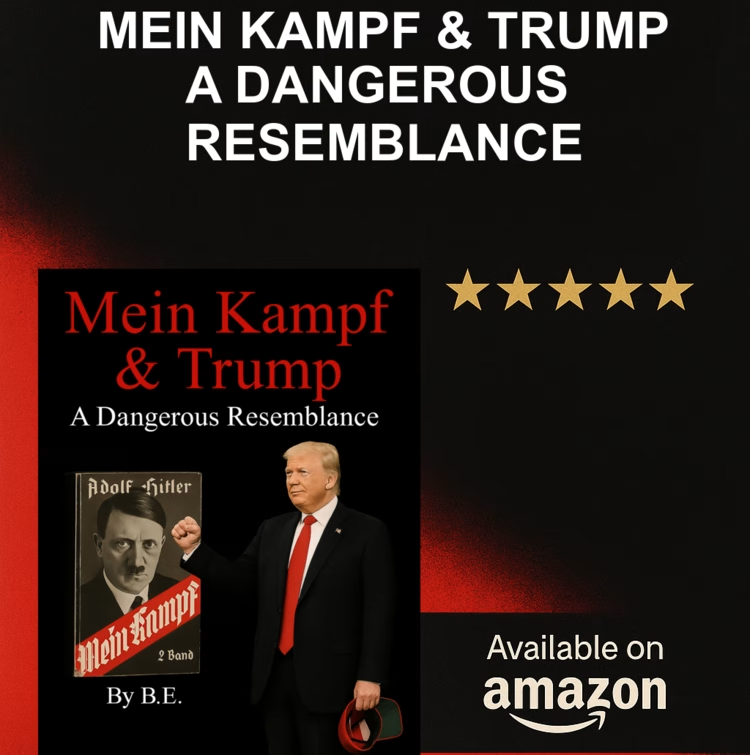
Mein Kampf & Trump — Available on Amazon
Still, in moments of uncertainty, parties gravitate toward familiarity. They rally around figures who can instantly command national attention. In that climate, Obama’s name will inevitably surface.
Would he actually run? That remains uncertain. He has shown little visible desire to return to elected office. But politics has a way of reshaping intentions. If the country were staring down a constitutional standoff, the calls for him to step in would grow louder by the day.
Perhaps the real contest in 2028 would not simply be Obama versus Trump. It would be restraint versus ambition. Norms versus personal will. The question would not just be who wins — but whether the system itself holds.
And the fact that this scenario no longer feels impossible says more about the moment than any campaign slogan ever could.