

By Don Terry | Monday March 02 2026 | 4 min read
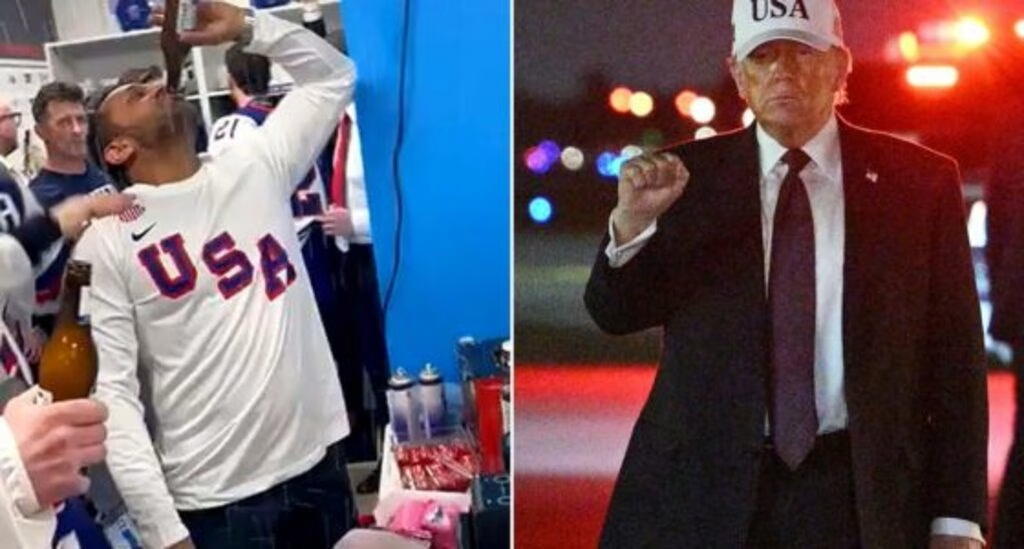
Last Sunday should have been simple. The U.S. men’s hockey team won gold. There were hugs, beer showers, the kind of messy, joyful celebration sports are built for. And then there was the director of the FBI, in the locker room, hoisting a bottle and spraying it into the air like he’d just clinched the Stanley Cup himself.
It was a strange image: the nation’s top law enforcement official grinning ear to ear, splashing beer across players half his age. His office had insisted the trip to the Olympics was official business. When his schedule became public, it told a different story — a handful of meetings scattered across four days, buffered by long stretches of leisure time, culminating in the gold medal game and a flight home.
Let’s be clear: there’s nothing inherently wrong with attending a major sporting event. Public officials are allowed to be human. But there’s a difference between showing up and inserting yourself into the champagne spray. There’s also the matter of the jet.
By law, the FBI director must use the bureau’s aircraft for travel. If the trip is personal, he’s required to reimburse the government — though only the cost of a commercial ticket. That technical compliance may check a box, but it doesn’t quiet the optics. Particularly not when the same man once criticized his predecessor for using the government plane for vacations, suggesting maybe it should be grounded.
Since taking office, Director Kash Patel has logged frequent flights that blur the line between work and personal life: a golf getaway in Scotland, a wrestling event where his girlfriend performed the national anthem, a stop at a Texas resort owned by a political donor. Each trip can be defended in isolation. Together, they sketch a portrait of a director who seems to relish the perks of the job at least as much as the job itself.
The pattern extends beyond travel. There have been stories — disputed, but persistent — about wardrobe theatrics before press conferences, about a fixation on social media messaging during active investigations, about a need to be seen at the center of the action. When conservative activist Charlie Kirk was shot last year, Patel prematurely announced a suspect was in custody, only to correct himself shortly after. In crisis management, words matter. Precision matters. Reassurance without accuracy can do real harm.
Patel defended the post as transparency. But the FBI director is not a cable news pundit. The role demands steadiness, discretion, and an understanding that not every development needs to be broadcast in real time. The public’s trust in federal law enforcement has been fragile for years. It doesn’t need theatrics; it needs competence.
Then there’s the Epstein matter — the shadow that hangs over much of Washington. Before becoming director, Patel was vocal about releasing names and documents tied to Jeffrey Epstein’s crimes. He criticized Republicans for not pushing harder. Now, in office, his tone has shifted markedly. He has said there is no credible evidence of trafficking beyond Epstein himself, even as newly released materials have raised fresh questions, including about what may have been omitted from public files.
To be fair, none of this proves misconduct. Public service is messy. Political appointments are inherently political. But the through line in all of it — from the locker room spray to the conference call outbursts — is a sense of misplaced priorities. A sense that optics sometimes outrun substance.

Mein Kampf & Trump — Available on Amazon
The FBI is not a brand to be managed. It is an institution that investigates terrorism, organized crime, cyber threats, public corruption. Its director’s job is not to trend on social media or collect photo ops in far-flung locales. It is to safeguard credibility inside an agency where morale and mission depend on leadership that projects seriousness.
The locker room clip will fade. Viral moments always do. What lingers is the quieter question: who is cleaning up afterward? When headlines shift and attention moves on, the bureau’s career agents and analysts remain. They will still be tasked with doing the work — meticulously, often anonymously, and without beer showers.
Celebration has its place. So does humility. The director of the FBI should know the difference.