

By Don Terry | Sunday February 15, 2026 | 5 min read
The debate over the release of documents connected to the Jeffrey Epstein investigation has intensified, fueled by conflicting public statements, internal agency communications, and growing demands for full transparency. What began as a routine update on document disclosures has evolved into a broader dispute over privilege claims, redaction practices, and the handling of sensitive information involving high‑profile individuals.
What should have been a procedural update became something far more combustible when attorney Pam Bondi declared that “all” Epstein files had been released. The statement landed with a thud in Washington, not because transparency is unwelcome, but because it seemed to contradict earlier explanations. Bondi had previously suggested that some materials remained protected under privilege. If everything was now public, what changed?
The question was not asked quietly.
Representative Nancy Mace responded in a sharply worded social media thread, insisting that the public had not, in fact, seen the full picture. She argued that the legal reasoning offered to justify withholding additional records — including claims of “work product privilege” — would not survive meaningful scrutiny. Her tone was less partisan than prosecutorial. Something, she implied, did not add up.
At the center of the dispute is a familiar but opaque concept: privilege. Attorneys rely on it to protect internal strategies, draft arguments, and deliberations. It exists for good reason. But in a case as sprawling and politically sensitive as Epstein’s, critics worry that the doctrine can be stretched, intentionally or not, into a kind of institutional armor.
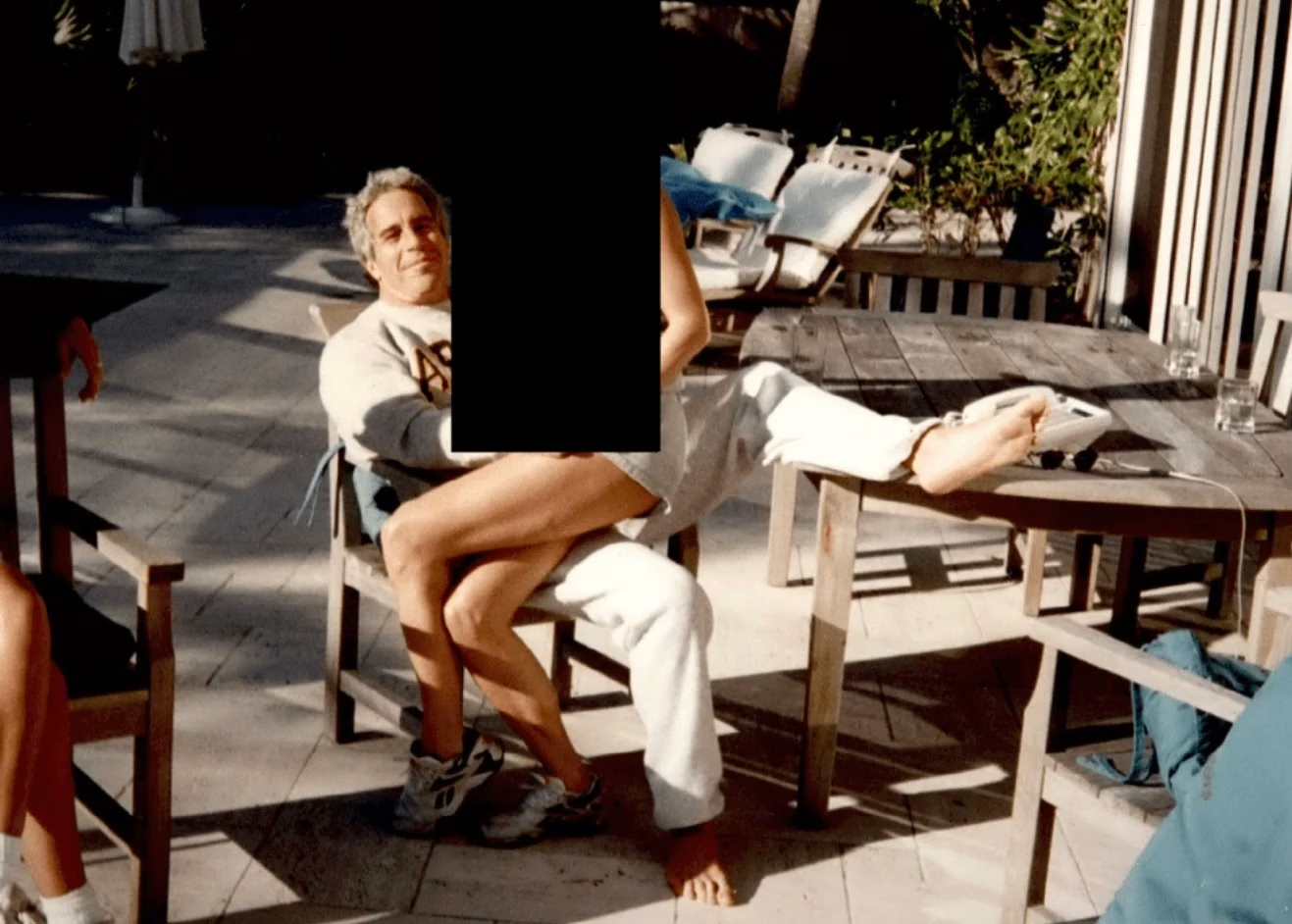
Mace’s skepticism intensified when she referenced an internal FBI email from March 2025. According to her account, agents sought “clear and specific guidance” on how to redact photographs depicting former U.S. presidents, a secretary of state, and other public figures. The implication was not that those individuals committed crimes — the released documents repeatedly caution that the appearance of a name does not equal wrongdoing — but that redaction decisions were not as straightforward as officials suggested.
That tension is what keeps this story alive. The files reportedly number in the millions of pages. They span decades, continents, and a network of relationships that included titans of business, media, and politics. Some mentions are incidental, others more direct. Sorting relevance from rumor is painstaking work. But to many Americans, that complexity is precisely why full disclosure matters.
It is impossible to separate this debate from the broader climate of distrust surrounding federal agencies. The Department of Justice insists that its memo clarifies the status of the documents and that any remaining materials are protected by established legal standards. Yet for a public conditioned by years of institutional failures — from financial crises to intelligence missteps — assurances alone rarely suffice.
The Epstein case, in particular, carries a residue of unfinished business. His death in federal custody fueled conspiracy theories across the political spectrum. The prosecution of Ghislaine Maxwell answered some questions but left others lingering. Who knew what? Who enabled whom? And did influence, wealth, or proximity to power ever shape investigative decisions?
None of those questions are resolved by declaring the files complete.
There is also a human dimension that can be lost amid arguments over privilege doctrine and redaction protocols. Survivors of abuse have waited years for accountability, for acknowledgment, for a sense that every stone has been turned. For them, transparency is not a slogan. It is part of healing. Each withheld document can feel like another closed door.
At the same time, agencies must weigh privacy, due process, and the risk of unfairly implicating individuals through uncontextualized material. Dumping raw files without explanation could cause collateral damage. Transparency, done poorly, can distort as easily as concealment.

Mein Kampf & Trump — Available on Amazon
That is the uncomfortable space this dispute occupies. Between legal caution and public hunger. Between protection and perception. Between the slow mechanics of bureaucracy and the urgency of outrage.
What is clear is that the controversy is no longer just about what is in the files. It is about credibility. When officials say “all,” the public hears a promise. When lawmakers say “not so fast,” the public hears doubt. In the gap between those two voices, trust either grows or erodes.
The Epstein documents may eventually be fully aired or definitively closed. But the larger question — whether institutions can convincingly police the powerful and explain themselves along the way — will linger far beyond this particular case.