

By Ben Emos | Thursday, March 26, 2026 | 4 min read
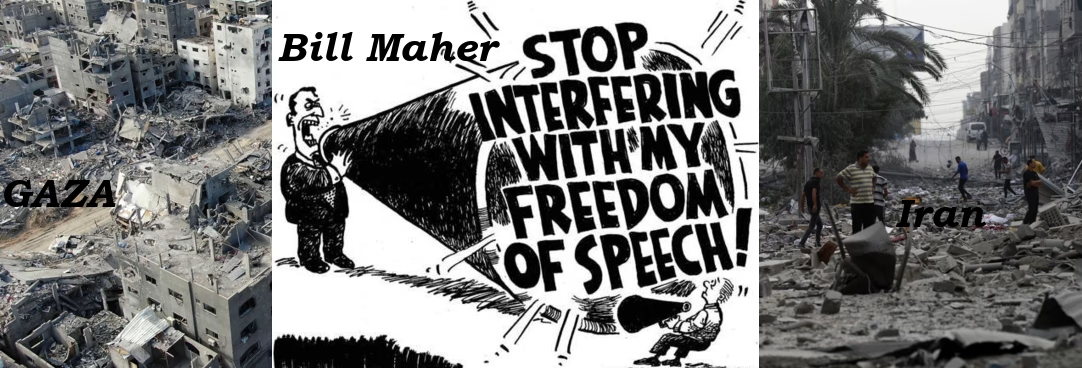
For years, Bill Maher has built a reputation on skepticism. His brand has always been rooted in questioning authority, poking at hypocrisy, and challenging narratives that others accept too easily. That’s what made him compelling—whether you agreed with him or not, you expected him to push back.
Which is why his posture on Israel has struck so many as unusual.
Maher has long been an outspoken supporter of Israel, especially as tensions in the Middle East have escalated. Much of his commentary centers on Israel’s right to defend itself and its long-term security. He frequently calls out critics he believes cross into hostility or denial of Israel’s legitimacy. That position, in itself, isn’t new or even rare. But what has drawn increasing attention is what some see as an imbalance—an eagerness to defend, paired with a reluctance to scrutinize.
Even fellow comedians have noticed. Dave Chappelle took a pointed jab at Maher in a public setting, criticizing what he viewed as selective outrage—particularly in the wake of reports that more than 200 journalists had been killed in Gaza. For Chappelle and others, the question isn’t whether Israel has security concerns. It’s whether those concerns are being used to shield actions that deserve the same level of criticism Maher routinely directs elsewhere.
That tension becomes sharper when placed against a longer historical backdrop.
More than two decades ago, Benjamin Netanyahu stood before the United Nations and warned that Saddam Hussein was on the verge of acquiring nuclear weapons. The message was clear: the threat was immediate, urgent, and too dangerous to ignore. It helped shape the global narrative that led to the Iraq War.
But the weapons of mass destruction never appeared.
What followed was not a quick resolution, but years of instability, violence, and unintended consequences that reshaped the region. In hindsight, those warnings are often cited as a cautionary tale—about how fear, certainty, and incomplete information can combine to justify decisions with lasting consequences.
Today, echoes of that moment are hard to ignore. As tensions with Iran continue to dominate headlines, similar language about existential threats and urgent action has returned. The stakes are enormous, and the rhetoric is familiar.
Even Donald Trump has, at times, adopted a tone that aligns with those earlier warnings, framing Iran as a danger that cannot be allowed to grow unchecked. Whether one agrees with that assessment or not, it underscores how persistent these narratives have become—and how influential they can be in shaping policy and public opinion.
This is where Maher’s position becomes harder to reconcile for some observers.
A commentator known for challenging power now appears, in this context, to be reinforcing it. A voice that often demands evidence and accountability seems less inclined to apply that same standard when it comes to Israel’s leadership or its stated threats. And for critics, that raises a deeper question: is this consistency, or is it something else?
To be fair, Maher would likely argue that he is being consistent—that he sees Israel as a democratic ally in a volatile region, and that its security concerns are not abstract but real. From that perspective, defending Israel is not about ignoring suffering, but about recognizing the complexity of the conflict.
But complexity cuts both ways.
If past lessons have taught anything, it’s that claims of imminent danger deserve scrutiny, not just acceptance. And that the consequences of acting on those claims—especially when they involve war—extend far beyond the moment.

Mein Kampf & Trump — Available on Amazon
So the question isn’t just about Maher. It’s about what we expect from public voices who shape opinion.
Should they choose sides, or should they challenge them? Should they defend allies, or question them when the stakes are highest?
Maher built his career on the idea that no one should be beyond critique. The current moment tests that principle. Because when the costs are measured in lives, silence—or selective scrutiny—carries its own weight.
And that’s the question hanging in the air: not whether Israel faces threats, but whether those threats—and the responses to them—are being examined with the same rigor Maher once demanded everywhere else.
#BillMaher, #IsraelGaza, #GazaWar, #Netanyahu, #IranTensions, #MiddleEast, #PoliticalCommentary, #MediaCriticism, #WarDebate, #USForeignPolicy
Y