
By Mary Jones & Jane Lewis | Monday, December 15, 2025 | 5 min read
In congressional hearing rooms, words carry consequences, especially when they involve national security and groups like Antifa. Language in that setting isn’t just explanatory—it can become a warning, a justification, or even an admission. Every statement made under oath shapes how the public understands threats and how much power the government claims in response. That’s why a recent exchange between lawmakers and an FBI national security official struck such a nerve. It wasn’t explosive or theatrical. It was tense, awkward, and revealing. And in that quiet discomfort, a deeper truth about rhetoric, evidence, and accountability came into focus.
The moment centered on a claim that has been repeated often in political circles: that Antifa is the “number one domestic terrorist organization” in the United States. It’s a sweeping statement, the kind that should rest on hard facts. Numbers. Locations. Evidence of coordination. So when a committee member asked a senior FBI official—specifically the operations director of the bureau’s national security branch—to explain what that claim actually meant, the answers that followed were startling in their emptiness.
It began innocently enough with a technical question about headquarters and organizational structure. Then the focus sharpened. If Antifa is a terrorist organization, where does it operate? How many members does it have? What infrastructure exists? These were not trick questions. They were basic, foundational inquiries—the kind any serious threat assessment should be able to answer.
What followed was hesitation. Deflection. Broad comparisons. The official suggested that understanding Antifa was an “ongoing” process, fluid and evolving, likening it to investigations into al Qaeda or ISIS. That comparison alone raised eyebrows. Those groups are internationally recognized terrorist organizations with documented hierarchies, leadership, financing networks, and histories of mass casualty attacks. Antifa, by contrast, has no membership cards, no central command, no official headquarters.
The committee member tried again, narrowing the question. Not names. Not identities. Just numbers. How many people has the FBI identified as being part of Antifa? Again, no answer. Investigations are active, the official said. The information is still developing.
At that point, frustration surfaced plainly. The lawmaker pointed out what many watching were likely thinking: you don’t come before Congress and declare a group the nation’s top domestic terror threat unless you can back it up. “You wouldn’t say something you can’t prove,” the member said. Then came the line that lingered: “But you did.”
That exchange cut to the heart of a growing problem in American political life—the casual inflation of language around national security. “Terrorist” is one of the most powerful labels the government can apply. It carries legal consequences, shapes surveillance practices, influences public perception, and can justify extraordinary measures. When that label is used without clear evidence, it doesn’t just weaken the argument—it weakens the institution making it.
Antifa’s Historical Roots
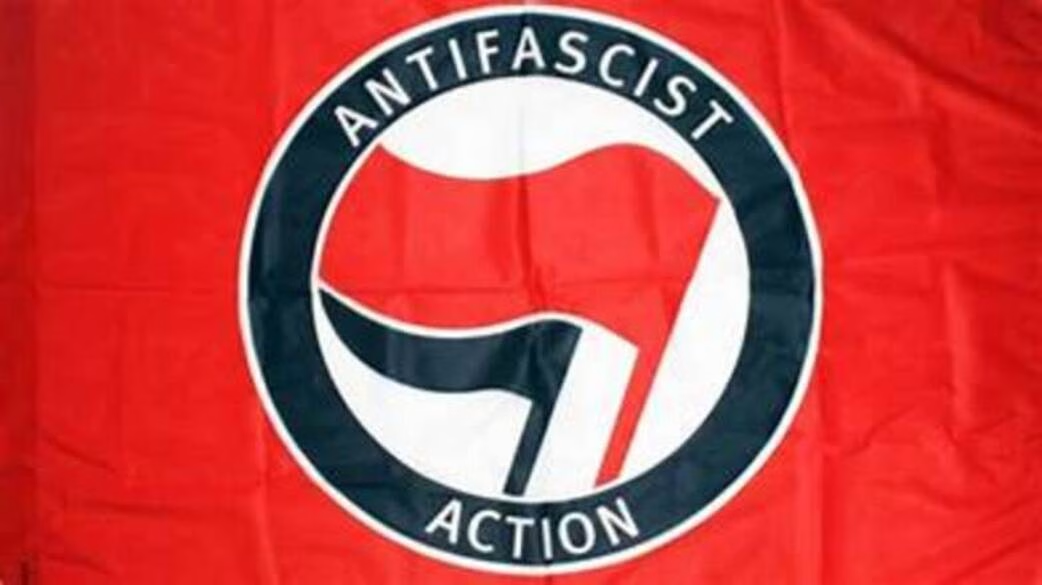
To understand why this matters, it helps to be clear about what Antifa actually is and isn’t. The term itself is shorthand for “anti-fascist,” and its roots trace back to Europe in the 1930s, when activists organized to resist the rise of fascist regimes. In the United States, Antifa isn’t an organization in any formal sense. It’s a loose label adopted by individuals and small groups who oppose fascism, white supremacy, and far-right extremism, sometimes through confrontational or even violent tactics.
That lack of structure is precisely what makes Antifa difficult to quantify—and also what makes claims of it being a centralized terrorist organization so problematic. There is no national leader. No headquarters. No unified strategy. People act independently, often locally, under a shared ideological banner. Some have engaged in criminal activity. Many have not. Treating that entire spectrum as a single, organized terror network collapses important distinctions and invites overreach.

The danger isn’t just theoretical. History shows that vague threats justify broad crackdowns. When definitions blur, so do civil liberties. Protest becomes suspect. Dissent becomes dangerous. And the public is asked to trust institutions that can’t—or won’t—explain the basis of their claims.
What made this hearing moment resonate wasn’t partisan posturing. It was the insistence on evidence. The lawmaker wasn’t defending Antifa. He was defending the idea that government power should be grounded in facts, not slogans. If officials can’t articulate what makes a group the “number one” threat, then the phrase becomes more about politics than protection.
In the end, the exchange served as a quiet but powerful reminder. National security demands seriousness. Seriousness demands precision. And precision demands proof. Without it, the line between responsible warning and reckless rhetoric grows dangerously thin—and public trust erodes right along with it.
More From FeDlan News:
Public Opinion Shifts: GOP Faces Replacement, Trump Probe, and SCOTUS Oversight
Liberal Justices Caution That Trump’s Case Risks Reshaping the Structure of U.S. Government
The Supreme Court’s Silence on Trump’s Third-Term Fantasies Is Louder Than Words
Trump and Pete Hegseth Were Eager to Release the First Strike—So What’s in the Second Video?
Kristi Noem and Advisor Corey Lewandowski Face Questions Amid Affair Allegations
 Donate
Copyright 2024 FN, NewsRoom.