

By Don Terry | Wednesday, January 14, 2026 | 5 min read
The brief exchange between Donald Trump and a Ford worker — a moment that flashed across social media within hours — might seem like another blip in a political landscape already saturated with conflict. But the interaction deserves a closer look, not because of the personalities involved, but because of what it says about the state of public life in America and the widening gap between those who hold power and those who live with the consequences of it.
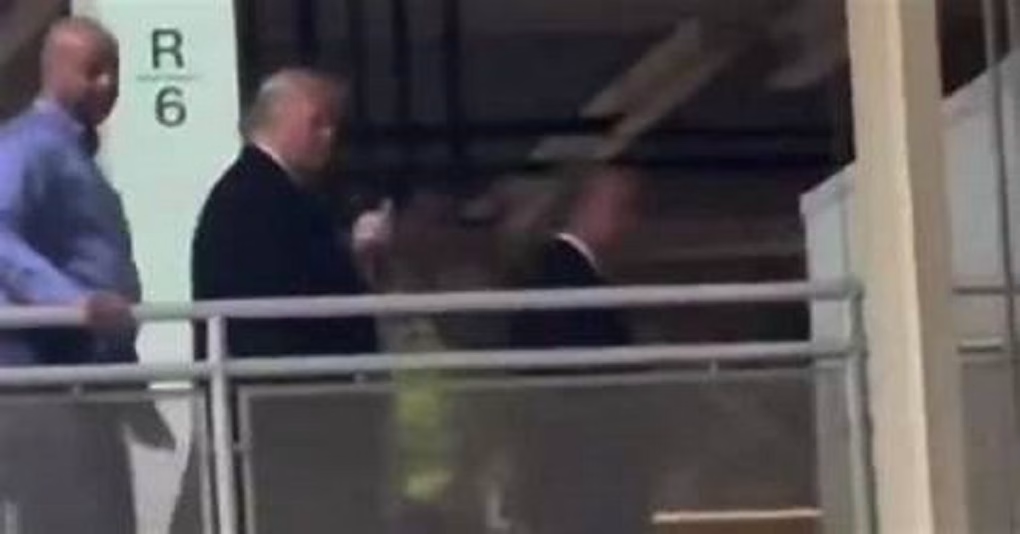
According to the footage circulating online, a worker shouted an accusation at Trump, one that touched on the protection of an alleged pedophile. It was a raw, unfiltered moment — the kind that doesn’t come from political consultants or campaign scripts. The worker’s voice carried the frustration of someone who felt unheard for too long. And Trump’s response, a gesture widely interpreted as an obscene dismissal, captured something equally revealing: a reflexive instinct to meet criticism not with engagement, but with contempt.
This wasn’t just a clash of personalities. It was a snapshot of a deeper tension in American life. Workers on the factory floor are living through economic uncertainty, rising costs, and a political climate that often treats them as props rather than participants. When one of them speaks up — loudly, emotionally, perhaps imperfectly — it’s worth asking why that moment of confrontation felt necessary in the first place.
The gesture Trump made in response may seem trivial to some. After all, political figures have been reacting to hecklers for as long as politics has existed. But gestures matter. Body language matters. The way leaders respond to ordinary people matters. When someone in a position of extraordinary influence reacts to a citizen’s accusation with a dismissive flick of the hand, it sends a message far beyond the walls of that factory.
It tells people that their anger is an inconvenience. That their questions are unwelcome. That their voices are disposable.
And that message lands hardest on those who already feel pushed to the margins.
The worker’s accusation — whether one agrees with it or not — came from a place of moral urgency. People don’t shout things like that unless they believe something has gone deeply wrong. In a healthy democracy, such moments should spark conversation, not contempt. They should prompt leaders to address concerns, not wave them away.
What happened at Ford is part of a larger pattern in American politics: the erosion of accountability. Too often, public figures respond to criticism not by engaging with the substance, but by attacking the critic. The result is a political culture where power shields itself from scrutiny, and where ordinary people are left shouting into the void.
This isn’t about one gesture or one confrontation. It’s about the growing sense that the distance between leaders and the public has become a chasm. When a worker risks his job and reputation to speak out, and the response is a crude dismissal, it reinforces the belief that the powerful answer only to themselves.
Moments like this should make us pause. They should make us ask what kind of political culture we are building — and what kind we are willing to tolerate. Democracy doesn’t erode all at once. It erodes in small gestures, in shrugged‑off questions, in the quiet normalization of contempt.
The Ford worker may never know how many people watched that moment or how many truly grasped the frustration behind his words. Yet his voice — unsteady, angry, rough around the edges — managed to cut through the constant political noise in a way that carefully scripted speeches rarely do. It was a reminder that democracy isn’t a stage show. It’s a relationship between leaders and the people they serve, and right now that relationship feels deeply strained.

Mein Kampf & Trump Now On AMAZON
The exchange that followed could end up being more than a fleeting viral clip. Trump’s reaction may become a spark that encourages others across the country to voice similar accusations, especially from those who feel ignored or dismissed. When a leader uses harsh labels for entire groups of people, including calling them rapists, dangerous or unhinged, it leaves real wounds behind. In that context, the worker’s accusation — whether grounded in fact or driven by emotion — becomes a mirror held up to the pain many feel.
Maybe moments like this will force a pause. Maybe they will make him confront the impact his words and actions have on ordinary people who don’t have the luxury of brushing off the consequences. Sometimes it takes a raw, uncomfortable confrontation to reveal just how much hurt has been building beneath the surface.
Leaders don’t have to agree with every accusation hurled their way. But they do owe the public something more than a gesture of dismissal. They owe engagement. They owe respect. They owe accountability.
Because when those things disappear, the consequences reach far beyond a factory floor.