

By Don Terry | Friday February 13, 2026 | 4 min read
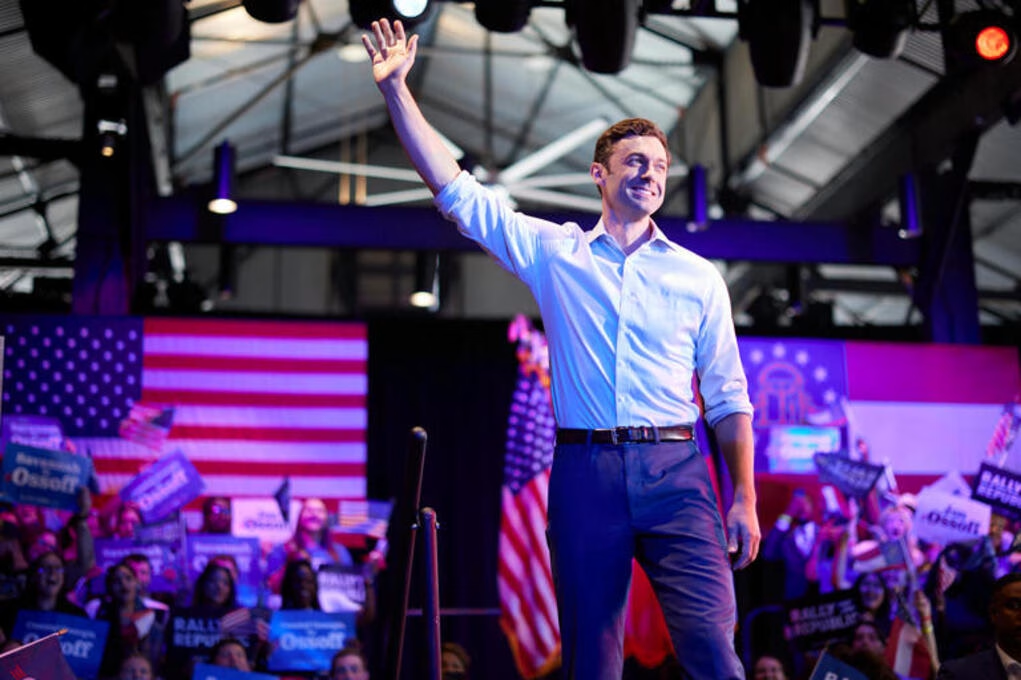
In Atlanta this week, Senator Jon Ossoff delivered a line that cut through the usual campaign noise with unusual clarity. He didn’t talk about Democrats or Republicans. He didn’t rehearse the familiar script of red versus blue. Instead, he went straight for the fault line that has been widening beneath American politics for years: class.
“Trump was supposed to fight for the working class,” Ossoff said. “Instead, he’s literally closing rural clinics, and hospitals to cut taxes for Elon Musk.” It was a sharp accusation, but what made it resonate was its simplicity. Ossoff wasn’t talking about ideology. He was talking about who wins and who loses.
Standing before supporters, he cast the coming election as a contest between everyday Americans and what he called a “gilded political class.” Then came the phrase that landed like a hammer: “This is the Epstein class, ruling our country.” It was a deliberately provocative choice, meant to evoke a world of private jets, sealed court files, and a level of privilege so insulated that accountability becomes optional.
Ossoff’s argument wasn’t aimed only at Democrats. By invoking both George Soros and Elon Musk—billionaires who sit on opposite ends of the ideological spectrum—he signaled that the problem, as he sees it, isn’t left or right. It’s the sheer concentration of wealth and influence shaping public policy in ways most Americans never voted for.
Democrats have been refining this message for months. Polling shows deep frustration with economic inequality and a growing sense that the system is rigged for those at the top. Rather than diving into culture-war skirmishes, the party is leaning into a broader critique: who benefits from the decisions made in Washington, and who pays the price.
Fueling that narrative are new reports about the Trump family’s financial gains during his presidency. The New York Times recently estimated that Trump has netted more than $1.4 billion since returning to office—through licensing deals, cryptocurrency ventures, and even a $400 million jet provided to the United States by Qatar, a plane he is expected to use after leaving office. The Times noted the real figure could be far higher.
To Trump’s supporters, this is proof of his business savvy and independence. To critics like Ossoff, it’s evidence of a presidency where public service and private enrichment have become dangerously intertwined.
That tension—between populist rhetoric and elite reality—is where Democrats see their opening.
Ossoff reminded the crowd of the promise they once heard. “We were told MAGA was a movement for working‑class Americans. Do you remember that?” he said. Then he pointed to what he sees now: a government stacked with billionaires rewriting the rules to benefit themselves, a White House that talks like champions of ordinary people while governing like a private club for the ultra‑rich.

Mein Kampf & Trump — Available on Amazon
It’s a message crafted for more than the Democratic base. It’s aimed at suburban independents, small‑town voters watching their hospitals close, and working‑class conservatives who once believed Trump saw them. Whether it sticks is another matter. Trump’s political brand has survived scandals that would have ended most careers, and his supporters often interpret criticism as proof that he is disrupting entrenched power.
But Ossoff’s speech hinted at something larger: Democrats are preparing to challenge the very definition of populism. Is it a movement that dismantles elite control—or one that simply replaces one set of elites with another? The furor over the still-sealed Epstein files — documents in which Trump’s name and several Cabinet members reportedly appear multiple times — has only deepened the sense of mistrust swirling around Washington. For many voters, the secrecy fuels a broader anxiety about who really holds power and how it’s exercised behind closed doors. That unease has given fresh energy to Ossoff’s message and, at the same time, created quiet discomfort within Republican circles wary of the political fallout.
As Election Day draws closer, the question may not be which party wins. It may be which vision of populism the country believes — the one that promises to lift working people, or the one that masks corruption, cruelty, and relentless grifting behind slogans and spectacle. In the end, voters will decide whether populism is a shield for the powerful or a tool for those who have been ignored for far too long.
Y