

By Ben Emos & Don Terry | Tuesday February 17, 2026 | 7 min read
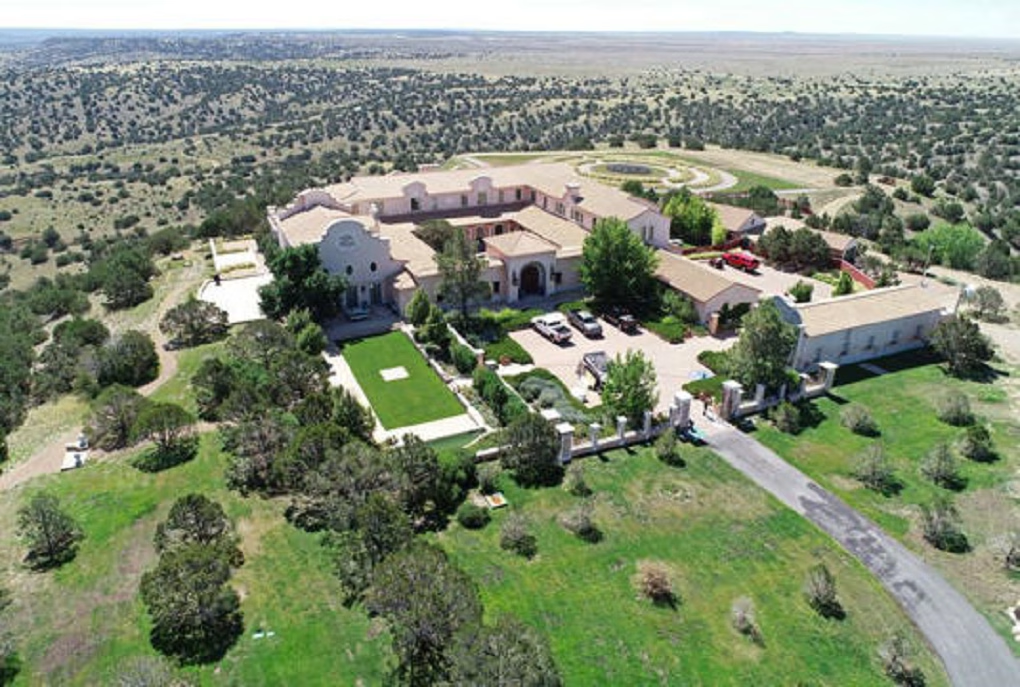
For years, the high desert south of Santa Fe kept its silence. Locals drove past the gates of Zorro Ranch—7,600 acres of scrubland and big sky—knowing only whispers. It was called “the playboy ranch.” Private jets came and went. Black SUVs rolled through small highways better known for dust storms than decadence. Workers signed nondisclosure agreements. Neighbors learned not to ask questions.
Now, decades later, New Mexico lawmakers have decided the silence can no longer stand.
On Monday, in a rare unanimous vote, the state House approved legislation creating what supporters call the first full investigation into what happened at Jeffrey Epstein’s Zorro Ranch. The bipartisan “truth commission,” made up of four lawmakers and backed by $2.5 million in funding, will have subpoena power. It will seek testimony from survivors who say they were trafficked and abused at the estate roughly 30 miles south of Santa Fe. It will also call on local residents—anyone who saw something, heard something, suspected something—to step forward.
LAW&CRIME: Bodies Buried on Epstein’s Ranch?
The question hanging in the air is as haunting as the desert wind: what, exactly, happened behind those adobe-style walls? And is there more to uncover than anyone has yet dared to imagine?
Epstein died in a New York jail cell in 2019, his death ruled a suicide while he awaited federal sex trafficking charges. His death closed a criminal case but opened a wound. For survivors, there was no trial. No cross-examination. No final accounting. Just an abrupt ending and a cascade of unanswered questions.
Much of the national focus has centered on Epstein’s Manhattan townhouse and his private Caribbean island. Zorro Ranch, despite civil suits alleging sexual assault of minors there as far back as the 1990s, remained in the background. There is no public record of a full federal search of the property. For a place accused of hosting abuse for decades, that absence is startling.
State Representative Andrea Romero, a Democrat and co-sponsor of the initiative, put it bluntly: “He was basically doing anything he wanted in this state without any accountability whatsoever.” Her words carry both outrage and admission—an acknowledgment that New Mexico may have looked away for too long.
The newly released federal files have only intensified the urgency. They reveal connections between Epstein and prominent New Mexico political figures, including two former Democratic governors and a former attorney general. Campaign donations flowed. A plane was chartered. Lunches were held. Emails referenced what one guest called “the pink bottom ranch.”
Many named have denied wrongdoing. Some have said they returned donations or gave them to charity. Others insist their visits were innocuous, professional, brief. Investment consultant Joshua Ramo, who visited the ranch in 2014 with academics from major universities, has said he assumed Epstein had been vetted and expressed grief for survivors.
But grief is not accountability. And assumption is not innocence.
Survivor advocates argue that Zorro Ranch deserves scrutiny precisely because it has been overshadowed. Attorney Sigrid McCawley, whose firm has represented hundreds of Epstein survivors, has said many victims had experiences in New Mexico—and that local officials were aware of what was happening. Among them was Virginia Giuffre, who testified she was abused multiple times at the ranch. In her memoir and sworn statements, she described how coded language like “massage” meant something far darker.
The investigation now underway will attempt to identify who visited the ranch, who may have known about the abuse, and whether state officials failed in their duty to protect children. Testimony gathered could be used for future prosecutions. Lawmakers are also pushing to extend New Mexico’s statute of limitations for childhood sexual assault, giving survivors more time to pursue civil action.
Yet beyond political fallout lies an even more disturbing possibility.
Epstein’s victims came from all over the world numbering thousands. Teenagers were recruited from the United States, Europe, and beyond. They were moved across state lines and international borders. If exploitation was happening on a secluded 7,600-acre property for decades, is it unreasonable to ask whether more evidence remains hidden there?
Some families of missing children still live with open-ended grief—a photograph on the mantel, a bedroom left untouched. While there is no public evidence confirming that missing children are buried at Zorro Ranch, or any of Epstein’s properties including Little St. James, the scale and isolation of the property inevitably raise painful questions. Large tracts of land can conceal more than secrets. They can conceal crimes.
To suggest such a possibility is not to inflame conspiracy but to acknowledge reality: predators thrive in darkness. Comprehensive investigations exist precisely to confront the unthinkable. If there are answers buried in New Mexico soil—literal or figurative—then excavation, forensic and moral, is overdue.
This investigation isn’t just rattling officials in Santa Fe — it’s sending shockwaves well beyond New Mexico. The Justice Department’s latest release of Epstein-related records has revived intense national scrutiny, creating fresh political headaches for President Donald Trump and others trying to manage the renewed fallout. In a state led by Democrats, the inquiry has the potential to surface uncomfortable connections that cut across party lines, academia, business circles, and even law enforcement.
Among the federal documents made public this week is a troubling email from someone who said they once worked at Jeffrey Epstein’s former Zorro Ranch in New Mexico. The writer claimed that two girls were buried near the property. The message is part of a broader collection of materials that has drawn close attention from advocacy organizations and legal analysts, according to reports.
The email, dated Nov. 21, 2019, was forwarded to the FBI and later folded into the Department of Justice’s ongoing disclosure of files tied to Epstein’s associates and alleged activities. The sender — whose name was redacted — described themselves as a former staff member at Zorro Ranch. In the message, they alleged that two “foreign girls” were buried outside the ranch at the direction of Epstein and a woman referred to only as “Madam G.”
But at its heart, this is not about politics.

Mein Kampf & Trump — Available on Amazon
It is about young girls—some just 16, some even younger—who say they were abused in a mansion under the New Mexico sun while powerful adults came and went. It is about millions of children reported missing worldwide each year. It is about local workers who may have sensed something was wrong. It is about a community that deserves to know whether its institutions failed.
Truth commissions are imperfect instruments. They cannot resurrect the dead. They cannot undo trauma. But they can force sunlight into places long kept dark.
Zorro Ranch has stood for decades against a horizon of silence. The gates are still closed. The desert is still vast. But for the first time, the state of New Mexico is formally knocking.
If any secrets remain at Zorro Ranch—hidden in files, in tangled relationships, or, hauntingly, beneath the soil—the survivors and families of the missing deserve nothing less than the full truth. As for President Trump, one of the questions now unavoidable for the press will be whether he ever visited Epstein’s New Mexico estate. If he claims he did not, the flight logs may have the final word.
Yah