

By Ben Emos & Don Terry | Sunday, January 04, 2026 | 8 min read
In a 2009 interview, Hugo Chávez, Venezuela’s late president and Nicolás Maduro’s predecessor, pushed back hard against claims that his distrust of the United States was rooted in paranoia. For Chávez, it wasn’t fear—it was memory. He argued that Washington’s interest in Venezuela had never truly been about promoting democracy, but about oil: who controls it, who profits from it, and who ultimately shapes the destiny of a nation sitting atop some of the largest petroleum reserves on Earth. From his perspective, the pattern was neither subtle nor new—economic pressure, political destabilization, attempts at regime change, and, when the opportunity arose, the installation of a government more agreeable to U.S. interests in Caracas.
Chávez wasn’t speaking in the abstract. He rattled off names that still echo through Latin American history: Jacobo Árbenz in Guatemala, overthrown after pushing land reform that threatened U.S. corporate interests; João Goulart in Brazil, removed with Washington’s blessing; Salvador Allende in Chile, whose death followed a U.S.-backed coup; Juan Bosch in the Dominican Republic, ousted after an American invasion; and Panama’s Omar Torrijos, whom Chávez accused—controversially—of being assassinated by the CIA. Whether one accepts every claim or not, even many U.S. historians acknowledge that American intervention in the region has been frequent, forceful, and often destructive to democratic institutions.
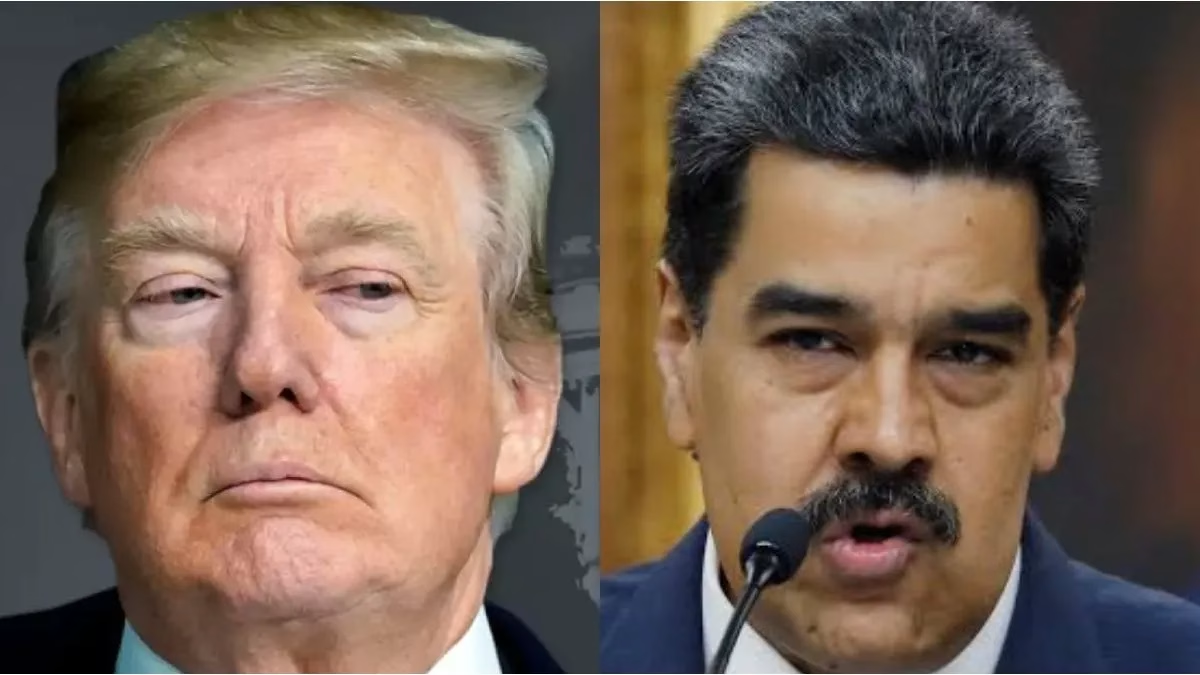
That long and fraught history is why the latest developments involving Venezuela have set off alarm bells well beyond Washington. When U.S. officials announced that President Nicolás Maduro could face prosecution in American courts—on charges ranging from narco-terrorism conspiracy to weapons offenses—the reaction was immediate and divided. Attorney general Pam Bondi vowed that Maduro would face the “full wrath” of the U.S. justice system, while Secretary of State Marco Rubio confirmed that he would stand trial in the United States following a dramatic operation that Venezuelan authorities and international observers described as a direct violation of the country’s sovereignty.
Trump has repeatedly accused Maduro of working hand-in-glove with drug cartels to funnel narcotics into the United States. Those claims have landed in a climate already thick with suspicion. Part of that skepticism stems from Trump’s broader immigration crackdown and his long-standing hostility toward Venezuela’s socialist government. Part of it comes from the administration’s actions themselves. U.S. strikes on boats in international waters—described by the Pentagon as drug-interdiction operations—have drawn sharp criticism across the political spectrum. The Defense Department has released videos of these attacks, but it has not provided public evidence showing that the targeted vessels were carrying drugs bound for the United States.
As a result, journalists, Democrats, and even segments of Trump’s own MAGA base have treated the allegations against Maduro warily. To many, they look less like a focused law-enforcement effort and more like a convenient diversion from domestic turmoil—or worse, a familiar prelude to another regime-change campaign. The parallels to Iraq are hard to ignore for critics who remember how intelligence claims once paved the way for war. Public opinion reflects that unease. A Quinnipiac poll conducted in December found that nearly two-thirds of Americans opposed military action against Maduro.
At the same time, the superseding indictment unveiled this weekend goes well beyond the original 2020 charges. It lays out detailed allegations about the scale of drug shipments, the routes used to transport them, connections to broader cartel networks, and the alleged use of Venezuela’s diplomatic channels to move drugs and launder money. Prosecutors argue that Maduro exploited his position as foreign minister to shield these operations, using state power as cover for criminal activity.
One detail stands out in particular: a key figure named in the original indictment has already pleaded guilty. Hugo Armando Carvajal Barrios, a former head of Venezuelan military intelligence and a onetime confidant of Hugo Chávez, admitted to charges closely resembling those now facing Maduro and is awaiting sentencing. Carvajal’s résumé is formidable. He was a retired general, a diplomat, and a central player in Venezuela’s security apparatus. He and Chávez were jailed together after a failed coup attempt in 1992, forging a bond that later placed Carvajal at the heart of the Chávez government after its electoral victory in 1998.
According to the Justice Department, Carvajal and other members of what prosecutors call the Cartel de los Soles corrupted major Venezuelan institutions—from the military and intelligence services to the legislature and courts—to facilitate the shipment of tons of cocaine into the United States. In announcing his guilty plea, federal officials described a sprawling criminal enterprise that blurred the line between state authority and organized crime.
The timing, however, is hard to ignore. Carvajal’s plea deal became public on June 25, 2025. Roughly two months later, Trump dramatically ramped up his rhetoric and military signaling toward Venezuela. For critics, that sequence deepens the unease. It suggests that legal developments may be getting woven into a broader political playbook—one where legitimate prosecutions risk being repurposed for leverage on the world stage. The pattern feels uncomfortably familiar to those who remember Trump pressing Ukraine to publicly announce an investigation into Joe Biden, blurring the line between law enforcement, foreign policy, and personal political advantage.
Governments across the Global South have condemned the episode as a violation of international law. Even among U.S. allies, there are murmurs of unease. The concern is not merely about Maduro—an authoritarian leader whose record includes repression, economic mismanagement, and the silencing of dissent—but about precedent. What does it mean when a powerful country removes a sitting head of state and promises to try him in its own courts? And who gets to decide when that line is crossed?
The charges themselves have raised eyebrows. U.S. prosecutors allege that Maduro is at the center of a sprawling narco-terrorist enterprise, conspiring to flood the United States with cocaine while stockpiling machine guns and destructive devices. On paper, it sounds like the script of a crime thriller. In practice, critics argue, it strains credulity. Venezuela sits on some of the largest proven oil reserves on the planet. Is it plausible, they ask, that the leader of an oil-rich state would hinge his power on drug trafficking—especially while the United States conducts aggressive maritime interdictions that often destroy evidence in high-seas chases?
These questions are not defenses of Maduro so much as challenges to the coherence of the narrative. Over time, Washington’s portrayal of Maduro has shifted dramatically: from illegitimate strongman, to regional menace, to narco-terrorist mastermind. Each label serves a purpose, critics say, especially when domestic political messaging matters as much as foreign policy outcomes. Under Donald Trump, that tendency toward rhetorical escalation was constant. His presidency was marked by a documented avalanche of false or misleading statements—more than 30,000 by some tallies—blurring the line between fact, exaggeration, and outright fiction.
Seen in that light, skepticism isn’t cynicism at all—it’s a matter of responsibility. Serious scrutiny is what courts are meant to provide, especially when the stakes are this high. It would press for answers, even if doing so proved uncomfortable. Where is the evidence, exactly, and under what conditions was it collected? Why has the justification for pursuing Nicolás Maduro changed so dramatically over time? And why does this case arrive now, at a moment shaped by renewed anxiety over energy security, growing weariness with sanctions, the steady release of Epstein-related revelations, and a global landscape where alliances are visibly shifting?
There is also a deeper problem of credibility. Washington says it is acting in defense of the rule of law, but many outside the United States see a record that tells a far more complicated story. From backing coups and propping up friendly strongmen, to deploying federal force against states led by political opponents, to skirting international legal norms when they prove inconvenient, the message has often felt inconsistent. Critics also point to moments like the official pardon of former Honduran president Juan Orlando Hernández—once described by U.S. authorities themselves as a central figure in one of the world’s most violent drug-trafficking networks—as evidence of how selectively justice can be applied.
You cannot claim the moral high ground on sovereignty while appearing to trample it. And you cannot ask courts, or the world, to place their trust in evidence when the story behind that evidence seems to shift with the political weather. In the end, some argue, a genuinely independent judge might conclude that the case fails to meet the most basic standards—dismiss it outright, and order that Nicolás Maduro and his wife be returned safely to Venezuela.
None of this absolves Maduro of responsibility for Venezuela’s suffering. His government has presided over economic collapse, mass emigration, and brutal crackdowns. But justice that looks selective or theatrical risks becoming something else entirely: a performance designed for domestic consumption, not a process rooted in law.
As this case moves forward—if it does—the real trial may not be Maduro’s alone. It may be a test of whether U.S. courts can separate evidence from geopolitics, accountability from vendetta, and justice from a long, unresolved history of intervention. Latin America has seen this movie before. The question now is whether the ending will be any different.