

By Ben Emos | Friday March 06 2026 | 4 min read
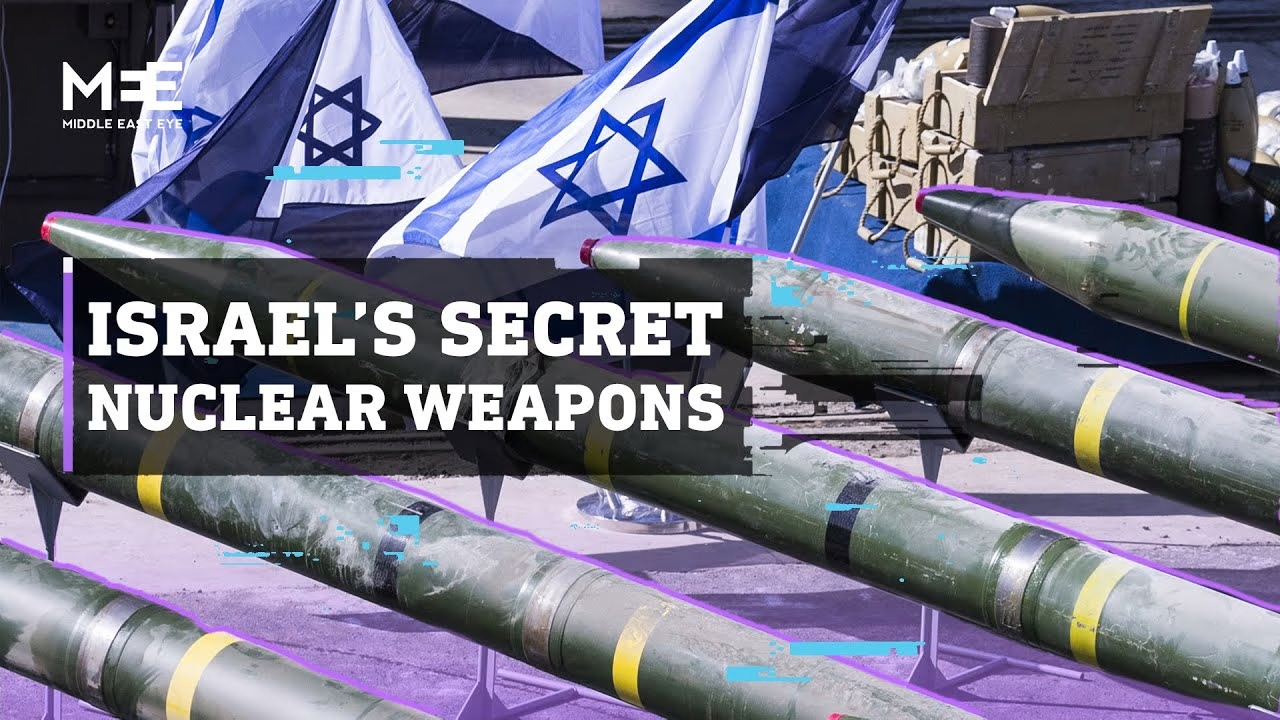
For decades, one of the most consequential facts about the Middle East has existed in a strange state of public awareness. It is widely known, quietly acknowledged by governments, and discussed by scholars and diplomats. Yet in everyday political debate—especially in the United States—it is rarely addressed directly. The open secret is this: Israel is widely believed to possess nuclear weapons, making it the only country in the Middle East with a nuclear arsenal.
And yet, in much of the mainstream media conversation about nuclear threats in the region, that reality is often left unsaid.
Israel has never formally confirmed that it possesses nuclear weapons. Instead, it maintains a policy known as “nuclear ambiguity”—neither admitting nor denying the existence of its arsenal. The policy dates back to the Cold War and was designed to deter adversaries while avoiding the diplomatic consequences of openly declaring nuclear capability.
But ambiguity has its limits. Experts have long estimated that Israel possesses dozens—possibly more than a hundred—nuclear warheads. The program is widely believed to have been developed at the Negev Nuclear Research Center in the Negev desert. Even major global institutions like the International Atomic Energy Agency and numerous defense analysts treat Israel as a de facto nuclear state.
In diplomatic circles, this is hardly controversial. It is simply understood.
Yet when nuclear proliferation in the Middle East becomes a topic of public debate, the focus almost always shifts elsewhere—usually to Iran and its disputed nuclear ambitions. Iran’s program, which it insists is civilian in nature, has dominated headlines, policy discussions, and cable news panels for years.
The imbalance is striking. One country is widely believed to already possess nuclear weapons. The other is under constant scrutiny over whether it might develop them.
To be clear, Israel’s security concerns are real and historically grounded. Since its founding in 1948, the country has faced wars, regional hostility, and existential threats. Many Israeli strategists argue that nuclear ambiguity has been a stabilizing force, deterring potential aggressors without triggering an arms race.
From that perspective, the policy has worked. Israel has avoided nuclear confrontation and maintained a powerful deterrent without formally entering the nuclear club.
But acknowledging Israel’s nuclear capability does not automatically mean condemning it. It simply means discussing reality openly.
That’s where the media silence becomes more complicated.
In the United States especially, coverage of Israel often carries an additional layer of political sensitivity. The country is a close American ally, and discussions that touch on its military capabilities can quickly become entangled in domestic political arguments. Journalists, editors, and commentators sometimes tread carefully, wary of being accused of bias or hostility.
The result is a kind of quiet avoidance. Stories about nuclear proliferation in the Middle East frequently proceed as if the region’s nuclear landscape begins and ends with Iran.
But any honest conversation about nuclear policy in the region has to acknowledge the full picture.
Israel’s nuclear ambiguity may serve strategic purposes for Israeli leaders, but ambiguity in public discourse serves a different function. It narrows the scope of debate. It prevents audiences from understanding the strategic calculations that shape the region’s balance of power.

Mein Kampf & Trump — Available on Amazon
Consider how different the conversation about Middle Eastern nuclear policy might sound if Israel’s arsenal were openly acknowledged in the same breath as concerns about Iranian enrichment. Discussions about deterrence, arms control, and regional stability would inevitably become more complex—and perhaps more honest.
None of this suggests that Israel should disarm unilaterally, nor does it ignore the genuine security threats the country faces. Nuclear weapons exist in a world of difficult trade-offs, and every nation that possesses them has its own strategic logic.
But democratic societies depend on open conversation about the most powerful weapons ever created.
Pretending that Israel’s nuclear capability is too sensitive to mention does not strengthen that conversation. It weakens it.
The Middle East’s nuclear reality is already widely understood by experts and policymakers. The only place where it often remains unspoken is in the broader public discussion.
And in the long run, silence is rarely the best foundation for serious debate.