

By Jane Lewis | Tuesday, January 13, 2026 | 5 min read
Every so often, a news story cuts through the noise—not because it reveals something new, but because it forces you to feel something you hoped you’d never have to. The recent New York Times reporting on a U.S. strike off the coast of Venezuela does exactly that. Not because violence is unfamiliar to us—we have learned to live alongside it—but because this strike wasn’t carried out in a declared war. It was executed quietly, using a disguised aircraft, in a space where the rules are supposed to be clear and the lines are not supposed to blur.
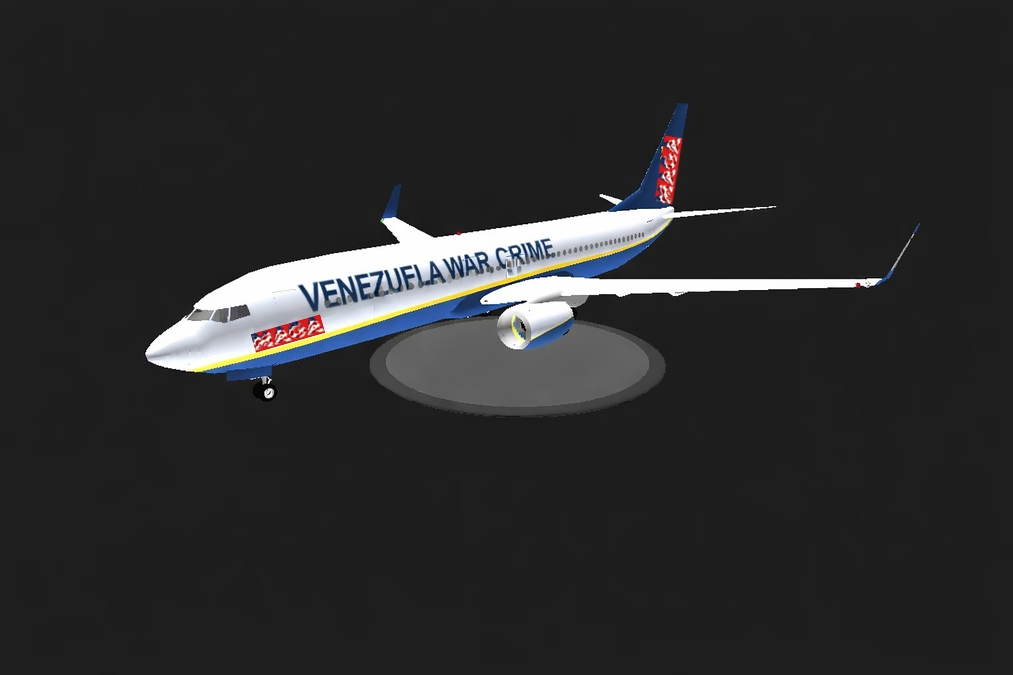
According to officials briefed on the operation, the Pentagon used a secret aircraft painted to resemble a civilian plane to strike a boat it claimed was smuggling drugs, killing 11 people. The aircraft reportedly carried its munitions inside the fuselage, not under the wings, further concealing its military nature. Survivors of the initial strike were later killed in a follow-up attack after waving at the plane.
That detail matters. Waving is what civilians do when they believe they are being seen, not targeted.
Under the laws of armed conflict, pretending to be a civilian in order to attack is prohibited. It’s called perfidy, and it is considered a war crime. The rule is not obscure. It’s one of the first principles taught to military lawyers and commanders alike. The reason is simple: if you blur the line between civilian and combatant, you don’t just endanger the enemy—you endanger everyone.
And yet, even that framing gives too much ground. Because perfidy assumes a war. Here, there was none.
The United States is not at war with Venezuela. There has been no declaration, no authorization for use of military force, no publicly articulated legal basis that transforms a drug interdiction into an armed conflict. Without that predicate, these strikes don’t fall under the law of war at all. They fall under ordinary law. And under ordinary law, killing people without due process is not a violation of the rules of engagement. It is homicide.
This is the part that should trouble us most. Not just that a rule may have been broken, but that the entire legal framework seems to have been treated as optional. When governments operate in that gray zone—insisting we are “not at war,” while acting as if we are—the result is a dangerous vacuum. In that vacuum, accountability disappears.
Former military legal experts who reviewed the incident say the implications are unmistakable: if the mission was authorized, it means a senior official approved it. And if it was approved, then the Defense Department’s own legal advisers were either sidelined, overruled, or pressured into legitimizing an operation they should never have endorsed. What happened, they argue, reflects not a technical lapse but a deeper institutional failure.
Retired Maj. Gen. Steven J. Lepper, a former senior officer in the Judge Advocate General’s Corps, told the New York Times that using an aircraft disguised as a civilian plane to carry out a strike would constitute a war crime under modern laws of armed conflict.
“Concealing your identity is a form of perfidy,” Lepper said. “If an aircraft cannot be recognized as a military platform, it should not be conducting military operations.”
According to the Times, the targeted vessel spotted the plane overhead and turned back toward Venezuelan waters before the attack. After the initial strike, two survivors were seen drifting beside the wreckage for roughly forty minutes. A second strike then killed them as they floated in the water.

Mein Kampf & Trump Now On AMAZON
The damage doesn’t stop with the victims of the strike. It radiates outward. When the U.S. disguises military aircraft as civilian, it weakens the global norm that protects actual civilian planes. When it lectures other countries on the laws of war while quietly redefining them at home, it erodes credibility. When it tells service members they are fighting honorably while quietly bending the rules, it places an unbearable moral burden on the very people it sends into harm’s way.
We ask service members to carry weapons, not moral confusion. We tell them that adherence to law is what separates them from the very forces they may be fighting. What happens when that promise collapses?
There is also the unsettling silence surrounding the evidence. Surveillance video exists, we are told, but remains unreleased. If the actions were lawful, transparency would strengthen that claim. If they were not, secrecy only deepens the stain.
None of this requires defending the Venezuelan government or denying the reality of transnational crime. It requires something far simpler: insisting that power be exercised within law, not around it. Especially when lives are at stake.
A country that prides itself on the rule of law cannot afford “nameless wars” and deniable killings. When war has no name, law becomes optional. And when law becomes optional, so does our claim to moral authority.
That is not a partisan concern. It is a civic one.