

By Andrew James | Saturday February 14, 2026 | 4 min read
A federal grand jury’s decision not to indict six congressional Democrats this week should close one chapter. But it should also open a louder, clearer political one.
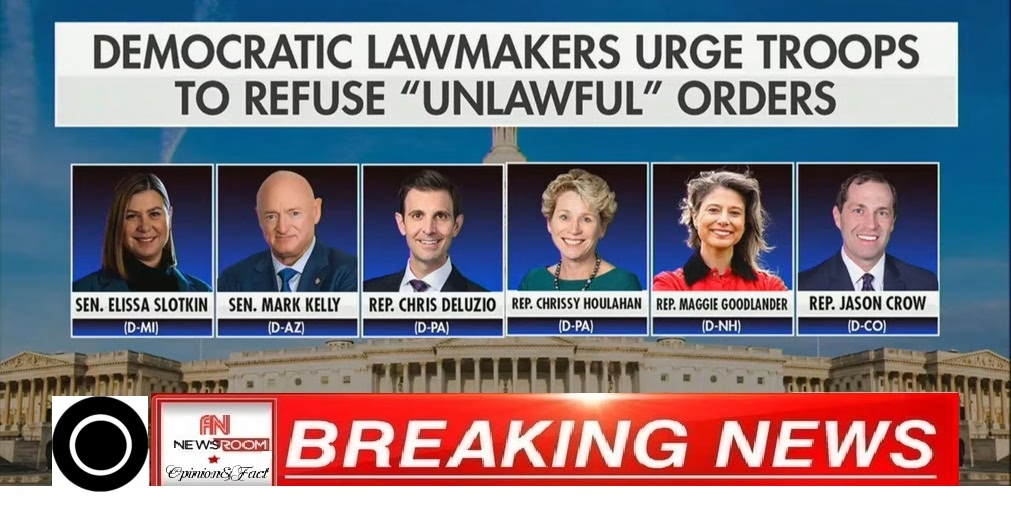
Last fall, these lawmakers recorded a video message aimed at members of the U.S. military. Their point was simple: service members swear an oath to the Constitution, not to any individual president, and they have a duty to refuse unlawful orders. That message—rooted in long‑standing constitutional principles—was enough to draw the ire of President Donald Trump, who labeled their comments “seditious” and demanded their arrest.
According to reporting first published by The New York Times and confirmed by CBS News, federal prosecutors examined whether the lawmakers could be charged under 18 U.S.C. § 2387, a statute that criminalizes attempts to cause insubordination or disloyalty within the military. Conviction would have required proving that the lawmakers intended to undermine morale or discipline. A grand jury declined to indict.
In a healthier political climate, that might have been the end of the story. But these are not ordinary times, and this was never just a legal dispute. It was a warning shot—about speech, dissent, and the ways political power can be marshaled against elected officials who challenge it.
The six Democrats have every reason to feel vindicated. They condemned the investigation from the start and welcomed the grand jury’s decision. And they are right to do so. The ability of lawmakers to speak openly about constitutional limits on executive authority is not a privilege reserved for quiet moments. It is a core function of representative government.
Now comes the harder question: What should they do with that vindication?
Their original message—that no one in uniform is obligated to carry out an illegal order—was narrow but essential. The broader principle behind it is even more urgent. In a democracy, no public official is required to participate in conduct that undermines lawful elections. The oath to the Constitution is not ceremonial. It is a guardrail.
Across the political spectrum, voters are increasingly anxious about how federal power might be used in the run‑up to elections. Immigration enforcement, in particular, sits at a combustible intersection of law, fear, and politics. Even the perception that agencies like ICE could be deployed in ways that intimidate communities before ballots are cast would corrode trust in the outcome.
That is why silence now would be a mistake.
These six lawmakers know what it feels like to be singled out. They know what it means to be accused of criminal wrongdoing for articulating a constitutional argument. That experience gives them credibility. It also gives them a responsibility: to speak clearly about the stakes of protecting the vote.
Defending elections is not a partisan slogan. It is a civic obligation. Warning against interference—whether through unlawful orders, selective enforcement, or the strategic use of fear—is well within the bounds of legitimate political speech. In fact, it is exactly what members of Congress are elected to do: debate, warn, and legislate in defense of democratic norms.

Mein Kampf & Trump — Available on Amazon
Doubling down does not require inflammatory rhetoric. It requires returning to first principles. It means explaining, in plain language, why the rule of law depends as much on restraint as on authority. It means reminding Americans that the legitimacy of any election rests not only on the ballots cast but on the public’s confidence that no one is tilting the scales.
The grand jury did its job. It refused to turn a political disagreement into a criminal prosecution. That decision should not be treated as a cue to move on quietly. It should be understood as a reaffirmation that constitutional debate belongs in the public square, not in a courtroom.
If warnings are needed, they are needed before an election, not after. The six Democrats were right about one thing: allegiance runs to the Constitution. Now they should say it again—calmly, clearly, and without apology.