
By Don Terry | Friday, December 12, 2025 | 5 min read
Before diving into the legal intricacies of Trump v. Slaughter, I keep circling back to a simple, unsettling question: Are the six conservative justices on the Supreme Court so entangled—politically, ideologically, or otherwise—with the Trump-era project that they are willing to pry loose the bolts holding together the American system of government?
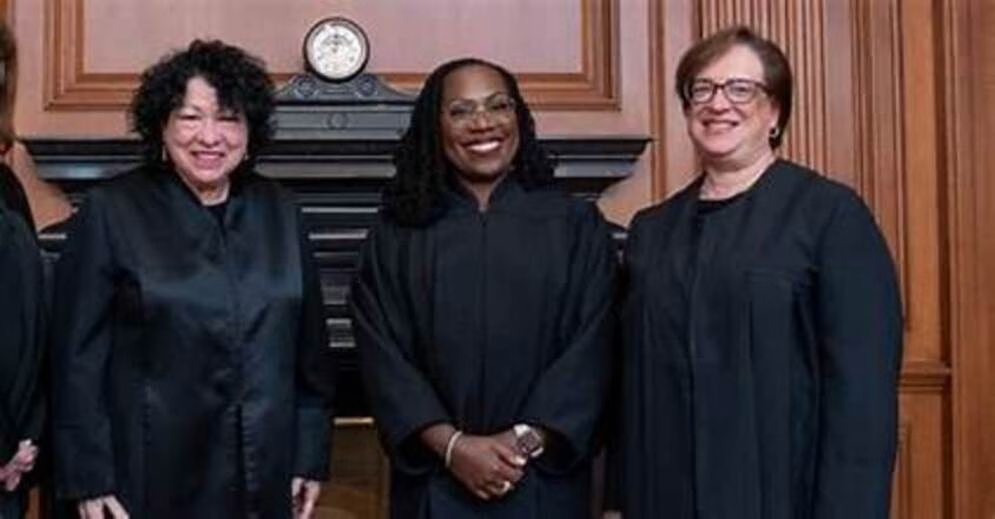
Because that is the implication sitting just beneath the surface of Monday’s arguments. And it’s why Justice Sonia Sotomayor’s warning cut through the courtroom like a cold draft.
The case itself seems procedural on paper: Should the president have the power to fire members of the Federal Trade Commission at will? But in practice, the question reaches far beyond the FTC. It reaches into the balance of powers that has held this country together for nearly a century. It tests whether the Court is prepared to hand any president—this one, and whoever comes next—control over dozens of independent agencies designed to insulate the public interest from raw political pressure.
And on Monday, the alarm bells didn’t just ring. They screamed.
“You’re asking us to destroy the structure of government.”
That was Justice Sotomayor’s blunt assessment to Solicitor General D. John Sauer, who arrived in court with the Trump administration’s argument tucked neatly under his arm: that the president’s power to remove executive officers is “exclusive and illimitable,” and that a 90-year-old precedent restraining that power—Humphrey’s Executor—should simply be thrown out.
Sotomayor didn’t disguise her disbelief.
“You’re asking us to destroy the structure of government,” she said, “and to take away from Congress its ability to create agencies that operate independently.”
She wasn’t talking about minor housekeeping changes. She was talking about a foundational redesign of American governance. Her message was clear: If the Court sides with Trump, it won’t be tinkering with the system—it will be rewriting it.
Independent agencies: not a modern invention, but part of the nation’s DNA
Sauer tried to frame independent agencies as some modern bureaucratic experiment gone awry. Sotomayor immediately corrected him. Independent bodies have existed since the nation’s earliest days. They were built—as Congress intended—to do the work that shouldn’t belong to any single politician or party.
Her warnings grew sharper as she laid out the consequences of the administration’s argument:
“You’re putting at risk the independence of the tax court, the claims court, and the civil service.”
Sauer tried to reassure the Court that the administration wasn’t going after those institutions. Sotomayor didn’t budge. “Not yet,” she said.
Two words, dripping with both realism and dread.
No stopping point—just a straight line to unchecked presidential power
Justice Elena Kagan picked up where Sotomayor left off, pursuing a question that ought to keep every American awake:
If the Court accepts Trump’s argument, what limits remain?
Kagan suggested the answer may be none. Because once the president can fire commissioners at independent agencies, those agencies effectively become extensions of the Oval Office. And some of those agencies don’t just enforce rules—they make them.
Under Trump’s theory, Kagan said, the president would not just execute laws but “make law through legislative and adjudicative frameworks.”
In other words: goodbye checks and balances.
Even Kavanaugh saw the danger
Perhaps the most remarkable moment came from Justice Brett Kavanaugh. He, too, signaled discomfort, noting that the administration’s argument could undermine the independence of the Federal Reserve—a pillar of global financial stability.
He asked the solicitor general to draw a meaningful distinction between the FTC and the Fed. The answer was as thin as tracing paper.
What’s really at stake
Strip away the legal jargon, and the picture becomes stark:
This isn’t just about the FTC.
This isn’t about one precedent.
And it isn’t even about Donald Trump alone.
It’s about whether the Supreme Court is willing—or eager—to rearrange the American government around a single, powerful executive. The founders feared this exact concentration of power. Congress designed around it. Courts have spent generations reinforcing guardrails to prevent it.
Yet here we are, staring down the possibility that the Supreme Court’s conservative majority may give the presidency a lever that can pry apart the very structure they are sworn to uphold.
If that happens, it will not be a legal adjustment.
It will be a redrawing of the American system itself.
And the question that now hangs over the country—loud, uncomfortable, unavoidable—is this:
The question hanging over this moment is bigger than any single case: Will the Supreme Court safeguard the constitutional balance that has steadied this country for generations, or will it clear a path for a president determined to bend the system to his own purposes? And if the Court fails to hold that line, will voters respond the only way they can—by turning out in overwhelming numbers to demand change, not just in Congress but in the structure of the Court itself?
More From FeDlan News:
The Supreme Court’s Silence on Trump’s Third-Term Fantasies Is Louder Than Words
Trump and Pete Hegseth Were Eager to Release the First Strike—So What’s in the Second Video?
Trump says it’s ‘time to pursue’ Obama as his DOJ weighs charges tied to Russia ‘hoax’
A Presidency in Decline: Grave Questions About Trump’s Age, Health and Fitness
Pete Hegseth’s “Kill Them All” Order Sparks Accusations of Advocating War Crimes
 Donate
Copyright 2024 FN, NewsRoom.