


By Don Terry | Thursday February 19, 2026 | 5 min read
The latest release of documents tied to the Jeffrey Epstein investigation has once again pulled Donald Trump into an uncomfortable spotlight. While the files themselves center primarily on Epstein’s network and years of alleged abuse, they have also revived broader conversations about Trump’s own history of inflammatory rhetoric and the sexual misconduct allegations that have followed him for decades.
For critics, the renewed scrutiny feels like history circling back.
Trump first ignited controversy on the national stage long before he entered politics. In 1989, he took out full-page newspaper ads calling for the reinstatement of the death penalty after five Black and Latino teenagers — later known as the Central Park Five — were accused of raping a woman in New York. The teens were ultimately exonerated years later. Decades after that, during his 2015 presidential campaign announcement, Trump described some Mexican immigrants as “rapists,” comments that sparked immediate backlash and helped define his hardline immigration persona.
Now, with the release of additional Epstein-related records, critics argue that Trump’s words about migrants and crime sit uneasily alongside allegations made against him personally.
Among the documents disclosed in the recent file dump are references to an allegation that Trump sexually abused a teenage girl in the 1980s. The claim, which appears in internal summaries of tips received by the FBI, has not resulted in charges and is not supported by corroborating evidence within the released materials. Trump has denied wrongdoing in connection with Epstein and has repeatedly said he had no involvement in Epstein’s criminal conduct.
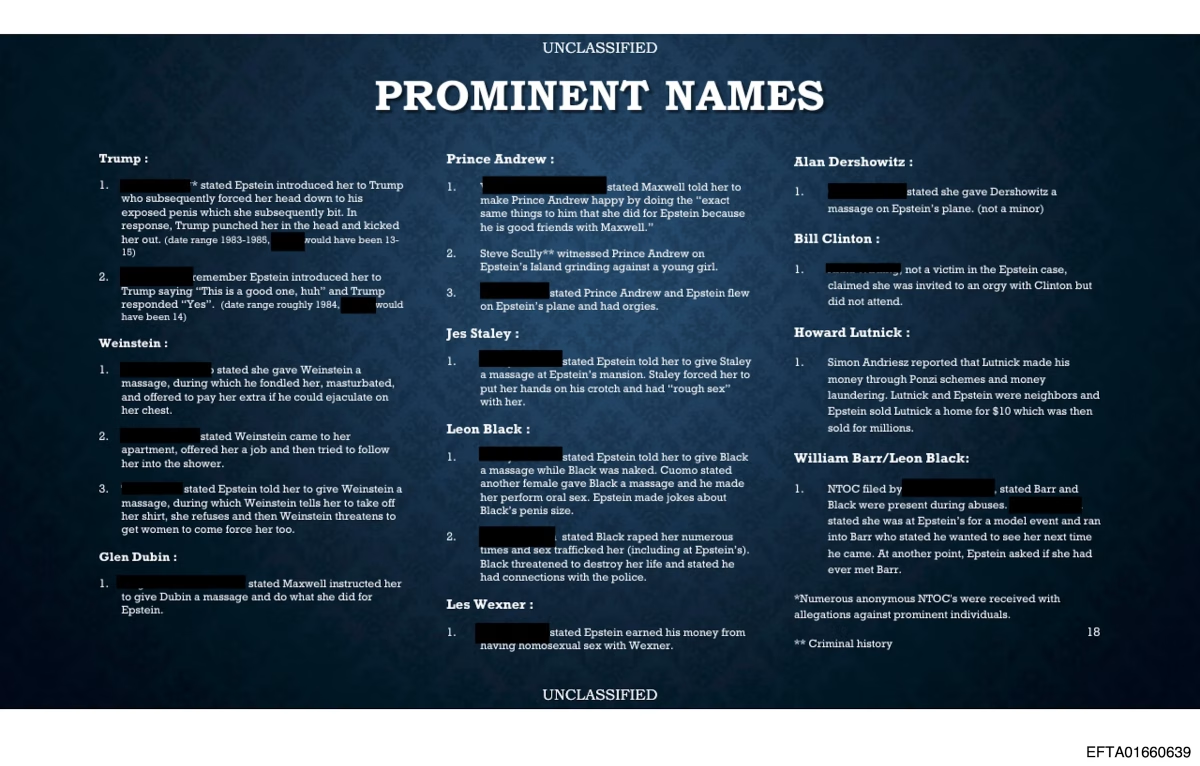
Still, the allegation’s presence in federal investigative files has fueled sharp reactions online and among political opponents. Some argue that Trump’s pattern of rhetoric — particularly his use of charged language about crime and sexual violence — reflects projection rather than principle. Others caution that allegations, even serious ones, are not the same as legal findings.
Trump’s legal history further complicates the picture. In 2023, a New York civil jury found him liable for sexually abusing and defaming writer E. Jean Carroll in connection with an incident she said occurred in the 1990s. The jury did not find him liable for rape under New York’s specific legal definition, but it did conclude that he had sexually abused her and later defamed her when he publicly denied her account. Trump has continued to deny her allegations and has appealed the rulings.
That distinction — between criminal conviction and civil liability — is central to understanding the broader debate. A criminal conviction requires proof “beyond a reasonable doubt,” the highest legal standard. Civil cases, by contrast, operate under a lower threshold of proof, typically “preponderance of the evidence.” While Trump has faced civil liability, he has not been criminally convicted of rape.
Over the years, at least two dozen women have publicly accused Trump of various forms of sexual misconduct, including unwanted touching, assault, and, in some instances, rape. These accusations span decades. Trump has denied all allegations of sexual misconduct, often describing them as politically motivated or false.
Supporters argue that without criminal convictions, the accusations remain unproven claims. Critics counter that the sheer number of allegations and the civil jury findings should carry weight in public evaluation of his character. The renewed attention from the Epstein file release has amplified that divide.
The broader political context adds another layer. Immigration has been a defining theme of Trump’s campaigns, with crime frequently emphasized in his speeches. His comments describing migrants as “rapists” became a flashpoint early in his political rise. Opponents now argue that such language appears hypocritical when viewed alongside the allegations documented in public records and civil proceedings.

Mein Kampf & Trump — Available on Amazon
For many Americans, the issue is not just about legal thresholds but about moral consistency. They see a political leader who has used harsh rhetoric about criminality while facing serious accusations himself. Others view the ongoing focus on allegations as an attempt to relitigate matters that have already been adjudicated in civil court or dismissed without charges.
The release of Epstein-related materials has not introduced new criminal findings against Trump. What it has done is reopen old wounds — and reignite a debate that has followed him throughout his public life. As with much of Trump’s political story, reactions fall along familiar lines: fierce condemnation on one side, steadfast defense on the other.
In the end, Trump might act immune to the allegations he hurls at others, but when it comes to his own behavior, the facts are inescapable. No loyal aide, not even FBI director Kash Patel or Attorney General, Pam Bondi can cover it up.