
By Ben Emos & Tony Bruce | Thursday, January 02, 2026 | 7 min read
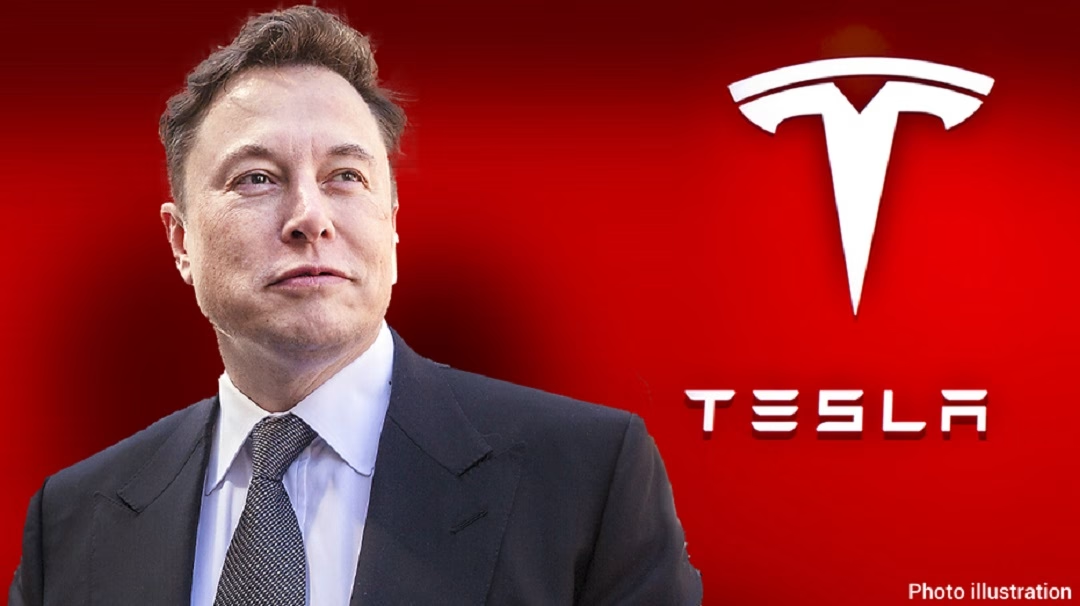
California has given Tesla a blunt ultimatum: change the name “Autopilot” or risk being shut out of the state’s car market. The company has 90 days to comply, or it could face a 30-day suspension of its sales license in what remains Tesla’s single most important U.S. market. For longtime observers, the move feels less like a surprise and more like a reckoning that’s been a long time coming.
Tesla’s branding has always walked a fine line between ambition and exaggeration. Calling a driver-assistance system “Autopilot,” and later selling an upgrade labeled “Full Self-Driving,” created a powerful impression that Tesla vehicles were far more autonomous than they actually are. In reality, drivers are still required to remain alert, keep their hands ready, and take over at any moment. The technology can help with steering, speed, and lane changes—but it does not drive itself.
California regulators are now forcing that distinction into the open. According to the Department of Motor Vehicles, Tesla’s naming conventions mislead consumers by implying a level of autonomy that the vehicles simply do not have. If Tesla fails to correct that messaging within the next three months, the California DMV could suspend its ability to sell cars in the state for 30 days. The action targets Tesla’s sales license, not its manufacturing operations, meaning factories would continue running—but the commercial impact could still be severe.
This standoff didn’t emerge overnight. California first accused Tesla of false advertising back in 2022, arguing that the company’s feature names overstated what the technology could safely do. Tesla’s response at the time was not to scale back the claims, but to double down—rebranding its premium driver-assistance package as “Full Self-Driving,” even as it continued to require constant human supervision. That decision only deepened concerns among regulators and safety advocates.
Critics argue that this confrontation with regulators didn’t come out of nowhere—and that Tesla’s shareholders, in particular, should not be surprised. Just last year, investors signed off on an extraordinary compensation package for Elon Musk, valued at roughly a trillion dollars in stock gains. In doing so, they weren’t just rewarding performance; they were endorsing Musk’s style of leadership, with all its bravado, risk-taking, and disregard for conventional guardrails.
That style has long extended to how Tesla markets its technology. Musk’s public persona thrives on bold promises and boundary-pushing language, often years ahead of what regulators or engineers are willing to certify as reality. In a December 17, 2024 article titled “Scrapping Tesla Self-Driving Crash Reporting Rules Gives Elon Musk the Licence to Kill,” warnings were already being raised about the dangers of granting Musk too much leeway to make sweeping claims about autonomous driving. The current standoff in California feels less like a sudden shock and more like a delayed reckoning.
To understand why regulators are drawing a line now, it helps to look at how autonomy is actually defined within the industry. Over the past decade, the Society of Automotive Engineers (SAE) developed a framework that breaks vehicle automation into five levels, from Level 0 to Level 5. This scale has become the gold standard, adopted by the U.S. Department of Transportation and widely accepted across the automotive and tech sectors.
At the lower end, Levels 0 and 1 involve little to no meaningful automation—basic features like cruise control or lane warnings. Level 2 is where Tesla currently sits. At this level, a vehicle can assist with certain tasks, such as steering or maintaining speed, but it still depends entirely on a human driver. The person behind the wheel must stay alert at all times, hands ready, eyes on the road.
Level 3 represents a step up, allowing limited autonomy in specific situations, like highway driving, where the car can operate without constant monitoring for short periods. Level 4 is what most people think of as true self-driving. Vehicles at this level, such as Waymo’s robotaxis, can operate without a driver under defined conditions and environments. Level 5—complete autonomy anywhere, anytime—remains theoretical. No company has achieved it, and many experts aren’t convinced it’s even possible.
Tesla’s trouble stems from how it has blurred these distinctions. The phrase “Full Self-Driving” sounds definitive, even liberating. To the average consumer, it suggests a car that can handle the journey on its own. Yet in technical filings submitted to California’s DMV and other regulators, Tesla is far more careful. Those documents explicitly state that the system cannot drive itself and requires continuous human attention.
That contradiction is hard to ignore. Even Tesla’s much-publicized robotaxi pilot in Austin, Texas appears to rely heavily on human backup. Reports indicate that remote monitors can intervene when needed and that a safety driver remains seated up front. That reality falls short of Level 4 autonomy and raises uncomfortable questions about how close Tesla truly is to delivering what its branding implies.
For most people, “full self-driving” conjures a simple image: getting into a car, relaxing, and letting technology do the rest. The gap between that expectation and what Tesla’s systems actually provide is where regulators see danger. There is a profound difference between pushing over-the-air software updates and claiming a vehicle can independently perceive, decide, and act in the real world.
Conflating those ideas has consequences. When drivers overestimate what a system can do, they may trust it too much, too soon—and history has shown that such misplaced confidence can end badly. California’s intervention is less about punishing innovation and more about protecting consumers. At its core, it’s an attempt to ensure that when people get behind the wheel, they understand exactly who—or what—is really in control.
What heightens the stakes is just how central California is to Tesla’s identity and bottom line. It isn’t merely one of the company’s largest markets; it’s a bellwether. When California regulators move, others tend to follow, both across the United States and abroad. A forced pullback in the state would send a powerful signal, potentially encouraging regulators elsewhere to scrutinize more closely how “autonomous” technology is described, marketed, and ultimately delivered to the public.
That kind of scrutiny is unlikely to stop at cars. Once regulators start questioning how Tesla describes autonomy, the ripple effects could reach much further—into the company’s bigger, more speculative bets. Chief among them is Optimus, Elon Musk’s heavily promoted vision of humanoid robots he has described as a potential trillion-dollar business.
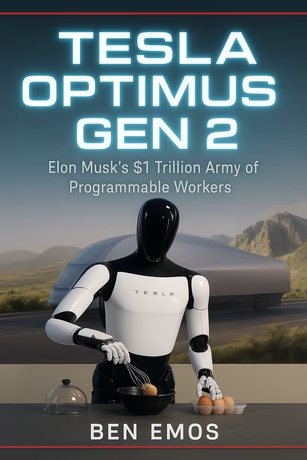
Musk himself has invited the comparison. He often talks about Optimus in the same breath as Tesla’s vehicles, saying “these robots are just like Tesla cars,” essentially portraying them as machines on legs rather than wheels. That framing makes sense from a hype perspective, but it also opens the door to tougher oversight. If regulators determine that Tesla has overstated what its cars can do, they may feel obligated to probe whether similar exaggerations are being made about robots that could one day work alongside humans, replace jobs, or operate in public spaces.
Promises about autonomy don’t exist in a vacuum. They shape expectations, investment decisions, and public trust. When those promises start to outpace reality, especially across multiple product lines, regulators tend to step in. And with technologies as consequential as self-driving cars and humanoid robots, the questions won’t just be about marketing—they’ll be about safety, accountability, and the real-world consequences of selling the future before it’s fully built.
For now, Tesla has a choice. It can adjust its language to better reflect reality, or it can dig in and risk losing access to one of its most critical markets, even temporarily. Either path carries consequences. What’s clear is that the era of selling futuristic promises without regulatory pushback may be ending.
As California draws a line, the rest of the world is watching. Not just investors and regulators, but everyday drivers who want innovation without illusion—and safety without spin.
More From FeDlan News:
Trump’s Concealed MRI Raises Medical and Ethical Questions, Says Doctor
Elon Musk Pushes $1 Trillion Tesla Pay Plan to Preempt Shareholder Lawsuit Over $29 Billion Award
Democrats and Independents’ New Argument to Judges on Crime: “Trump Won’t Pardon Us”
Trump’s Golden Ballroom: White House Demolition Sparks a Constitutional Crisis
Tense Oval Office Meeting: Zelenskyy Confronts Trump After Shouting Match
 Donate
Copyright 2024 FN, NewsRoom.