

By Don Terry & Ben Emos | Saturday, December 27, 2025 | 8 min read
Christmas morning is supposed to arrive quietly. In Nigeria this year, it arrived with explosions.
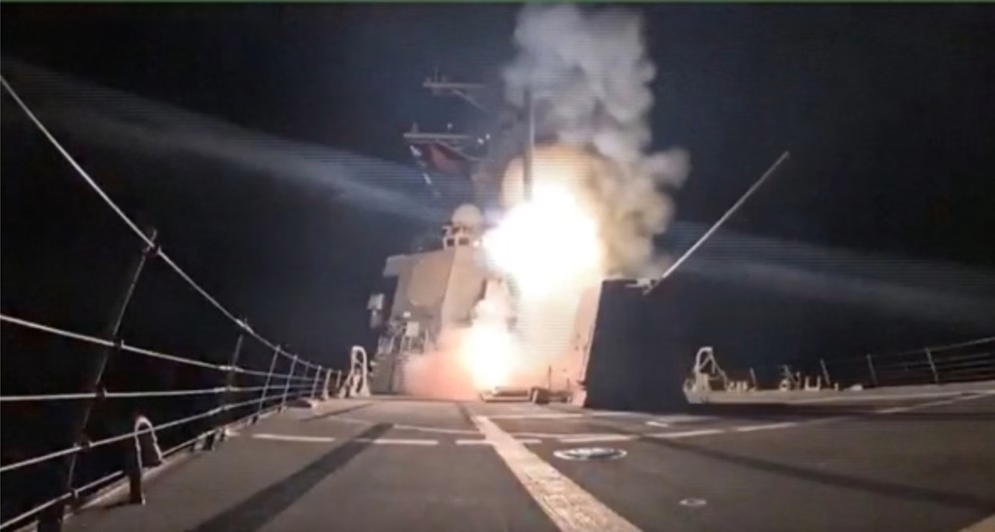
As families gathered to pray, cook, and mark one of the most important days on the Christian calendar, U.S. military strikes landed under the banner of fighting terrorism—framed for American audiences as a defense of persecuted Christians against Islamist violence. The imagery was not subtle. Social media posts announcing the strikes leaned into Christmas symbolism, pairing “Merry Christmas” messaging with airstrikes in a country thousands of miles away. It was jarring, even grotesque.
The justification was familiar: extremists killing Christians, America stepping in as moral enforcer. But Nigeria’s reality is far more complex than that narrative allows. Northern Nigeria is religiously mixed, with large Muslim populations who have also been victims of violence. The country’s insecurity is rooted in decades of poverty, corruption, ethnic tension, and state failure—not a simple religious war. Reducing that complexity to a civilizational clash is not only dishonest; it’s dangerous.
This kind of framing brings back an uneasy sense of déjà vu. For many Americans, it recalls the phantom “weapons of mass destruction” that paved the way for the Iraq War, or the later moment when Donald Trump famously altered a hurricane map with a Sharpie rather than admit he was wrong. The pattern is familiar: when facts become inconvenient, the story gets reshaped.
This time, the improvisation shows up in the language itself. A sprawling, deeply rooted insurgency like Boko Haram is flattened into the far more familiar and emotionally loaded label of “ISIS.” It’s a shortcut designed for American ears, a name that immediately signals danger without requiring explanation. By using it, a distant and complex conflict suddenly feels recognizable—filtered through fears the public already understands.
But that sense of familiarity comes with a real price. This is less about thoughtful foreign policy and more about presentation—about packaging a conflict in a way that’s easy to sell back home. Accuracy on the ground takes a back seat to clarity for a domestic audience. Once labels replace understanding, the complexity disappears, and so does any serious chance of responding effectively. What’s left is a stripped-down narrative that may resonate politically in the United States, but risks badly misrepresenting realities in places where the consequences are painfully real.
The human toll in Nigeria underscores just how dangerous that kind of simplification can be. According to a report by SBM Intelligence, at least 5,873 Nigerians were killed by Boko Haram over a 30-month period. The report, released on June 30, 2023, documented those deaths across 430 separate incidents between December 2020 and May 2023. Borno State bore the heaviest burden, followed by Yobe, Niger, Katsina, and Adamawa. These are not abstract numbers or distant headlines—they represent families torn apart, communities destabilized, and a conflict that has already exacted an enormous price.
Placing those figures alongside violence closer to America brings the issue into sharper focus. In 2023, nearly 47,000 people in the United States died from gun-related injuries, according to the most recent data from the Centers for Disease Control and Prevention. Even though the number declined for the second year in a row, it still stands as one of the highest totals ever recorded. The intention isn’t to collapse very different realities into one, but to draw out a shared lesson: violence, whether overseas or within America’s own borders, can’t be solved with slogans, shortcuts, or neatly packaged narratives.
That lesson becomes even harder to ignore when looking at the nature of extremism attacks in America. During the same period, white supremacists were responsible for more than 80 percent of extremism-related murders in the United States. It’s a stark reminder that the most persistent threats are often not the ones made easiest to recognize or sell politically, but the ones rooted in deeper, more uncomfortable truths.
When policymakers reduce complex conflicts to familiar labels, they may gain short-term political clarity, but they lose long-term credibility and effectiveness. Real people live with the consequences of those choices—long after the headlines fade and the talking points move on.
Nigeria is not a blank slate where slogans neatly translate into results. Any serious military operation there would require deep coordination with Nigerian intelligence services, regional authorities, and local communities—relationships shaped by years of mistrust, internal politics, and hard-earned knowledge of the terrain. That kind of cooperation is slow, fragile, and often frustrating. Skipping or rushing that process doesn’t simplify the mission; it makes it far more likely to go wrong.
There’s also the risk of misreading the political and religious landscape entirely. Nigeria is densely populated, sharply divided along ethnic and religious lines, and governed by a Muslim president. That reality doesn’t make cooperation impossible, but it does mean that crude assumptions—especially ones filtered through American culture-war lenses—can quickly lead to bad intelligence and worse outcomes. When policymakers treat the region as a stage for symbolic gestures rather than a living, complicated society, targets blur and objectives drift.
Early reports suggest that the recent strikes didn’t even hit Boko Haram targets at all—regardless of what name was used to justify them. If true, that alone underscores the danger of oversimplification. Fortunately, it appears no lives were lost. But the absence of casualties shouldn’t be mistaken for success. Missed targets still send messages, inflame tensions, and risk creating exactly the instability such operations claim to prevent.
What’s most troubling is how familiar this pattern feels. Instead of grappling honestly with complexity, the story is streamlined, repackaged, and sold back to the public as decisive action. The map is redrawn. The label is swapped. And the audience is asked to nod along. But reality, whether in the path of a hurricane or the villages of northern Nigeria, has a way of resisting that kind of narrative control.
Measured against Trump’s own slogan—America First—the strike makes little sense. Nigeria poses no direct threat to the United States. There was no imminent danger to American lives, no clear national interest articulated. What there is, however, is a powerful bloc of right-wing evangelical activists in the U.S. who are deeply invested in the fate of Christians in Africa. Their influence on Republican foreign policy has grown steadily, and this strike appears tailored more to that domestic audience than to any coherent strategy abroad.
Stack Nigeria alongside Iran, the Caribbean, and the Pacific, and a pattern emerges. This is not a president winding down foreign entanglements. It is a president expanding them—into places that were never central theaters of U.S. military action. The promise to end “forever wars” has quietly morphed into a willingness to start new ones, often without public debate or congressional authorization.
The incoherence is striking. Trump continues to sell himself as a peacemaker, even floating fantasies of a Nobel Peace Prize, while simultaneously authorizing strikes in countries Americans could barely locate on a map. The whiplash is not accidental; it is the product of a foreign policy untethered from principle. Decisions appear driven by impulse, factional pressure, and personal politics rather than any articulated vision of the national interest.
It is also telling that the United States currently has no ambassador in Nigeria, following a broader withdrawal of diplomats from dozens of countries, including many in Africa. Bombs are easier to deploy than diplomacy, but they are far less effective at producing stability. Dropping ordnance into a fractured society while hollowing out diplomatic engagement is a recipe for long-term disaster.
For Nigeria, the consequences are profound. Allowing an external power to conduct military operations on its soil underscores the failures of its own government—failures rooted in corruption, mismanagement, and neglect of civilian protection. Worse, it risks inflaming religious and ethnic divisions in a country already stretched to the breaking point. Introducing the language of holy war into that environment creates an existential crisis that will linger long after the news cycle moves on.

The same fog surrounds other theaters. In Iran, Americans were told the nuclear program was “obliterated,” until assessments suggested otherwise and the messenger was punished. In Venezuela, shifting rationales—drug interdiction, sanctions enforcement, regime change—mask what looks increasingly like preparation for another destabilizing intervention. Across all these cases, one constant remains: we are asked to trust claims that change by the week.
This should be a political vulnerability. Voters are exhausted by endless conflict. They were promised restraint, focus at home, and fewer foreign wars—not new ones launched with slogans and social media posts. Democrats, and anyone serious about constitutional governance, should not hedge on this. There must be real debate, real oversight, and real resistance to the casual normalization of violence abroad.
We have seen this movie before. Grand justifications, simplified villains, moral certainty—and years later, regret. The hope is that this time, Americans recognize the pattern before the cost becomes irreversible. The worry is that, once again, we won’t.
Yahoo a