

By Don Terry & Ben Emos | Wednesday, December 24, 2025 | 4 min read
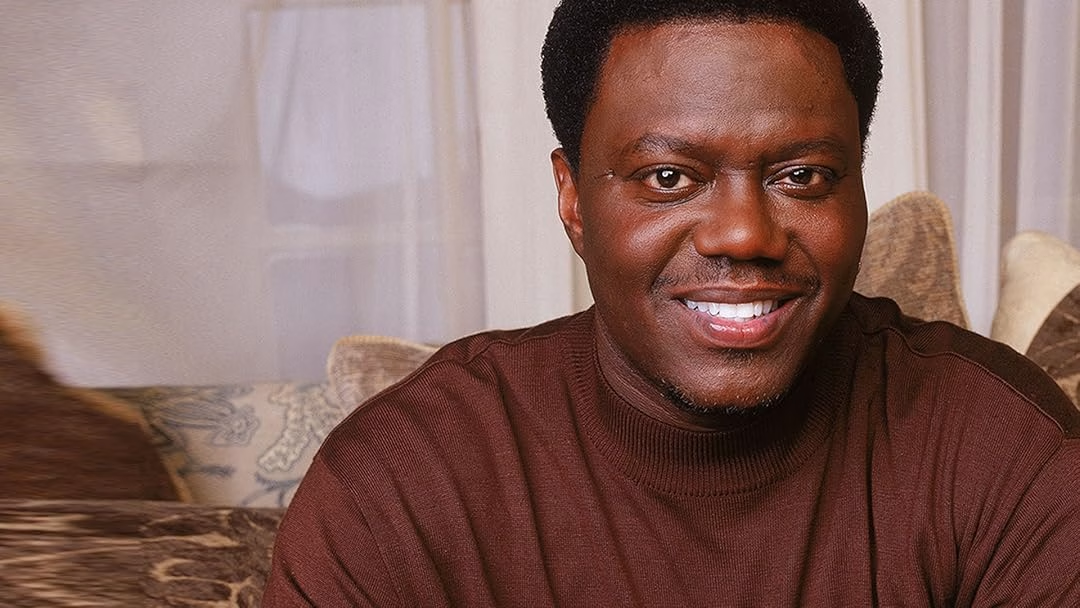
Long before Donald Trump’s political persona hardened into something familiar—predictable, even—one comedian was already calling out the moves. Not the policies. Not the polls. The tactics. Comedian Mac was among the first to publicly clock what many would later come to recognize as Trump’s signature clapback style: deflect, attack, dominate the moment, and move on before the facts can land.
At the time, it didn’t look prophetic. It looked like comedy doing what comedy has always done—poking at ego, exposing insecurity, laughing at the powerful when others are too cautious to speak. But in hindsight, Mac wasn’t just riffing. He was naming a pattern that would eventually shape American political discourse.
Trump’s clapback tactics are simple but effective. When challenged, he doesn’t clarify—he counterpunches. When criticized, he doesn’t defend—he reframes. The goal is never persuasion; it’s disruption. Flood the moment with noise, force opponents to react, and keep the spotlight fixed squarely on himself. Mac saw this early, when Trump was still more brand than movement, more punchline than power broker.
Trump walks out of ‘Meet the Press’ interview after Welker challenges fixed election claims
That’s what made the observation so sharp. Comedy doesn’t rely on insider access or leaked documents; it relies on perception. From a distance—using what comics often describe as an “eye of God” view—Mac was able to see the larger pattern in how Trump responded to pressure: turning criticism into spectacle and wielding outrage not as a weakness, but as a tool. The humor landed because it traced behavior that was already in plain sight for anyone willing to look beyond the noise.
What’s striking now is how normalized those tactics have become. The clapback isn’t just Trump’s style anymore; it’s been adopted, copied, and refined across media and politics. Insult replaces argument. Confidence substitutes for evidence. Volume stands in for substance. When Mac called it out, it still felt absurd. Today, it feels like the operating system.
There’s also something important about who did the calling out. Not a pundit. Not a political strategist. A comedian. That matters because comedy often reaches people before analysis does. It bypasses defenses. It sneaks truth in through humor. When Mac mocked the reflexive deflection, the performative outrage, the endless victimhood wrapped in bravado, audiences laughed—but they also learned how to recognize it.
That’s the quiet power of satire: once you see the trick, it stops working quite as well. You start noticing how quickly Trump pivots to personal attacks. How often he declares victory without evidence. How reliably he frames criticism as persecution. Mac didn’t just make fun of the behavior; he gave it a name and a shape. He turned instinct into insight.

Mein Kampf & Trump — Available on Amazon
Of course, calling it out didn’t stop it. If anything, Trump’s rise proved that clapback politics thrives in an attention economy. Outrage travels faster than nuance. Conflict outperforms context. And the more critics react, the more oxygen the tactic receives. But that doesn’t make early warnings less valuable. It makes them more so.
Looking back, Mac’s commentary feels less like a joke and more like a field note from the early days of a cultural shift. He wasn’t predicting elections. He was diagnosing a communication style that would come to dominate headlines, debates, and timelines. And he did it from a stage, not a studio.
There’s a lesson there—not just about Trump, but about how we understand power. Sometimes the clearest warnings don’t come wrapped in seriousness. They come with a punchline. We ignore them at our own risk.
Comedy didn’t create Trump’s clapback tactics. But comedians like Mac helped us see them for what they were—long before the rest of the country caught up.
Yahoo a