

By Jane Lewis | Tuesday, December 23, 2025 | 7 min read
The handling of the Epstein files has reignited an old and unsettling question in American politics: what happens when power no longer fears consequence?
Critics argue that the Trump administration’s piecemeal, heavily redacted release of Epstein-related documents isn’t simply sloppy or bureaucratic—it reflects a system operating with near-total immunity. The concern isn’t just about what has been released, but what remains hidden, and why those decisions appear to carry no risk for the people making them.
That dynamic did not exist during Watergate. Richard Nixon knew that presidential immunity was not written into the Constitution. He understood that criminal prosecution was possible, which is why he ultimately resigned and sought a pardon from his successor, Gerald Ford. Nixon’s aides, lawyers, and senior officials were not spared; many were convicted and sent to prison.
Today’s landscape looks very different. A recent Supreme Court ruling has reshaped the boundaries of presidential accountability, effectively shielding a sitting president from criminal prosecution for official acts. Critics say that ruling has fundamentally altered the calculus inside the Justice Department. If the president cannot be prosecuted, and if pardons can be issued broadly, the incentive to follow the law weakens dramatically.
Legal experts and lawmakers argue that this helps explain the DOJ’s resistance to releasing the full Epstein files. Officials who might otherwise fear legal exposure could reasonably believe they are protected—either by presidential immunity at the top or by the promise of future pardons.
When asked recently about Epstein, Donald Trump brushed off the issue, saying he thought it was “finished.” To some observers, the remark suggested either evasion or indifference. Trump also claimed that “everybody was friendly” with Epstein—a statement that directly conflicts with the historical record.
Many wealthy and powerful figures in New York and Florida avoided Epstein entirely. Some lived near him and wanted nothing to do with him socially, professionally, or philanthropically. Trump, by contrast, publicly praised Epstein in 2002, calling him a “terrific guy” and remarking that Epstein liked women “on the younger side.”
That comment has taken on renewed scrutiny as survivor accounts continue to surface.
Reporting by The New York Times documents multiple parties at Mar-a-Lago in the 1990s where underage girls were present, alcohol flowed freely, and identification was not checked. One former model recalled attending a party at age 14, where she was repeatedly offered champagne by staff. Her mother said she stayed close by, intervening whenever older men approached her daughter.
According to her account, Marla Maples—Trump’s wife at the time—privately warned her to protect her daughter and keep her away from the men at the party, particularly Trump himself. Maples later denied making that specific comment but said she has always believed in protecting young women.
Survivors of Epstein’s trafficking network told the Times that Epstein was a frequent guest at Mar-a-Lago events. One woman said she attended multiple parties beginning at age 17 after being invited as “Donald Trump’s guest.” She described open bars, predatory behavior, and an atmosphere where boundaries were absent.
Another model said she became ill shortly after drinking champagne at one of the events and suspected her drink had been tampered with.
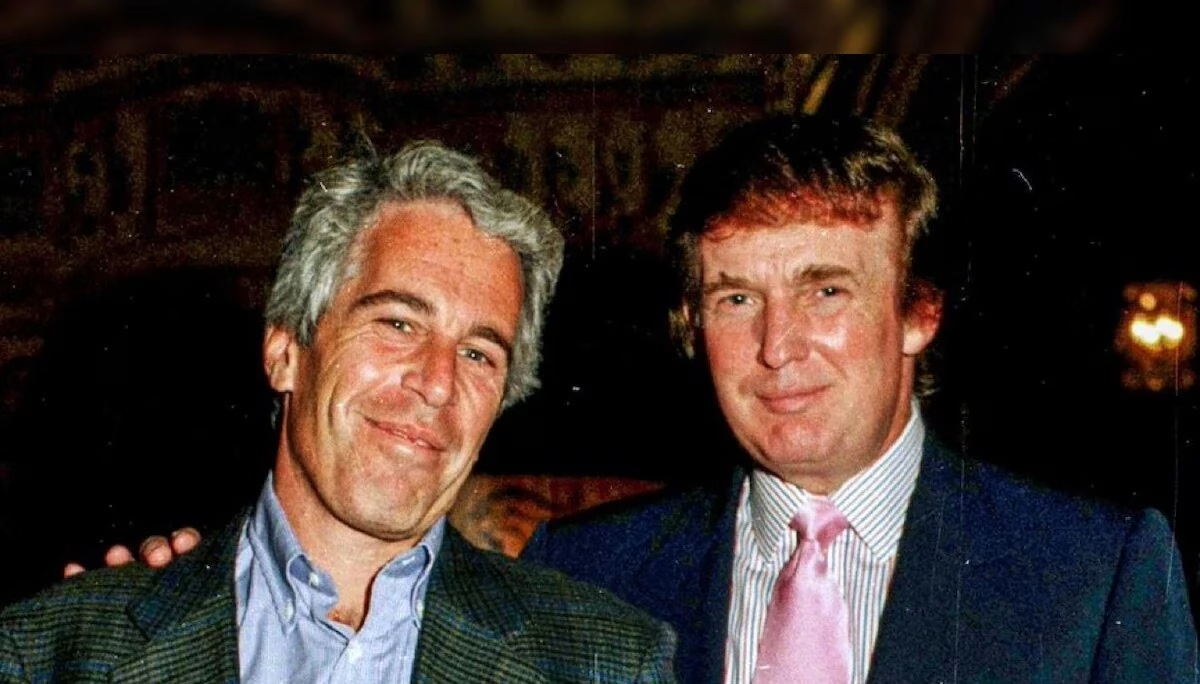
Multiple witnesses said Trump and Epstein attended parties at each other’s homes. In a 2010 deposition, Epstein invoked the Fifth Amendment when asked whether he had socialized with Trump in the presence of underage girls.
At least one woman recalled Epstein introducing himself at a party as “Don’s best friend.”
Trump has never been charged in connection with Epstein’s crimes, and he has denied knowing about Epstein’s abuse. Still, the accumulation of testimony, photographs, and contemporaneous reporting continues to raise uncomfortable questions.
Survivors including Marina La Certa and Jenna Lisa Jones have publicly described being abused by Epstein beginning at age 14. Their testimony, along with others, helped push Congress to pass the Epstein Files Transparency Act, which was intended to force the release of investigative materials related to Epstein, Ghislaine Maxwell, and others.

Yet survivors and lawmakers now say the DOJ’s response has fallen far short of the law’s intent. Hundreds of pages have been fully redacted. Key investigative records—FBI interviews, indictments, internal emails, digital evidence—remain undisclosed.
Attorney Bradley Edwards, who has represented Epstein victims for years, said the releases appear designed to protect powerful figures rather than expose wrongdoing. Congressman Ro Khanna echoed that concern, warning that the obstruction looks deliberate, not accidental.
For survivors, the process has been retraumatizing. Some say their identities were insufficiently protected, while alleged abusers remain shielded. They argue that the government has once again prioritized political insulation over justice.
The fight, they insist, is not over. If accountability does not come now, they warn, it may fall to future administrations to confront what this one chose to bury.
Until then, the Epstein files stand as a test—not just of transparency, but of whether the rule of law still applies equally to those at the top.
Yahoo