
By Tony Bruce | Monday, December 01, 2025 | 5 min read
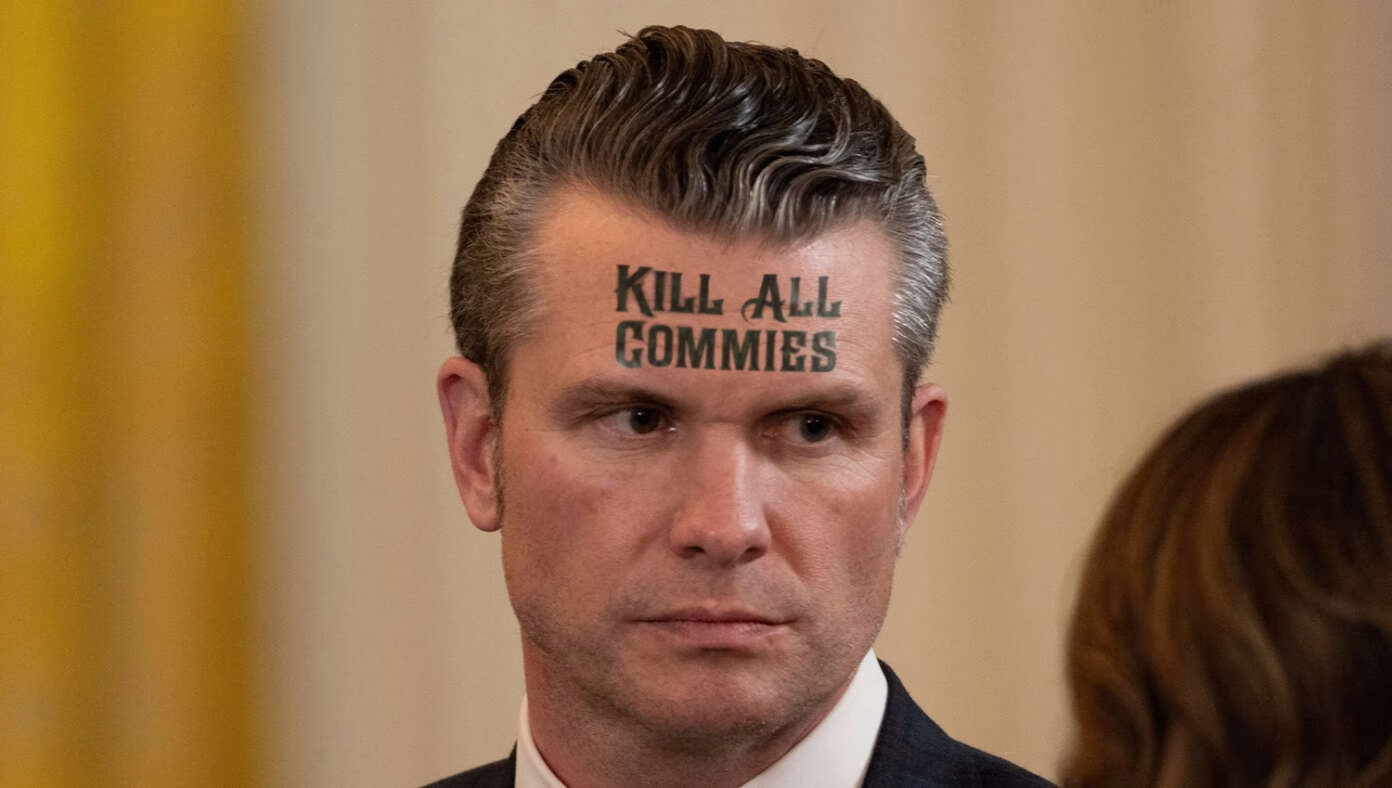
The Washington Post’s recent reporting on deadly boat strikes in international waters should chill anyone who believes in the rule of law or even the most basic principles of human decency. According to people familiar with the operation, Secretary of Defense Pete Hegseth allegedly issued a spoken directive that witnesses interpreted as a blanket kill-them-all order. One source recalled hearing, “The order was to kill everybody.” Even stripped of context, those words land like a gut punch. Spoken by a top defense official, they suggest not a momentary lapse in judgment but a deliberate push toward actions most Americans would recognize as plainly unlawful.
The story only becomes more disturbing as the details unfold. A missile was launched at a boat off the coast of Trinidad, a vessel believed to be carrying drug traffickers. The strike ignited the craft and sent flames ripping from bow to stern. Commanders watched the burning wreck live through a drone feed, able to see every second of the destruction.
When the smoke finally thinned, two men were left alive, clinging to debris, clearly shipwrecked and no longer any kind of threat. Yet instead of treating these men as survivors—people rendered helpless and hors de combat—a second missile was fired. The reporting suggests this was done explicitly to comply with the spoken directive the operators believed they were following.
The two men, already injured and fighting just to keep their heads above water, were killed where they floated. There’s no honest way to describe that scene other than what it appeared to be: an execution carried out in open water. And the part that lingers—the part people are whispering about—is the suspicion that this wasn’t about neutralizing a threat at all. It was about silencing the only surviving witnesses. According to those raising the alarm, the boat may not have been a narco vessel as claimed, but an ordinary fishing boat caught in the crosshairs. If that’s true, then the motive behind the second strike becomes even darker: kill the men, and the truth dies with them.
Dan Mau, a law professor and retired Army lieutenant colonel who spent years teaching constitutional and criminal law at West Point and training new officers in the Army’s JAG Corps, responded with visible anger. Mau wrote that if the reporting is accurate, he is “disgusted, appalled, and angry,” and that there is simply no legal framework in which such a directive could be considered lawful.
He emphasized that the rules governing wartime conduct are neither abstract nor optional. They are carved into the foundations of international law and have been honored—at least in principle—by militaries for centuries. “There is no way to wash clean the taint of illegality that defines an order to ‘kill everyone,’ including the survivors of the first strike clinging to the side of the sinking boat,” he said.
People sometimes imagine the Geneva Conventions as a stack of sterile, bureaucratic documents that only lawyers reference. Mau reminds us how wrong that is. The prohibitions at issue here—the ban on “no quarter” orders, the duty to protect and rescue the shipwrecked, the rule that you do not harm those out of the fight—are among the oldest and most widely respected laws governing warfare. They predate the United States itself. They exist because humanity learned, often through horrific violence, that even in war there must be limits. A society that abandons those limits abandons its own moral identity.

What may be even more alarming than the alleged order is how senior commanders reportedly interpreted and executed it. A three-star admiral—now promoted to a four-star heading Special Operations Command—authorized the second strike. His reasoning, according to the Post’s sources, was that the survivors might be rescued by associates and return to trafficking drugs.
Mau dismissed this as both factually implausible and legally irrelevant. Once the men were in the water, injured, unarmed, and unable to resist, they became protected persons under international law. Not only were they not to be harmed, they were owed rescue. The law is unambiguous on this point.
That the reported decision ran so far afoul of such a basic rule is not a small bureaucratic error; it is a profound breach of the moral and legal standards the United States claims to uphold. If the Washington Post’s reporting holds up under scrutiny, the American public deserves a full accounting of how such an order was given, how it was interpreted, and how it resulted in the deaths of men who, in that moment, were entitled to protection. Democracies do not preserve their values by simply asserting them. They preserve them by refusing to allow expediency, fear, or rage to eclipse what the law—and our shared humanity—demands.
More From FeDlan News:
PRESS RELEASE: Tesla Optimus Gen 2: Elon Musk’s $1 Trillion Army of Programmable Workers
Trump’s Concealed MRI Raises Medical and Ethical Questions, Says Doctor
Elon Musk Pushes $1 Trillion Tesla Pay Plan to Preempt Shareholder Lawsuit Over $29 Billion Award
Democrats and Independents’ New Argument to Judges on Crime: “Trump Won’t Pardon Us”
Trump’s Golden Ballroom: White House Demolition Sparks a Constitutional Crisis
Tense Oval Office Meeting: Zelenskyy Confronts Trump After Shouting Match
 Donate
Copyright 2024 FN, NewsRoom.