
By Ben Emos & Don Terry | Tuesday, December 02, 2025 | 5 min read
In the tech world, there are billionaires who chase attention—and then there are engineers who quietly build the future. Jensen Huang, the co-founder and CEO of Nvidia, belongs firmly in the second category. While the headlines often orbit around louder personalities like Elon Musk, the actual backbone of the modern AI revolution has been shaped not by showmanship but by Huang’s patience, humility, and unshakable belief in engineering over ego. Nvidia has quietly grown into a company worth more than Tesla, and it did so not because its CEO tweets provocations, but because he builds things that work.
Huang’s story doesn’t begin in a polished boardroom. It begins in 1963 in Taiwan, and then in Kentucky, where he arrived as a nine-year-old immigrant who barely spoke English. Due to a clerical error, he and his brother were enrolled in a reform boarding school. It wasn’t the sort of adversity that polishes a résumé—it was the kind that leaves a mark.
He was bullied, isolated, and scrubbed bathrooms daily. His mother, still thousands of miles away, would call long-distance to teach him new English words, trying to give her son a bridge out of the loneliness. It was a far cry from the tech executives groomed from prep schools and elite mentorships. Huang’s toughness was earned one phone call, one hardship at a time.
When his family finally reunited in Oregon, he pushed himself academically and graduated high school at 16. His first job was dishwashing at Denny’s, and he has never tried to rewrite that part of his story or bury it behind the gloss of success. He still jokes about how he treated the kitchen like an optimization problem—never walking anywhere empty-handed, always looking for the most efficient way to do every task. It’s the mindset of an engineer, long before he earned degrees from Oregon State and Stanford.
His early career at AMD and LSI Logic exposed him to cutting-edge chip design, but he couldn’t shake a feeling that something bigger was possible. Graphics processors were then considered little more than gaming accessories. Huang saw a different future, one where they could power vast new kinds of computation. On his 30th birthday, he met two fellow engineers at a Denny’s in San Jose and mapped out a company on a yellow pad. Nvidia was born over cheap coffee, not venture-capital theatrics.
The early years were brutal—a failed first product, a disastrous partnership with Sega, and a point where the company was days away from going under. But Huang didn’t blink. He wasn’t a hype man promising the moon. He was an engineer who believed in what he was building. When the GeForce 256 launched in 1999—the first chip marketed as a GPU—it changed everything.
Then came the real gamble. In 2006, he invested heavily in CUDA, a platform that let GPUs handle scientific and parallel computing workloads. Wall Street didn’t care. Most of Silicon Valley shrugged. But Huang wasn’t trying to impress them. He was building infrastructure for a future almost no one else could see. When researchers used Nvidia GPUs to train the breakthrough AI model AlexNet in 2012, the world finally caught up to Huang’s vision.
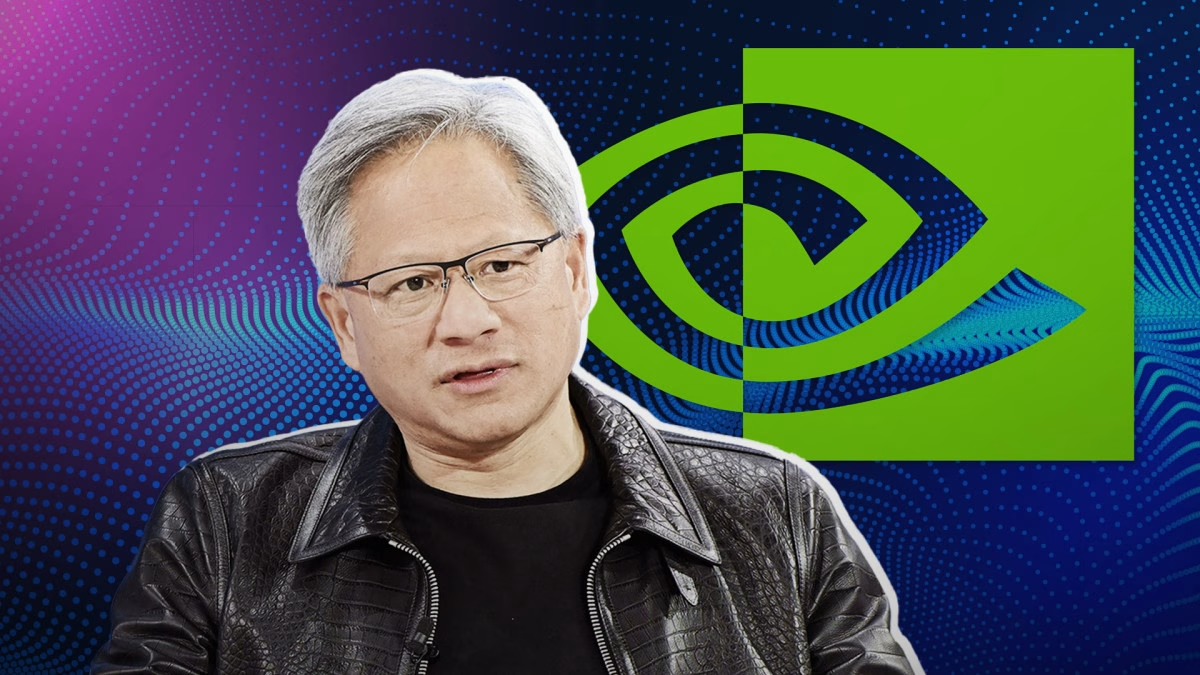
The Man in the Leather Jacket: Jensen Huang’s Relentless Rise
Today, Nvidia is the engine room of the AI boom. Its chips are in supercomputers, research labs, autonomous vehicles, and nearly every major AI project on Earth. Huang’s personal wealth has soared, but he remains almost startlingly grounded. He is still married to his college sweetheart. The famous black leather jacket he wears? His wife and daughter picked it out. He runs Nvidia with an unusual degree of transparency—no one-on-one meetings, more than 60 direct reports, and a belief that hiding information only distorts power. The foundation he runs with his wife quietly distributes billions for education and science—with almost no publicity, no media tours, no theatrics.
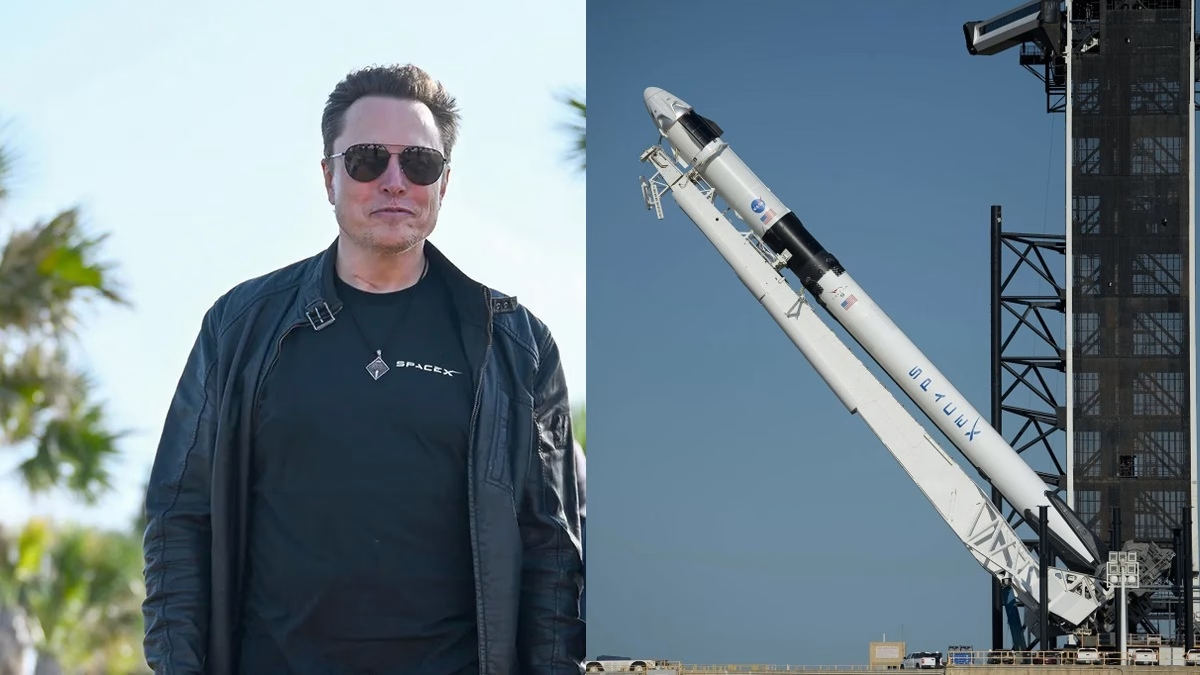
And this is where the comparison to Musk becomes unavoidable. Musk commands attention; Huang commands respect. Musk trades in spectacle; Huang trades in engineering. One seeks headlines, the other quietly shapes the world that future headlines will be written about. It isn’t that Musk hasn’t achieved remarkable things—he has—but Huang represents a different kind of leadership, one rooted in humility, steadiness, and the kind of deep technical expertise that can’t be faked on social media.
Huang’s rise is a quiet reminder that genuine brilliance doesn’t need a megaphone. You don’t have to be the loudest person in the room to shape the future. Sometimes being a great engineer—steady, curious, and stubborn in all the right ways—matters far more than cultivating a flashy persona. His life shows that family, loyalty, and a grounded sense of self aren’t obstacles to innovation. If anything, they’re the bedrock that allows someone to keep pushing through the long, unglamorous stretches of real work.
And in a tech era dominated by outsized personalities and eccentric theatrics, Huang stands apart not by trying to outdo them, but by refusing to play that game altogether. While some leaders name their children in ways that generate headlines or cultivate mystique, Huang seems uninterested in broadcasting his life for effect. He stays focused on the craft itself. The man in the leather jacket built a trillion-dollar company not by manufacturing attention, but by quietly doing the work. In doing so, he didn’t just help steer the direction of modern computing—he changed the world without ever needing to shout about it.
More From FeDlan News:
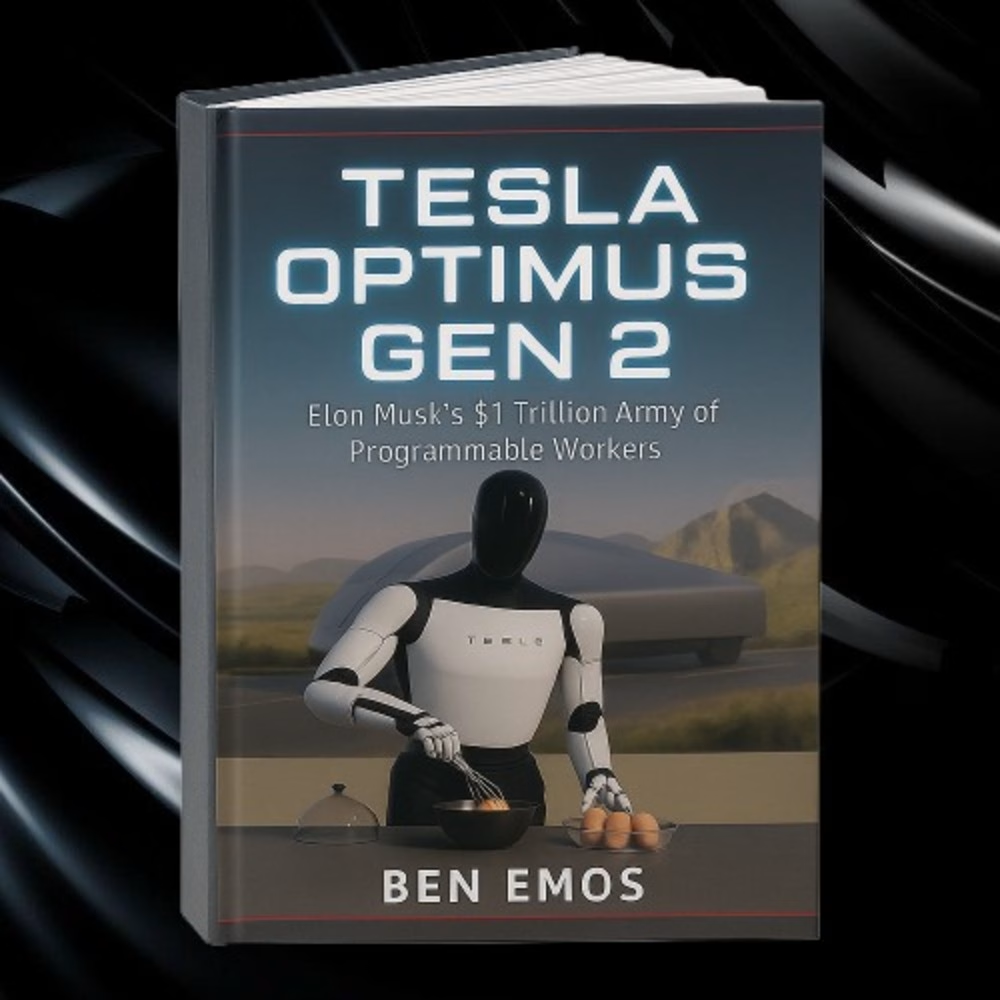
PRESS RELEASE: Tesla Optimus Gen 2: Elon Musk’s $1 Trillion Army of Programmable Workers
Pete Hegseth’s “Kill Them All” Order Sparks Accusations of Advocating War Crimes
A Republican Civil War: Why the GOP Is Quietly Bracing to Abandon Mike Johnson and Trump
Epstein Emails Claim Trump Was “Borderline Insane” and Showing Signs of “Early Dementia”
When Illegal Orders Became Legal Orders: The Trump–Vance Controversy
Trump Makes the “Epstein Files Transparency Act” Less Transparent by Signing It In Secret
 Donate
Copyright 2024 FN, NewsRoom.