

By Jane Lewis | Tuesday, January 06, 2026 | 5 min read
At a moment when many Americans are anxious about the economy—when inflation still bites, unemployment is creeping upward in key sectors, and the national debt has reached staggering levels—the idea that the United States might now be “running” Venezuela feels surreal. And yet, that is precisely what President Donald Trump has claimed. Not nudged. Not influenced. Not pressured. Run.
To anyone listening carefully, that declaration raises a far bigger question than partisan politics or even foreign policy bravado. What does it actually mean for the White House to say it is in charge of another sovereign nation?
That question exploded into public view after a dramatic U.S. operation that resulted in the capture of Venezuelan President Nicolás Maduro and his wife, who were transported to the United States to face criminal charges. Both pleaded not guilty in a New York court. Maduro continues to insist he remains Venezuela’s legitimate president, even as Washington asserts otherwise.
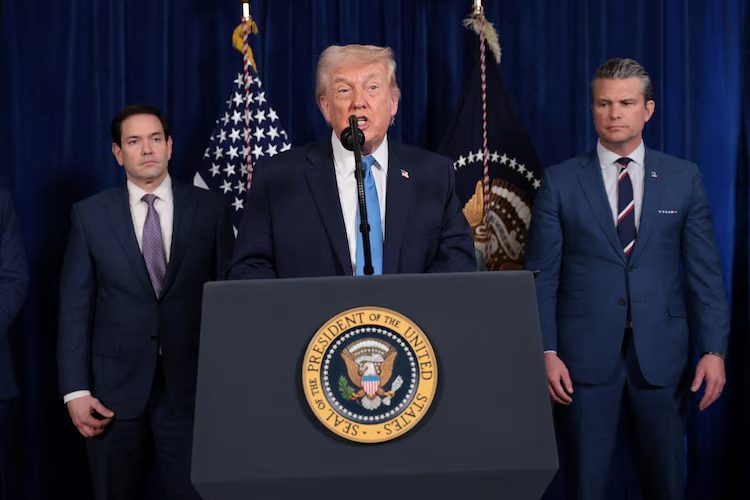
Back in Caracas, interim leader Delcy Rodríguez issued a statement offering to work with the United States. Trump dismissed it outright. “We’re in charge,” he said. No qualifiers. No legal framework. Just a blunt assertion of control.
“Don’t ask me who’s in charge,” Trump told reporters. “We’re in charge. We, the Trump administration. We, the United States of America.”
The confidence might play well to some audiences, but it immediately collides with reality—starting with the administration’s own internal contradictions. When Secretary of State Marco Rubio was asked whether he, the defense secretary, and the chairman of the Joint Chiefs were now running Venezuela, his answer sounded very different. Rubio described a pressure campaign involving military operations and Coast Guard seizures—what he framed as law enforcement actions.
That distinction matters. A law enforcement operation is not governance. Coercion is not administration. Applying pressure from the outside is fundamentally different from assuming responsibility for what happens inside a country of 28 million people with a shattered economy, fractured institutions, and deep political scars.
These are not minor semantic disagreements. They go to the heart of whether the United States has any coherent plan at all.
Retired Lieutenant General Mark Hertling put it bluntly in The Bulwark. Regime change, he wrote, fails less because of a lack of firepower than because of a lack of planning and accountability. Hertling’s “belly button rule” is simple: for any serious operation, one person must be clearly in charge. Everyone must know what the objective is, how success is defined, and who owns the outcome.
Right now, none of that is clear. Not the chain of command. Not the timeline. Not even the end goal.
That concern is echoed by Elliott Abrams, who served as Trump’s own envoy on Venezuela during his first term. Abrams has been explicit: the United States cannot run Venezuela. Worse still, he warns, is the risk of removing Maduro only to leave the same power structure intact—effectively rebranding the regime rather than changing it. That would not be American governance; it would be Venezuelan authoritarianism with new window dressing.
Yet Trump’s own words suggest a different priority altogether. Asked about elections, democracy, or political reform, he appeared uninterested. Asked about oil, he lit up. Venezuela, he said, needs to be “brought back.” Oil companies “want in so badly.” The United States, he argued, needs “total access” to Venezuela’s resources to rebuild the country.
Free and fair elections barely made the conversation. Oil dominated it.
That emphasis is not lost on observers abroad—or at home. It feeds a long-standing suspicion that lofty language about democracy often masks more transactional goals. It also raises an uncomfortable question: if the U.S. struggles to address economic pain, infrastructure decay, and political division within its own borders, what credibility does it have claiming it can manage another country’s recovery?
The implications stretch far beyond Venezuela. Trump has already signaled a broader posture. Colombia has been warned. Greenland has been openly discussed as a strategic acquisition. Cuba has been described as teetering. Each statement adds to a growing sense that the administration views the hemisphere less as a collection of sovereign nations and more as a chessboard.
That approach may project strength, but it also courts chaos. Running a country is not a slogan. It is an obligation—legal, moral, financial, and human. It means taking responsibility not just for oil contracts or security operations, but for schools, hospitals, food supply chains, civil unrest, and the everyday lives of millions.
So the real question is not whether the United States can force its will on Venezuela. History suggests it can, at least temporarily. The question is whether it understands what comes next—and whether Americans, grappling with their own unresolved crises, truly want their government to find out the hard way.