

By Tony Bruce | Thursday, January 08, 2026 | 5 min read
Fedlan News was among the first to connect the dots between President Donald Trump’s aggressive push for Ukraine to announce an investigation into Joe Biden and the broader strategy of using unverified allegations about Nicolás Maduro’s alleged drug ties to justify political and legal action. What at first seemed like disparate episodes were, in fact, part of a pattern in which political objectives appeared to drive prosecutorial and diplomatic decisions more than solid evidence.
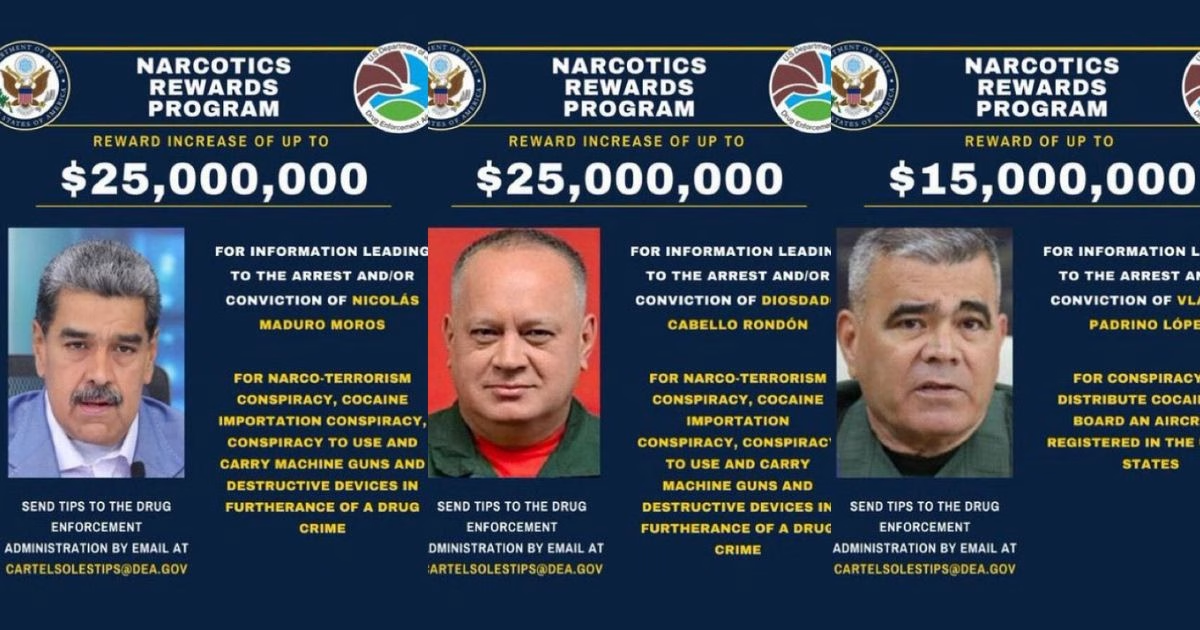
That pattern came into much sharper focus this week when the U.S. Department of Justice, under Attorney General Pam Bondi, was essentially forced to acknowledge that a central claim used to justify charges against Maduro was unsubstantiated. Prosecutors quietly backed away from the long-repeated assertion that Maduro was the head of the infamous “Cartel de los Soles”—a group that has never been proven to exist as an organized drug cartel in the way early indictments once claimed. Rather, recent court filings describe it more as a loose system of corruption among officials tied to drug proceeds than a formal trafficking organization.
The original, Trump-era indictment—drafted in 2020 and widely cited by Republican officials—repeatedly referenced the Cartel de los Soles as a sprawling drug cartel led by Maduro. That language became a cornerstone of the U.S. government’s public justification for increasing sanctions and, eventually, military pressure against Venezuela. But with the updated indictment now scaling back that claim, it’s clear the Justice Department no longer stands behind the idea that such an organization, with Maduro at its helm, has been proven in a court of law.
This shift isn’t a mere technicality. It reveals how powerful narratives—when repeated often enough by officials and amplified by media—can take on a life of their own. In this case, an allegation initially adopted from media shorthand was elevated into a linchpin of U.S. policy rhetoric, shaping public perception and foreign policy debates alike. The term “Cartel de los Soles” itself was invented decades ago by Venezuelan journalists to describe corruption among military officials, not as the name of a structured criminal organization with a defined leadership hierarchy.
The fact that the Justice Department eventually had to strip away language it once leaned on suggests a broader problem: when policymakers and prosecutors begin with a desired outcome and then seek out narratives to support it, truth can become collateral damage. The political and media momentum behind the cartel narrative made it difficult for critics to challenge the claim early on, even when experts in Latin American crime noted that the cartel was not recognized in formal drug trafficking assessments.
Now, as that foundational claim unravels, it’s worth reflecting on what it says about how power is exercised in Washington. When administrations—whether Republican or Democratic—use sweeping, unproven allegations to build public support for major foreign interventions or legal actions, they erode public trust. That trust is essential for democratic governance, especially when decisions involve national security, international alliances, or military force.
The pattern of stretching or misrepresenting facts isn’t confined to Venezuela. We’ve seen it in other arenas, including Trump’s attempts to pressure Ukraine over Biden investigations. When leaders allow political expediency to overshadow factual accuracy, it diminishes confidence in institutions and blurs the line between legitimate inquiry and partisan maneuvering.

The Cartel de los Soles saga is about far more than a single indictment or one embattled foreign leader. It highlights how the language used to describe threats—whether abroad or at home—can steer policy decisions long before the facts are fully tested. When those narratives drift away from verifiable reality, the fallout can be serious and lasting. And now, as Trump turns his attention toward Greenland with similarly questionable claims and confrontational rhetoric, journalists have a responsibility to challenge him directly, press for evidence, and hold those assertions up to rigorous public scrutiny rather than letting them harden into accepted truth.
In the end, this story goes well beyond a single case or one foreign leader. It touches on something far more serious: the loss of innocent lives at sea, justified under the sweeping claim of fighting drug trafficking. It also exposes a style of governance that too often leans on dramatic narratives instead of hard, verifiable facts. Holding that approach to account isn’t just good journalism—it’s essential to preserving the integrity of a democratic system that is supposed to value truth over convenience.
Yahoo an