

By Ben Emos | Tuesday, January 06, 2026 | 4 min read
If there is one constant in Donald Trump’s second act on the global stage, it is unpredictability. Crises appear almost on cue, conjured by impulse rather than evidence. This time, unable to accuse Denmark of drug trafficking or some other manufactured scandal, the White House reached instead for a familiar fallback: vague, unsubstantiated claims of “national security.”
In Denmark, concern quickly curdled into alarm.
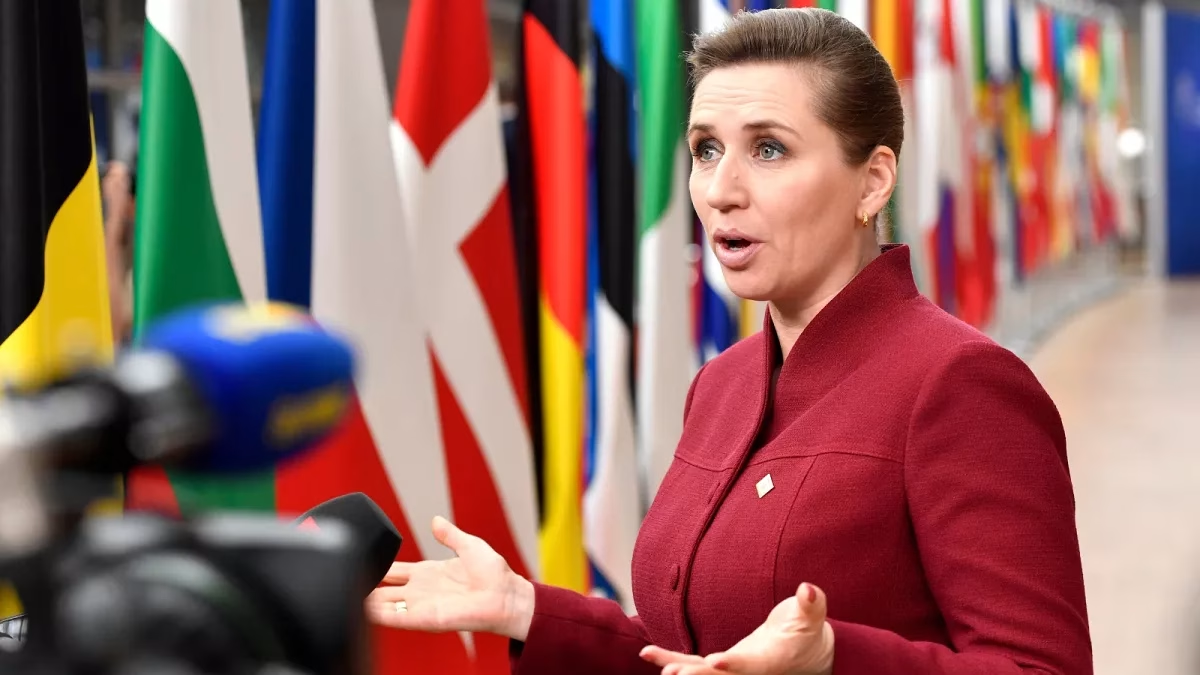
Prime Minister Mette Frederiksen did not mince words. The United States, she said plainly, has “no right to annex” Greenland. She reminded Washington that Denmark already provides the U.S. with extensive military access to the Arctic territory under existing NATO agreements. Greenland, Frederiksen emphasized, is not for sale—by Denmark or by Greenlanders themselves.
Her response was firm but measured, the language of a leader defending sovereignty rather than posturing for attention. It was also widely echoed across Europe. European Union leaders soon issued their own statement affirming Venezuela’s right to self-determination—a pointed response to Trump’s parallel vow to “run” Venezuela following the removal of Nicolás Maduro. Together, the messages carried a clear theme: power does not confer ownership.
What unsettled many Danes was not only Trump’s rhetoric, but the casual tone with which it was delivered. A social media post by a former Trump official showed an illustrated map of Greenland wrapped in the American flag, stamped with a single word: “SOON.” It may have been intended as bravado, or internet theater. Instead, it landed as something closer to a threat.
Danish diplomats responded publicly, demanding respect for their country’s territorial integrity. For a nation that has stood shoulder to shoulder with the United States through NATO, Afghanistan, and decades of security cooperation, the post felt less like a joke and more like a warning about how lightly sovereignty is treated when imbalance of power enters the conversation.
This is not happening in a vacuum. Trump’s foreign policy style thrives on spectacle and pressure. Countries are reduced to bargaining chips. Alliances become leverage. Longstanding norms are brushed aside if they complicate the performance. One day it’s Venezuela. The next, Greenland. Tomorrow, who knows?
What makes this moment feel particularly troubling is how little restraint seems to surround the president. Any healthy system relies on people who are willing to push back—to say “no,” or at least “let’s slow this down.” Even figures who might be expected to urge caution, like Pete Hegseth, a Norwegian American with close cultural ties to the region now being targeted rhetorically, have shown little inclination to rein in the president’s impulses. Instead, voices inside the administration appear either muted or fully in step with escalation. The result is an approach that shows scant regard for careful diplomacy, long-term strategy, or the fine line between projecting strength and igniting unnecessary instability.
Observers have begun to ask uncomfortable questions—not as insults, but as civic concern. Is decision-making being driven by strategy, or by impulse? Are threats weighed for consequences, or simply deployed for effect? When leaders speak casually about “running” other nations, do they understand what that implies in lives, legitimacy, and global order?
Denmark’s reaction matters because it reflects something larger than Greenland. It reflects the anxiety of allies who no longer know whether treaties will be honored, whether norms will hold, or whether tomorrow’s headline will casually rewrite yesterday’s understanding of sovereignty.

Prime Minister Frederiksen’s response was not anti-American. It was pro-law, pro-alliance, and pro-reality. Denmark has been a reliable partner. Greenland already hosts U.S. military assets. There was no crisis demanding annexation—only a narrative manufactured for domestic politics.
History shows that empires rarely collapse from external threats alone. They erode when restraint disappears, when power forgets its limits, and when bravado replaces judgment. The danger is not just what Trump says, but how often those words go unchecked.
In that sense, Denmark’s pushback was not defiance. It was a reminder—one the world may increasingly need—that sovereignty is not a suggestion, and that even the most powerful nations are still bound by rules they once helped write.
Yahoo an