

By Ben Emos & Don Terry | Wednesday, January 07, 2026 | 5 min read
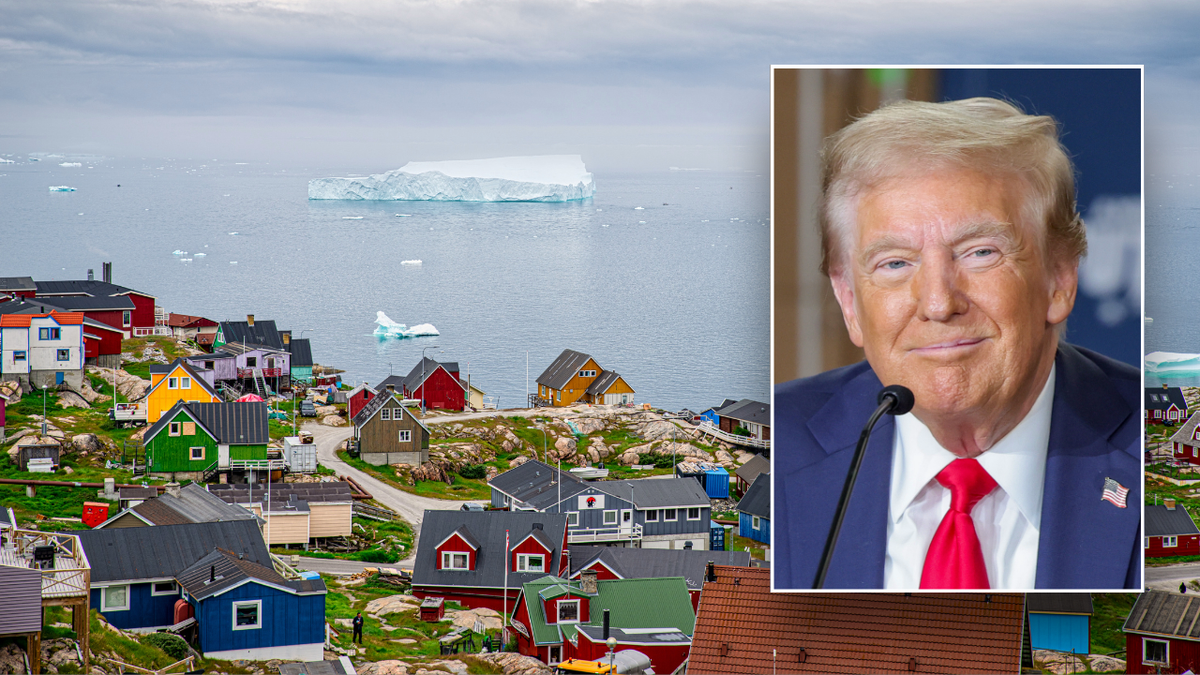
For years, Greenland has existed on the fringes of American political conversation—remote, frozen, and largely misunderstood by the public. That changed the moment Donald Trump, during his presidency, openly floated the idea of acquiring the island. What many initially dismissed as a passing remark or political theater has since evolved into a recurring talking point, reigniting debates about sovereignty, diplomacy, and America’s role in the Arctic.
Fedlan News has tracked the Greenland debate from the very beginning, and it is hard to ignore how the conversation has gradually shifted as more people take a closer look at the facts. It’s possible that open-minded voices in Washington, including lawmakers willing to question the narrative, have taken note of the reporting and analysis surrounding the issue.
When Donald Trump first floated the idea that the United States could take control of Greenland, the reaction across Europe ranged from disbelief to alarm, while diplomats quietly expressed concern behind closed doors. Since then, the language surrounding the proposal has only grown more aggressive. Highly publicized trips by Donald Trump Jr. and Senator JD Vance have further inflamed tensions, reinforcing the criticism that Greenland is being framed not as a partner to work with, but as a trophy in a high-stakes geopolitical competition.
The difference from earlier leadership could not be clearer. While in office, former President Barack Obama once described Denmark as a nation that “punches above its weight.” At the time, he was speaking specifically about Danish troops serving alongside U.S. forces in Afghanistan. But the remark has taken on a broader meaning over the years. Today, it resonates less as a comment on military capability and more as a reflection of Denmark’s steady commitment to international law, open governance, and cooperation with its allies. Those same principles are evident in Greenland, a self-governing territory whose people have repeatedly and firmly asserted that decisions about their future belong to them alone.
Despite this, Trump has revived the idea of bringing Greenland under U.S. control, framing it as a matter of national security. Members of his administration have suggested that all options—including military force—remain on the table. White House press secretary Karoline Leavitt recently stated that “utilizing the U.S. military is always an option at the commander-in-chief’s disposal,” a comment that sent shockwaves through diplomatic channels in Europe.
The renewed push has not gone unchallenged—this time from within Trump’s own party.
On Tuesday, Republican Senator Lisa Murkowski of Alaska publicly broke ranks with Trump, issuing one of the clearest rebukes yet of the Greenland rhetoric. In a post on X, Murkowski warned that any attempt to claim or seize the territory would severely damage U.S. credibility abroad.

“I continue to hope the administration’s rhetoric on Greenland is nothing more than posturing for a new era of cooperation,” Murkowski wrote, “because any effort to claim or take the territory by force would degrade both our national security and our international relationships.”
Murkowski’s opposition is rooted not only in principle, but in history. Alaska, like Greenland, occupies a critical position in the Arctic, where cooperation—not coercion—has long defined success. The senator emphasized decades of partnership between the United States and Greenland, dating back to World War II and continuing today through shared defense efforts such as the Pituffik Space Base.
“We have always been able to achieve our mutual goals through strong diplomacy with its people,” Murkowski said. “As Greenland charts its future, we must see it as an ally, not an asset, and focus on continued partnership rather than possession.”
Her comments reflect a broader unease within the Republican Party—one that extends beyond Alaska.
Later that same day, Senator Thom Tillis of North Carolina released a joint statement alongside Democratic Senator Jeanne Shaheen of New Hampshire. The two lawmakers, who co-chair the bipartisan Senate NATO Observer Group, stressed that Greenland is not for sale and that the United States has a responsibility to respect the sovereignty of the Kingdom of Denmark.
“When Denmark and Greenland make it clear that Greenland is not for sale,” the statement read, “the United States must honor its treaty obligations and respect the sovereignty and territorial integrity of the Kingdom of Denmark.”
The senators warned that even suggesting coercion against a NATO ally undermines the very foundation of the alliance. At a time when Russia’s war in Ukraine continues and China is expanding its presence in the Arctic and Indo-Pacific, internal division among allies could prove costly.
“With rising threats from Russia and China, we cannot afford distractions or divisions within NATO,” the statement continued. “The strength of the transatlantic community lies in its unity, built on mutual respect rather than transactional rhetoric.”

What makes this moment notable is not just the policy disagreement, but who is speaking out. For years, Trump’s foreign policy instincts went largely unchallenged within his party. Now, as voters, lawmakers, and allies alike revisit the implications of those ideas, the pushback is becoming more visible—and more public.
Greenland, for its part, has remained firm. Its leaders have repeatedly rejected the idea of annexation, emphasizing self-determination and cooperation over conquest. Denmark has echoed those sentiments, making clear that the island’s status is not a bargaining chip.
As global attention increasingly turns northward, the Arctic is becoming a test case for how the United States defines leadership in the 21st century. The choice, as Murkowski and others have suggested, is between partnership and possession—between diplomacy and destabilization.
For now, at least, a growing number of voices inside Washington are choosing the former.