

By Ben Emos & Andrew James | Thursday, January 15, 2026 | 4 min read
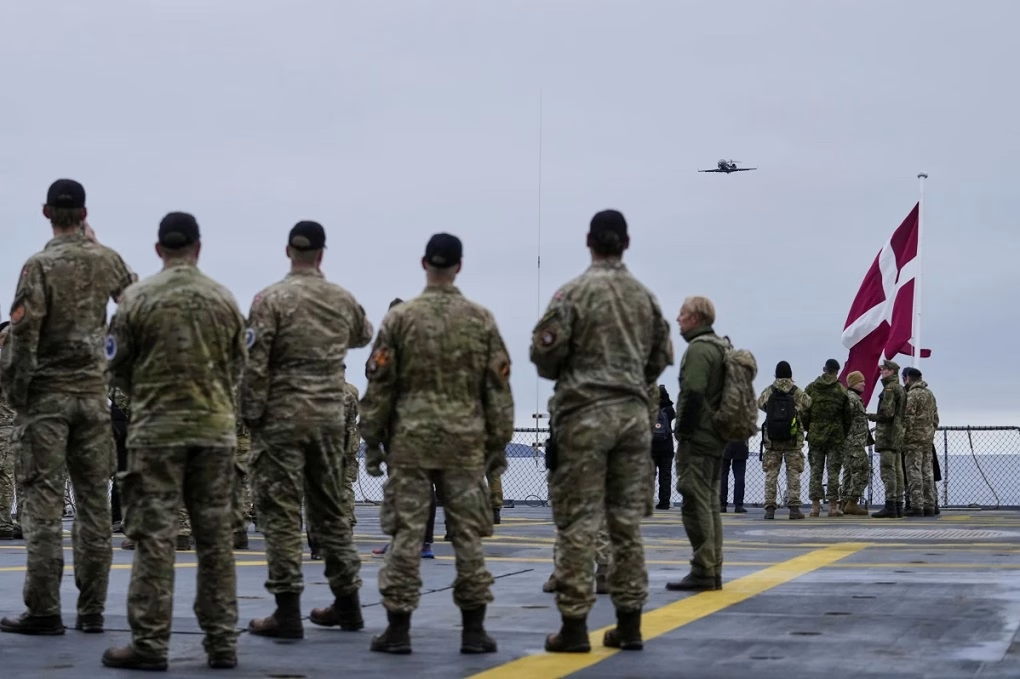
Europe’s decision to send troops to Greenland is being described in careful, diplomatic language: “military exercises,” “deterrence,” “security coordination.” But behind those phrases lies a far more unsettling reality. This deployment is not just about Russia, China, or the Arctic’s melting ice. It is about trust—specifically, the growing belief among America’s allies that the United States, under Donald Trump, cannot be relied upon to tell the truth or respect boundaries.
Donald Trump’s relationship with facts has long been strained. By the time he left office in 2020, The Washington Post had tallied more than 30,000 false or misleading claims. What is different now is not the volume of those falsehoods, but the stakes. Trump’s rhetoric has increasingly crossed from exaggeration into danger—danger measured in lives lost, property destroyed, and alliances shaken.
From deadly maritime operations that left people killed on boats, to a Christmas bombing in Nigeria that shocked observers, to the reckless labeling of Venezuela’s Nicolás Maduro as a “narco-terrorist,” Trump has repeatedly shown a willingness to invent or distort threats to justify force. Now Greenland has been added to that list, wrapped in a familiar claim: that Russian and Chinese vessels are swarming Arctic waters, and only the United States can save the territory from occupation.
European officials do not buy it.
Denmark’s recent move to increase its military presence in and around Greenland—joined by Germany and other European nations—came immediately after inconclusive talks in Washington. A Danish troop transport plane landed overnight in Nuuk, Greenland’s capital, as officials returned home empty-handed from meetings with Vice President J.D. Vance and Secretary of State Marco Rubio.
Those talks were meant to cool tensions. Instead, they confirmed fears.
“We had what I would describe as a frank but also constructive discussion,” a Danish official said afterward. “But our perspectives continue to differ.” It was diplomatic language masking a stark truth: the United States would not back down from its position, and there was no real belief that it could be persuaded.
President Trump made that clear himself. Standing in the Oval Office, he repeated the same talking point—that Denmark is powerless to defend Greenland against Russia or China, and that only Washington can guarantee security. It is a claim European intelligence services quietly dispute. While Arctic competition is real, the idea of imminent Russian or Chinese occupation is not supported by European assessments.
To many in Europe, Trump’s argument looks less like concern and more like pretext.
Greenland, after all, is not an empty slab of ice. It is home to roughly 57,000 people with their own government, culture, and political voice. Greenland’s prime minister, Jens-Frederik Nielsen, recently made something clear that would have been unthinkable a few years ago: faced with pressure from Washington, Greenland would rather remain with Denmark than fall under U.S. control. For a society that has long debated independence, that statement speaks volumes.
Trump’s response—openly asking who the Greenlandic prime minister even was—only deepened the sense of disrespect.
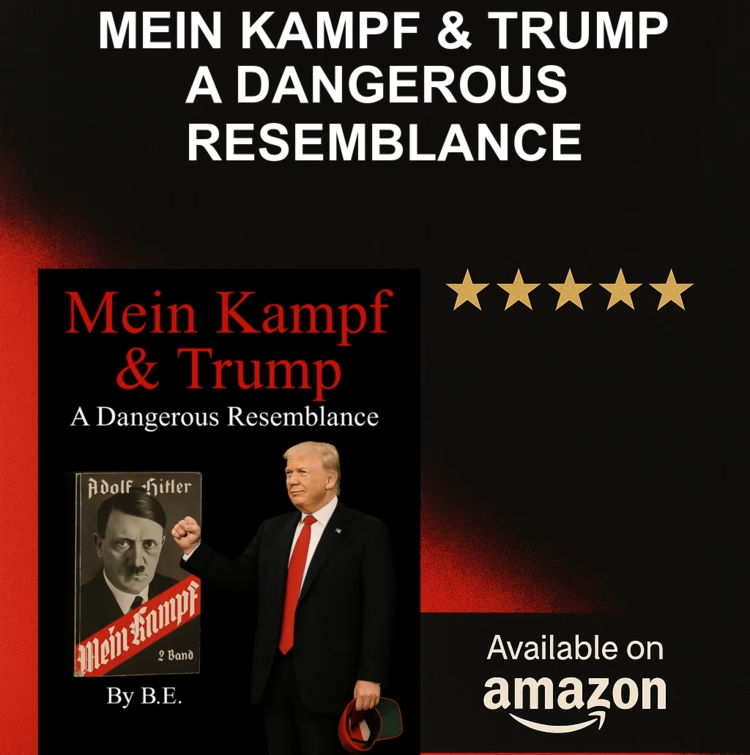
Mein Kampf & Trump Now On AMAZON
This is why Europe is acting now. Not because an invasion is imminent, but because uncertainty is. If the United States were to annex territory belonging to a NATO ally, the alliance itself would face an existential crisis. European Commission President Ursula von der Leyen has been blunt about the implications, calling for Europe to become a true military powerhouse capable of defending itself—even from the destabilizing actions of supposed partners.
France, Germany, Norway, Sweden, and Denmark are rallying not just to protect Greenland, but to draw a line. The multinational deployments, additional ships, aircraft, and installations are signals of resolve: Greenland is not for sale, not for conquest, and not a bargaining chip in anyone’s domestic political theater.
The Arctic will remain strategically important. Shipping routes, minerals, and climate change guarantee that. But Europe’s troop deployment is ultimately about something more basic—preserving a rules-based order where power does not excuse falsehood, and where allies are not treated as obstacles.
What Europe is responding to is not Russia, or China, or even the Arctic itself. It is the growing realization that when truth collapses, security soon follows.