
By Ben Emos | Wednesday, January 14, 2026 | 5 min read
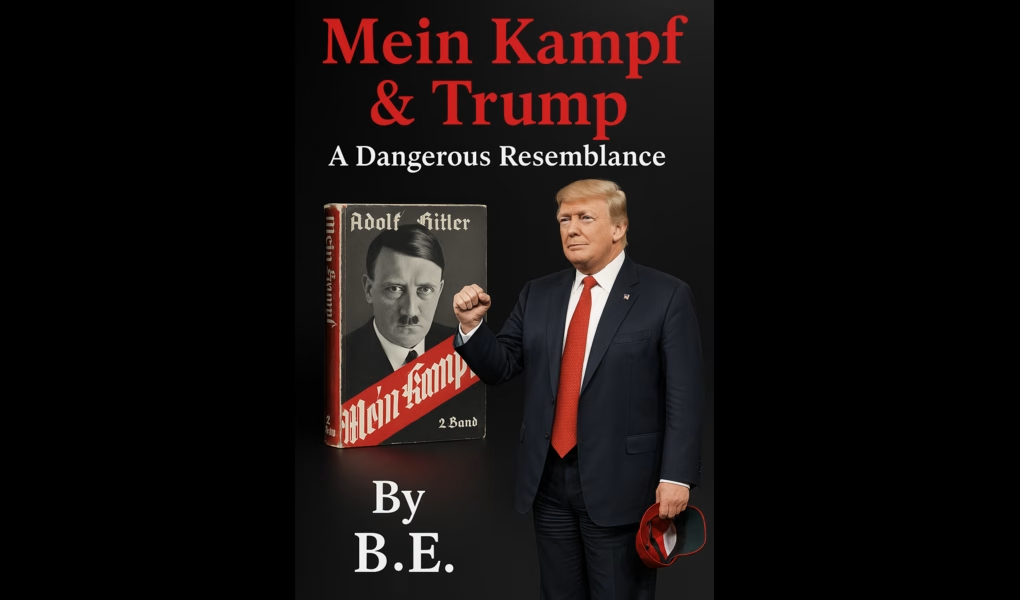
When a book’s title includes Mein Kampf, most people react before they read a single page. That reaction is understandable. Adolf Hitler’s manifesto is one of the most poisonous political texts ever written, and invoking it carries historical weight, emotional charge, and real risk. But that weight is also why Mein Kampf & Trump: A Dangerous Resemblance exists—and why many snap judgments about the book miss what it is actually trying to do.
At its core, the book makes a narrow, careful argument. It does not claim that Donald Trump is Adolf Hitler. It does not argue that the United States is Nazi Germany. It does not equate historical outcomes, moral scale, or political systems. Those comparisons would be crude, misleading, and historically irresponsible.
Instead, the book examines something more restrained—and more unsettling: recurring rhetorical and psychological patterns that appear in authoritarian movements across time, regardless of country or ideology.
History does not repeat itself cleanly. It echoes. And those echoes often begin in language.
Mein Kampf is treated here not as a prophecy or a roadmap, but as a case study in grievance politics. Hitler’s writing is saturated with themes of humiliation, betrayal, internal enemies, and personal destiny. Those ideas were not unique to Germany in the 1920s. They surface repeatedly in moments of perceived national decline, when leaders frame themselves as singular figures who alone can restore greatness and punish those blamed for loss.
The book traces how similar rhetorical devices appear in modern political speech: the powerful presenting themselves as victims, loyalty elevated above institutions, opponents cast as existential threats rather than political rivals, and legal constraints portrayed as conspiracies instead of democratic safeguards. The resemblance discussed is not moral equivalence. It is structural resemblance—how language can condition an audience to accept norm erosion before they recognize it as such.
Equally important is what the book does not argue.
It does not claim inevitability. One of the most damaging myths about authoritarianism is the belief that once certain patterns appear, catastrophe is unavoidable. History shows otherwise. Democracies encounter these patterns frequently—and sometimes correct course. Institutions matter. Courts matter. Civil society matters. Public awareness matters.
The book also does not argue that reading Mein Kampf is inherently radicalizing. It treats the text as a historical artifact: dangerous when mythologized, instructive when analyzed critically. Pretending such works are incomprehensible relics of a darker age does not protect democratic societies; it leaves them unprepared. Understanding how language normalizes exclusion, aggression, and exceptionalism is one of the few defenses democracies have.
Nor is the book a partisan attack. It does not ask readers to adopt a political identity or align with a party. Its focus is institutional stress, not electoral outcomes. The question it keeps returning to is deceptively simple: how do democracies talk themselves into accepting what they once would have rejected?
That question is uncomfortable because it shifts responsibility away from cartoon villains and toward systems—and citizens. It suggests that danger often arrives incrementally, wrapped in familiar grievances, reassurances, and promises of restoration.
If the book unsettles some readers, that discomfort is intentional. Not because it seeks outrage, but because it challenges a comforting assumption: that authoritarianism always announces itself clearly, wearing historical costumes we will instantly recognize. History suggests otherwise. It often sounds reasonable to those who feel ignored, justified to those who feel wronged, and exaggerated only to those convinced “it can’t happen here.”
This is where the book turns to something both ordinary and revealing: what leaders read. Not the books they quote onstage or display for cameras, but the ones they keep close—texts that shape how they think about power, loyalty, conflict, and victory.
When Ivana Trump told Vanity Fair in 1990 that Donald Trump kept a book of Hitler’s speeches by his bedside, the remark was widely dismissed as gossip. It was filed away as eccentric rich-man trivia, an awkward detail in a larger portrait of excess. Few people wanted to sit with it. The book asks readers to revisit that moment not as scandal, but as context.

Mein Kampf & Trump Now On AMAZON
Clear disclaimers matter. Mein Kampf & Trump: A Dangerous Resemblance does not argue that reading a single book determines belief or behavior. It does not allege ideological allegiance or psychological equivalence. It is explicit about these limits because careless comparisons flatten history and weaken serious analysis.
Methodologically, the work is comparative and textual. It analyzes language—speeches, writings, interviews, policy framing—not personalities. Sources are conservative and transparent: primary historical documents, peer-reviewed scholarship, contemporaneous journalism, court records, and direct quotations. Contested or anecdotal claims are labeled as such.
Ultimately, the book asks readers to pay attention—not to shock, but to substance. Not to labels, but to language. And not only to what leaders do in public, but to the ideas that quietly shape how they decide who deserves power, protection, and punishment.
Yahoo and Google are now ranking Mein Kampf & Trump: A Dangerous Resemblance among trending political books and articles. What’s fueling the attention? Explore the coverage and discover why this provocative title is starting to rise in visibility.
Disguised Aircraft, Deniable Deaths, War Crime and Extrajudicial Killings by the United States
Trump Urges Military to Draft Greenland Invasion Plan, Top Commanders Push Back
In 2028, Democrats May Need Jack Smith to Reset American Politics with R.A.G.E.
ICE Killed a White American Mother—Renee Nicole Good “Self-Defense” Wasn’t So Certain
When Claims About Maduro and the “Cartel de los Soles” Fall Apart: The Danger of Politicized Justice

Copyright 2024 FN, NewsRoom.