

By Jane Lewis & Don Terry | Friday, January 09, 2026 | 4 min read
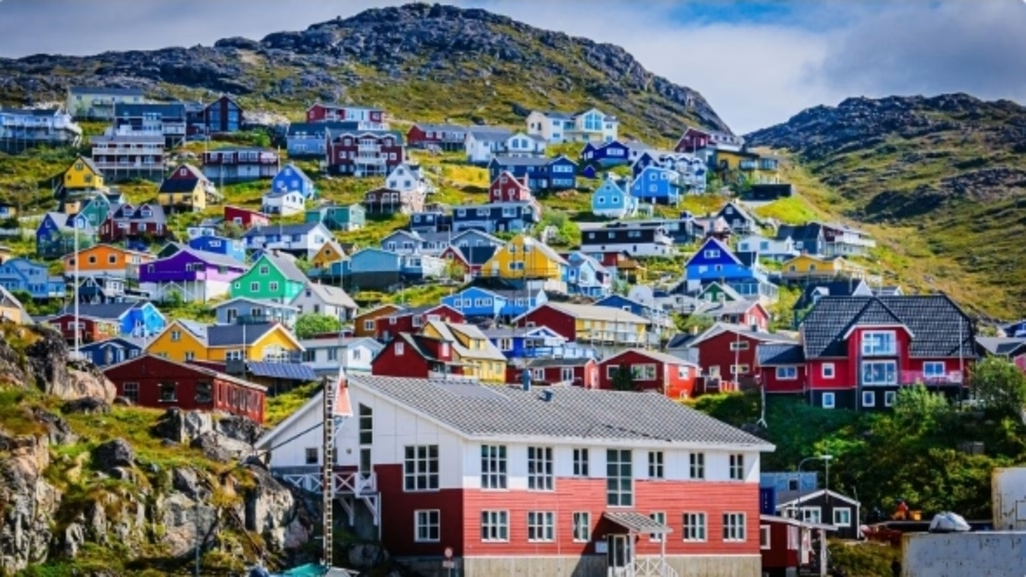
There are moments in history that force us to ask a simple question: what kind of country do we want to be? Not in abstract terms, but in the real world, where human lives, national sovereignty, and the dignity of entire peoples hang in the balance. One of those moments is unfolding now under the Trump administration, and it centers on a far-northern island most Americans barely think about: Greenland.
According to multiple reports, including an exclusive from Reuters, the Trump administration is considering offering direct cash payments to residents of Greenland — up to $100,000 per person — as part of a bid to convince them to secede from Denmark and align more closely with the United States. Officials have discussed figures ranging from $10,000 to $100,000 per person as part of internal deliberations on how the U.S. might approach acquiring the island.
At first glance, it sounds almost surreal: a foreign government openly weighing whether to pay people to change their national allegiance. A kind of geopolitical house sale, where citizens are the commodities up for negotiation. But this isn’t a late-night satire. These discussions are real, and they raise profound questions about respect for national sovereignty and the human consequences of wielding economic power as a substitute for diplomacy.
Greenland is not some empty expanse of ice. It’s home to about 57,000 people — families with roots, cultural traditions, and a long and complicated relationship with Denmark. Despite its small size, Greenland’s economy is surprisingly robust: its nominal GDP per capita is about $58,499, roughly on par with many European countries. That means many Greenlanders already enjoy a level of economic output comparable to middle-income Americans in states like Mississippi, Arkansas, and West Virginia — and their Nordic welfare system provides universal healthcare, free education, and social supports that are the envy of many.
So why would anyone entertain the idea of paying them to leave behind that system? The answer lies not in the economic wellbeing of Greenlanders but in the strategic calculus of world powers. Greenland sits in the Arctic — a region rapidly transforming as climate change opens new shipping routes, exposes valuable minerals, and reorders global military priorities. For Washington, it’s not just land. It’s leverage in an emerging geopolitical theater.
This brings us to the heart of the ethical problem: what happens when a superpower treats people and their homeland as bargaining chips? Can money ever be a substitute for genuine consent? And what message does it send when the discussion includes military options should the offer be rejected? Reports suggest that the consideration of payments is not the only idea on the table — some U.S. officials have discussed military options if Greenlanders do not accept the deal.
Imagine being a Greenlander watching this unfold. There is widespread opposition among residents to becoming part of the United States; one poll showed around 85% do not want their island to join the U.S. Many cherish their current autonomy and the protections and identity it brings. To them, a foreign government offering cash for their allegiance feels less like opportunity and more like coercion dressed up in economic language.

Mein Kampf & Trump Now On AMAZON
And this isn’t happening in a vacuum. The broader American conversation at home is dominated by debates over health care access, inflation, and economic insecurity for ordinary families. Meanwhile, the federal government is discussing spending billions in pursuit of geopolitical gain far from the concerns of everyday citizens.
Which brings us back to the fundamental question: what kind of country are we? A nation that respects the agency of other peoples and upholds international norms? Or a global power that uses its wealth to bend smaller communities to its will?
Treating a people’s future as a transaction cheapens the very ideals we claim to champion. Democracy and sovereignty are not for sale — not for any price. If the United States truly believes in freedom and self-determination, it must pursue those values with respect and partnership, not with the lure of cash and the shadow of force.
Greenlanders, like all people, deserve to chart their own course. Let that be the guiding principle — not the next price tag.